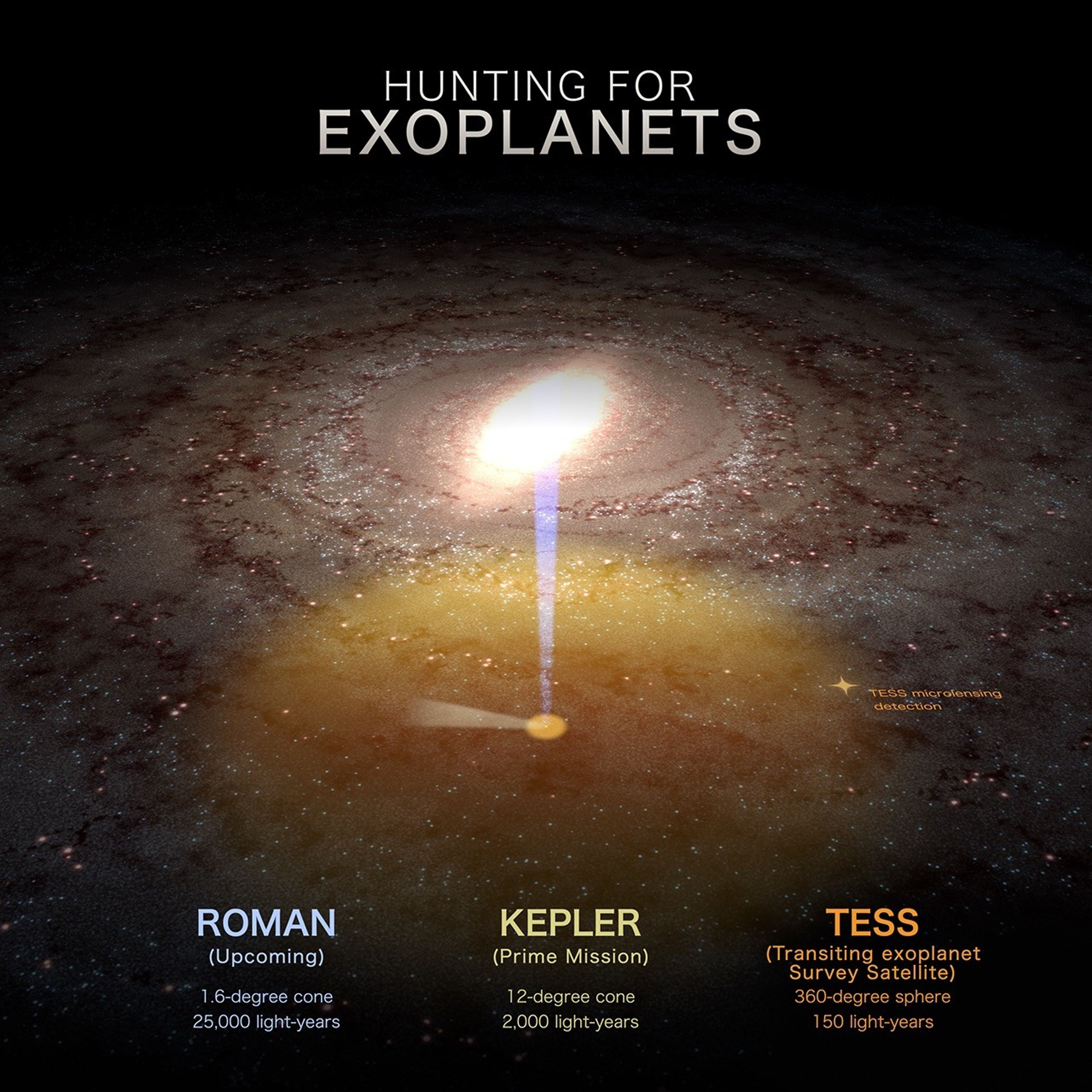
Quick Summary: NASA researchers uncovered an exoplanet called Gaia23bra b hidden within data from the TESS space telescope using the microlensing method, which is based on Einstein’s theory of gravity. The discovery shows that planets difficult to detect with the transit method can still be found and suggests that the Nancy Grace Roman Space Telescope could uncover thousands of new worlds in the future.
How was the planet hidden in TESS data found?
TESS, NASA’s Transiting Exoplanet Survey Satellite, has helped identify thousands of exoplanet candidates. But the method used in this new discovery was very different from TESS’s usual approach.
Researchers spotted evidence of a planet known as Gaia23bra b within TESS data. This world did not reveal itself by passing in front of its star and dimming its light. Instead, it gave itself away through an effect predicted by Einstein’s theory of general relativity.
When a planet passes between Earth and a more distant star, its gravity can slightly magnify the background star’s light. This phenomenon is known as microlensing. Although the effect is subtle, it can be detected with sufficiently precise observations.
Gaia23bra b first drew attention during exactly this kind of event. The planet’s gravity produced a brief brightening in the light of a background star. When scientists examined TESS data, the signal was confirmed.

Why does Einstein’s theory play such a crucial role here?
General relativity tells us that mass bends spacetime. Massive galaxy clusters create this effect strongly enough to distort the images of distant galaxies.
Planets are nowhere near as massive as galaxy clusters. Even so, they can still produce a small-scale lensing effect. That is the physical principle behind the microlensing method.
Astronomers have been using this technique for years. However, most exoplanet discoveries have come through other methods. The reason is that microlensing events are brief and notoriously difficult to catch.
What makes this study noteworthy is that it demonstrates how a spacecraft with a completely different primary mission, such as TESS, can also detect these events. A single observatory can therefore contribute to multiple scientific goals.
Michael Fausnaugh of Texas Tech University, a member of the research team, says this work serves as a preview of the microlensing surveys that the Nancy Grace Roman Space Telescope will conduct in the future.
“Microlensing offers an opportunity to understand how planetary systems vary across different regions of the galaxy because it can detect planetary systems similar to our own Solar System.”
Isn’t the transit method enough?
The transit method is TESS’s primary tool. When a planet passes in front of its star, it causes a slight dip in the star’s brightness. Astronomers identify planets by measuring these regular decreases in light.
The majority of the roughly 6,000 known exoplanets have been discovered using this method. According to the figures cited in the report, about 75% of all confirmed exoplanets were found through transits.
By contrast, only about 5% have been discovered through microlensing.
There is an important caveat, however. The transit method works only in specific geometric alignments. If a planet’s orbit is not oriented at the right angle from Earth’s perspective, it never crosses in front of its star and becomes much harder to detect.
Microlensing can uncover a different class of planetary systems. It is particularly powerful for finding planets farther from their stars, including worlds similar to Jupiter or Saturn in our own Solar System.
That is why astronomers do not want to rely on a single technique. Combining multiple methods provides a much clearer picture of the diversity of planets throughout the galaxy.
If you’re interested in the search for potentially habitable worlds, you may also enjoy our article explaining why a super-Earth 25 light-years away has attracted attention as a possible home for life.

What do the numbers behind the discovery tell us?
The key figures highlighted in the report help explain why microlensing is generating so much excitement. The table below summarizes the most important data.
| Parameter | Value |
|---|---|
| Known exoplanets | Approximately 6,000 |
| Share discovered via the transit method | Approximately 75% |
| Share discovered via microlensing | Approximately 5% |
| Publication date of the study | July 1, 2026 |
| Microlensing planets expected to be found by Roman | Approximately 1,000 |
| Transit planets expected to be found by Roman | Approximately 100,000 |
These figures suggest that while microlensing remains a relatively underused method today, it could drive far more discoveries in the future.
Why is the Nancy Grace Roman Space Telescope generating so much excitement?
NASA’s Nancy Grace Roman Space Telescope is widely regarded as one of the most ambitious astronomy missions of the coming decade.
One of Roman’s goals will be to conduct a detailed survey of the central region of the Milky Way. Stars in the galactic center are packed closely together, creating an environment where microlensing events occur more frequently.
For this reason, scientists expect Roman to discover a vast number of new planets. NASA estimates that the telescope could find around 1,000 microlensing planets. In addition, it may detect roughly 100,000 planets using the transit method.
The scale of those numbers is remarkable. Adding tens of thousands of new worlds to the few thousand exoplanets known today could reshape theories of planetary formation.
Roman’s success will also provide an opportunity to compare planetary populations in different parts of the galaxy. Do planetary systems change as the chemical composition of stars changes? Are Solar System-like architectures common everywhere? The answers to these questions may soon become much clearer.

How will this discovery help us understand planet formation?
One of the biggest challenges in exoplanet research is observational bias. The method you use determines which kinds of planets you are most likely to detect.
If you rely only on the transit method, you will disproportionately find planets in certain orbital configurations. If you focus only on velocity measurements, a different population of planets will stand out.
Microlensing adds new pieces to the puzzle. It is especially promising for uncovering planetary systems with more distant planets and architectures resembling our own Solar System.
This could help us determine whether our planetary system is ordinary or unusual within the galaxy. Perhaps Jupiter-like giant planets are far more common than we think. Or perhaps the opposite is true.
If you’re interested in missions exploring the distant reaches of space, you may also enjoy our analysis of when New Horizons may reach interstellar space and our report on the final Pegasus flight supporting the Swift mission.
The discovery of Gaia23bra b alone will not trigger a statistical revolution. But in astronomy, methodology can matter more than sheer numbers. This study suggests that additional microlensing events may still be hidden within archival datasets.
TESS data will continue to be analyzed for years to come. Other undiscovered planets may still be waiting in the same observations.
FAQ
How was Gaia23bra b discovered?
The planet was detected through a microlensing effect that slightly magnified the light of a background star. TESS data later supported the finding.
What is the microlensing method?
It is an observational technique based on the gravity of a celestial object acting like a lens and magnifying the light of a more distant star.
How many planets could the Roman Space Telescope find?
According to NASA estimates, the telescope could discover about 1,000 microlensing planets and roughly 100,000 planets using the transit method.
Sources
The Astrophysical Journal Letters
Editor’s Perspective: What impressed me most about this story was not a brand-new telescope, but the discovery of a planet hidden within data we already had. Sometimes the biggest breakthroughs come not from looking at the sky again, but from looking at existing data in a new way. When the Roman Telescope begins operations, I suspect the number of surprises like this will multiply dramatically.
Bir Yorum Yazın