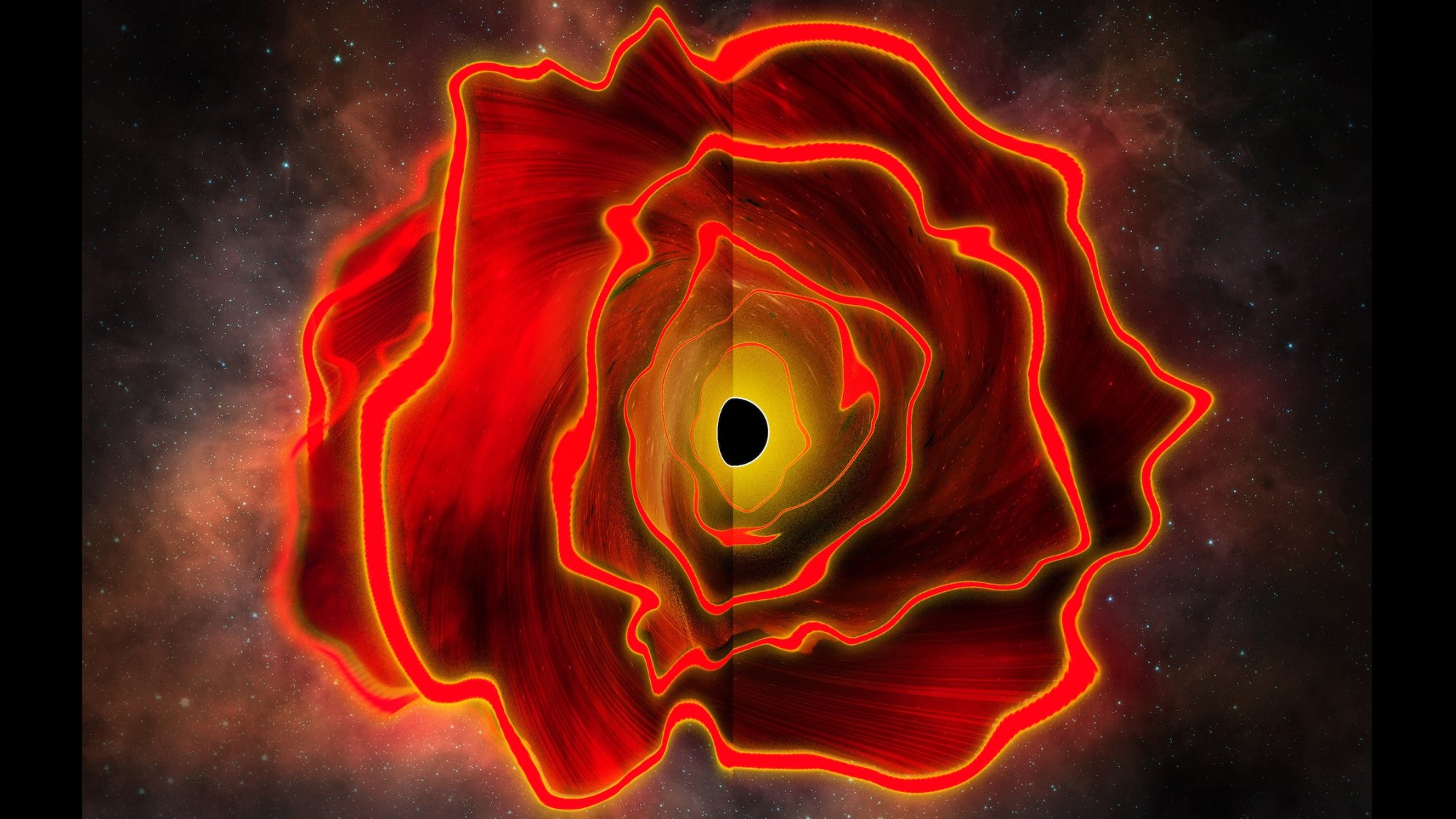
Quick Summary: MIT and international researchers using JWST have discovered a bright red object in the early universe, the size of our Solar System, emitting more energy than any known star. Named ‘black hole star,’ this object could represent a new class of astrophysical objects between stars and black holes.
What Is a Black Hole Star and Why Is It So Important?
The astronomical world has been buzzing with remarkable discoveries in recent years. The news of the mysterious black hole star found by JWST has become one of the most talked-about topics in the scientific community. Now, an MIT-led team has discovered a completely different object that existed in the earliest epochs of the universe, resembling both a star and a black hole. So what exactly is this ‘black hole star,’ and why is it so important?
In fact, this discovery is part of a puzzle that astronomers have been wrestling with for a long time. In the early universe, just a few hundred million years after the Big Bang, we observe galaxies that are far brighter and larger than expected. This contradicts current models of galaxy formation. This new discovery could unravel the mystery behind that brightness.

How Was This Discovery Made?
MIT astronomer Rohan Naidu and his team were not actually searching for black hole stars. As part of a research program they named ‘Mirage or Miracle,’ the team was looking for the most distant and oldest galaxies from a period when the universe was only a few hundred million years old. Their goal was to find galaxies that truly formed in this early epoch. However, things did not go as expected.
In a statement about the discovery, Naidu said, “There is a puzzle of many bright galaxies appearing at extremely early times,” and added, “What we found was that what seemed like an extremely bright early galaxy could, in some cases, be a ‘mirage’ rather than a ‘miracle.’” This ‘mirage’ pointed to the existence of a black hole star. Using JWST’s powerful infrared capabilities, the team examined this mysterious red dot in detail.
Black Hole Star: A Giant Object Surpassing Stars in Energy
This discovered object resembles a colossal star, comparable in size to our Solar System. But what is truly astonishing is the energy it produces. It emits energy that no known star can physically generate—100 billion times more than the Sun. This energy level is much closer to what a black hole can produce. That is why researchers have deemed the name ‘black hole star’ appropriate.
This energy likely comes from the friction and heating that occurs as the black hole consumes matter around it. What’s intriguing is that this energy emanates from a structure that looks like a star. This suggests the object could be a black hole hidden within the core of a massive star, or that an entirely new physical mechanism is at play.
This discovery, much like the discovery of water near the black hole at the heart of the Milky Way, could radically change our understanding of what happens under the universe’s most extreme conditions. Perhaps the earliest times of the universe saw the formation of objects we no longer see today.
| Parameter | Value |
|---|---|
| Object Type | Black Hole Star (New) |
| Size | Comparable to the Solar System |
| Energy Output | 100 Billion Times Greater Than Known Stars |
| Discovery Tool | James Webb Space Telescope (JWST) |
| Observed Epoch | First Few Hundred Million Years of the Universe |
How Does This Discovery Explain the Formation of the Universe?
The presence of such bright objects in the early universe has puzzled astronomers for a long time. According to current theories, it is very difficult for such large and bright galaxies to form this early. However, if some of that brightness comes from black hole stars at the centers of galaxies, this puzzle could be solved. In other words, some bright galaxies that astronomers have called ‘miracles’ might actually be ‘mirages’—not galaxies, but these new types of objects.
This could fundamentally impact our understanding of the early universe. If these black hole stars truly exist, we may need to rewrite all scenarios about how the first stars formed and how galaxies evolved. Additionally, the existence of such objects could shed light on other cosmic mysteries, such as dark matter and dark energy.

How Might Black Hole Stars Have Formed?
How these new objects formed remains a complete mystery. One theory suggests that in the early universe, massive gas clouds collapsed directly to form large black holes. These black holes rapidly consumed surrounding gas, emitting tremendous energy, and this process surrounded them with a dense shell of gas and dust that made them look like a star. This shell glows with the black hole’s energy, appearing as a massive star from the outside.
Another theory proposes that these objects are actually black holes that formed in the cores of the first stars. In this scenario, the core of a massive star collapses into a black hole, but the outer layers remain intact. The black hole produces energy by consuming matter from the star’s interior, causing the outer layers to swell, expanding the star to the size of the Solar System.
This discovery, much like the record set by SpaceX when it launched two Falcon 9 rockets 38 minutes apart, is a result of pushing technological boundaries. Without JWST, we would not have been able to observe such a distant and faint object in such detail.

What’s Next? What Will This Discovery Bring Us?
In the coming period, astronomers will continue using JWST to find more examples of these black hole stars. The goal is to understand how common these objects are and their role in the early universe. If these objects are indeed widespread, it means we must reevaluate everything we know about the universe’s first moments.
Moreover, this discovery breathes new life into theories about the formation and evolution of black holes. Perhaps black holes can form much earlier and in very different ways than we thought. This could offer new clues about the origin of supermassive black holes, one of the universe’s greatest mysteries.
From the Editor’s Desk: This discovery genuinely excited me. We’re facing a finding that could change such a fundamental piece of knowledge about the early universe. The concept of a ‘black hole star’ sounds like science fiction, but thanks to JWST, we can now observe such extraordinary objects. It’s proof of how creative and unexpected the universe can be. Who knows, maybe in the coming years, this discovery will become a cornerstone of cosmology.
Frequently Asked Questions
Is a black hole star really a star?
No, based on our current knowledge, a black hole star is not a star in the conventional sense. Although it looks like a star, it may derive its energy not from nuclear fusion but from a black hole at its center consuming surrounding matter. This makes it an entirely new class of astrophysical object.
Does this black hole star pose a threat to Earth?
No, it poses absolutely no threat. This object exists in the early universe, billions of light-years away from us. So what we are seeing is its state from when the universe was very young. What these objects are like now is a separate curiosity.
How did black hole stars influence the formation of the universe?
If these objects are common, the early universe may have contained much more energy and matter than we thought. This could have affected the rate and shape of galaxy formation. This discovery shows that we need to update our models of the early universe.
Bir Yorum Yazın