Quick Summary: Astronomers have mapped the distribution of ordinary matter in the universe using mysterious fast radio bursts (FRBs) from space. This has provided critical data that could shed light on cosmic mysteries such as dark matter, dark energy, and the mass of neutrinos. Researchers also discovered that the effect of galactic feedback is weaker than previously thought.
Radio Whispers from the Depths of the Universe: What are FRBs?
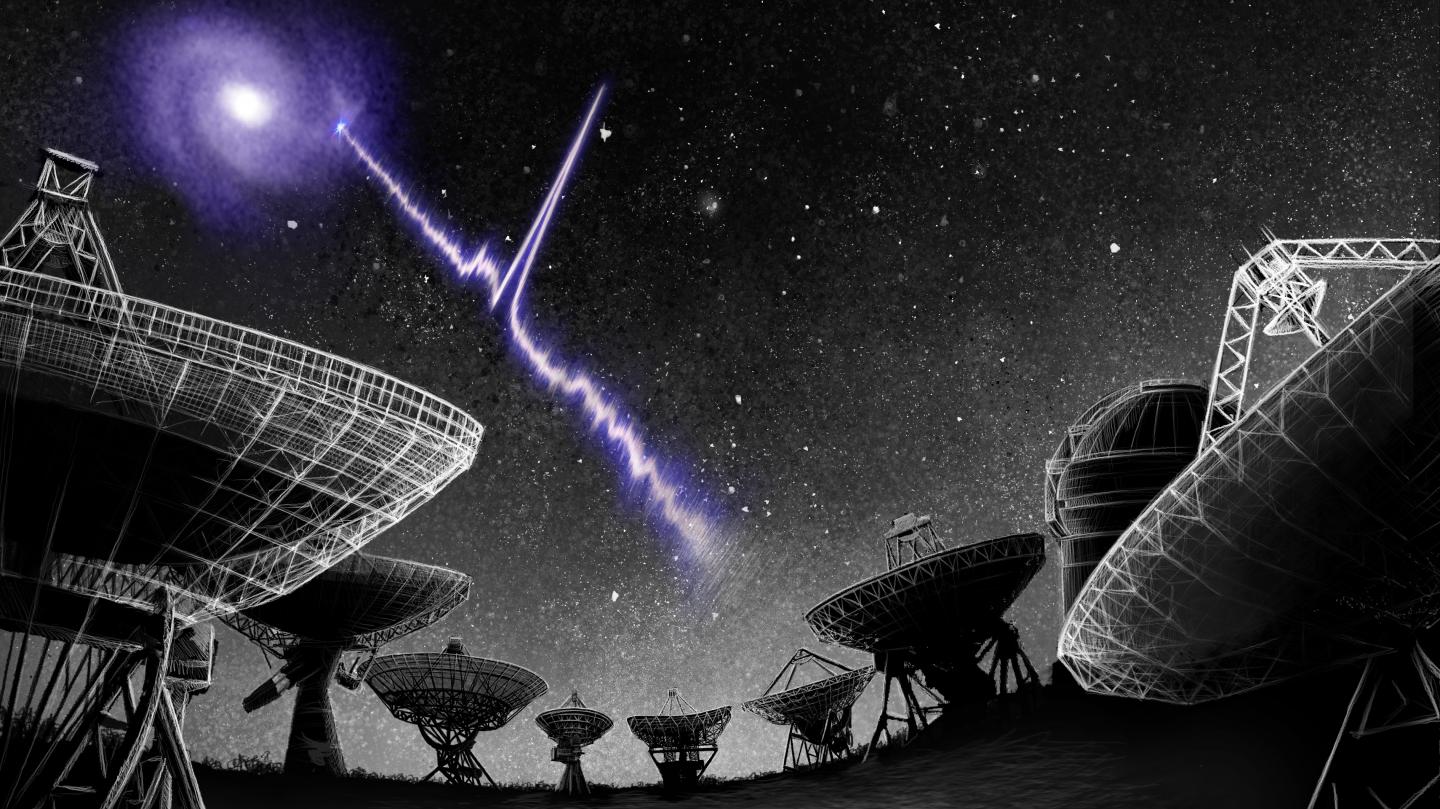
Fast Radio Bursts (FRBs), one of the strangest and most energetic events in the universe, act like cosmic lighthouses. These bursts are intense radio wave emissions that last only a few milliseconds but release more energy than the Sun produces in an entire day. So how can such a brief event solve the universe’s greatest mysteries?
Scientists believe that FRBs most likely originate from magnetars—rapidly spinning dead stars with the most powerful magnetic fields in the universe. But the real magic lies in the journey these bursts take before reaching Earth.

As these radio waves travel billions of light-years, they pass through dense clouds of gas and dust between galaxies, undergoing changes. This “cosmic fog” distorts the original FRB signal, and this distortion carries the fingerprints of how matter is distributed in the universe. That’s exactly what astronomers are leveraging.
How Do FRBs Map the Dark Universe?
This property makes FRBs a unique tool for mapping the distribution of ordinary matter (baryonic matter) in the universe. Why is this so important? Because the distribution of ordinary matter directly reflects the effects of dark matter and dark energy—the invisible heroes of the cosmos.
Dark matter, which makes up about 27% of the universe’s matter, doesn’t interact with light and therefore can’t be observed directly. However, through its gravitational influence, it guides the formation of galaxies and galaxy clusters. Similarly, dark energy, which accelerates the universe’s expansion, also affects the distribution of matter.
“Our FRB analyses reveal how gas emitted by astrophysical feedback suppresses cosmic structure. This is an incredible achievement, even with only about 100 FRBs in our sample. This is just the beginning.”
— Elisabeth Krause, University of Arizona
The research team analyzed signals emitted by FRBs to study the distribution of hot, ionized gas found in the spaces between galaxies, known as the Warm-Hot Intergalactic Medium (WHIM). This gas makes up a large portion of the universe’s ordinary matter but has been extremely difficult to detect until now. The imprints left by FRBs as they pass through offer a new way to map this invisible matter.
Galactic Feedback: The Universe’s “Cleaning Crew”?
One of the most intriguing findings of the study relates to how supermassive black holes at the centers of galaxies and supernova explosions affect the matter around them. These events, known as galactic feedback, heat and disperse surrounding gas, causing the cosmic structure to become “smoother.”

The team confirmed that galactic feedback indeed smooths out surrounding material—that is, it reduces the clumping of matter. However, the real surprise was that this effect is much weaker than expected. This finding could necessitate a re-evaluation of current models of the universe’s large-scale structure formation.
What Does This Discovery Mean for Us?
This research is not just an academic curiosity. Understanding the distribution of matter in the universe could also shed light on fundamental questions in particle physics, such as the mass of neutrinos. Neutrinos are among the most abundant particles in the universe, yet their masses are still not precisely known.
The data provided by FRBs offers a new indirect method to measure the mass of these invisible particles. Additionally, it adds a new dimension to debates about the nature of dark energy and the rate of cosmic expansion. This shows that FRBs are not just radio signals but windows into the depths of the cosmos.

This analysis, conducted with the approximately 85 FRBs discovered so far, shows that much more precise results can be obtained as more data is collected in the future. Each new FRB offers a fresh opportunity to illuminate the dark corners of the universe.
Numerical Data on FRBs
| Parameter | Value |
|---|---|
| Number of FRBs Discovered | ~85 (since 2007) |
| FRBs Used in the Analysis | ~100 |
| FRB Duration | A few milliseconds |
| Distance to Source | Billions of light-years |
| Likely Source | Magnetars (dead stars) |
This table highlights just how fast and far FRBs travel. It’s truly awe-inspiring that a flash lasting a few milliseconds, coming from billions of light-years away, can carry so much information to us.
Where Will FRB Research Take Us in the Future?
Currently, telescopes and detectors are constantly scanning the sky to detect FRBs. Instruments like the CHIME telescope in Canada and ASKAP in Australia are discovering dozens of new FRBs each year. This data stream is strengthening astronomers’ ability to map the universe.
In the coming years, as next-generation radio telescopes come online, the number of FRBs is expected to reach into the thousands. This will allow us to make much more precise inferences about the universe’s structure. Perhaps then, we will have a much clearer picture of the nature of dark matter and dark energy than we do today.
This study is based on a report published on Space.com. You might also find our article on cosmic mysteries like the Moon’s formation interesting. Understanding the universe’s large-scale structure is a real scientific endeavor beyond science fiction dreams.
From the Editor’s Perspective: This news genuinely excited me. The fact that a few milliseconds of radio bursts can illuminate the universe’s greatest mysteries is proof of how creative science can be. First discovered in 2007, these events are now taking center stage in cosmology studies. Just think—the death of a star billions of light-years away helps us understand dark matter. It shows how interconnected the universe is. And more importantly, this is only the beginning. Imagining what we’ll learn when thousands of FRBs are discovered is thrilling.
Frequently Asked Questions
- What is an FRB? Fast radio bursts are highly energetic radio wave bursts that last a few milliseconds. They are generally thought to originate from dead stars with strong magnetic fields called magnetars.
- Why are FRBs so important? As FRBs travel billions of light-years, they pass through the intergalactic medium, imprinting its properties onto the signal. This allows them to be used to map the distribution of matter in the universe.
- What did this research discover? The research found that the effect of galactic feedback is weaker than previously thought. This suggests that models of the universe’s large-scale structure need to be re-evaluated.
Bir Yorum Yazın