Quick Summary: Scientists have published new research suggesting that the Sun may have swallowed a super-Earth billions of years ago, and the traces of this event could still be hidden within the star. Computer models and unexplained solar features indicate that evidence of this cosmic cannibalism might be found in the Sun’s structure.
Did the Sun Really Swallow a Planet?
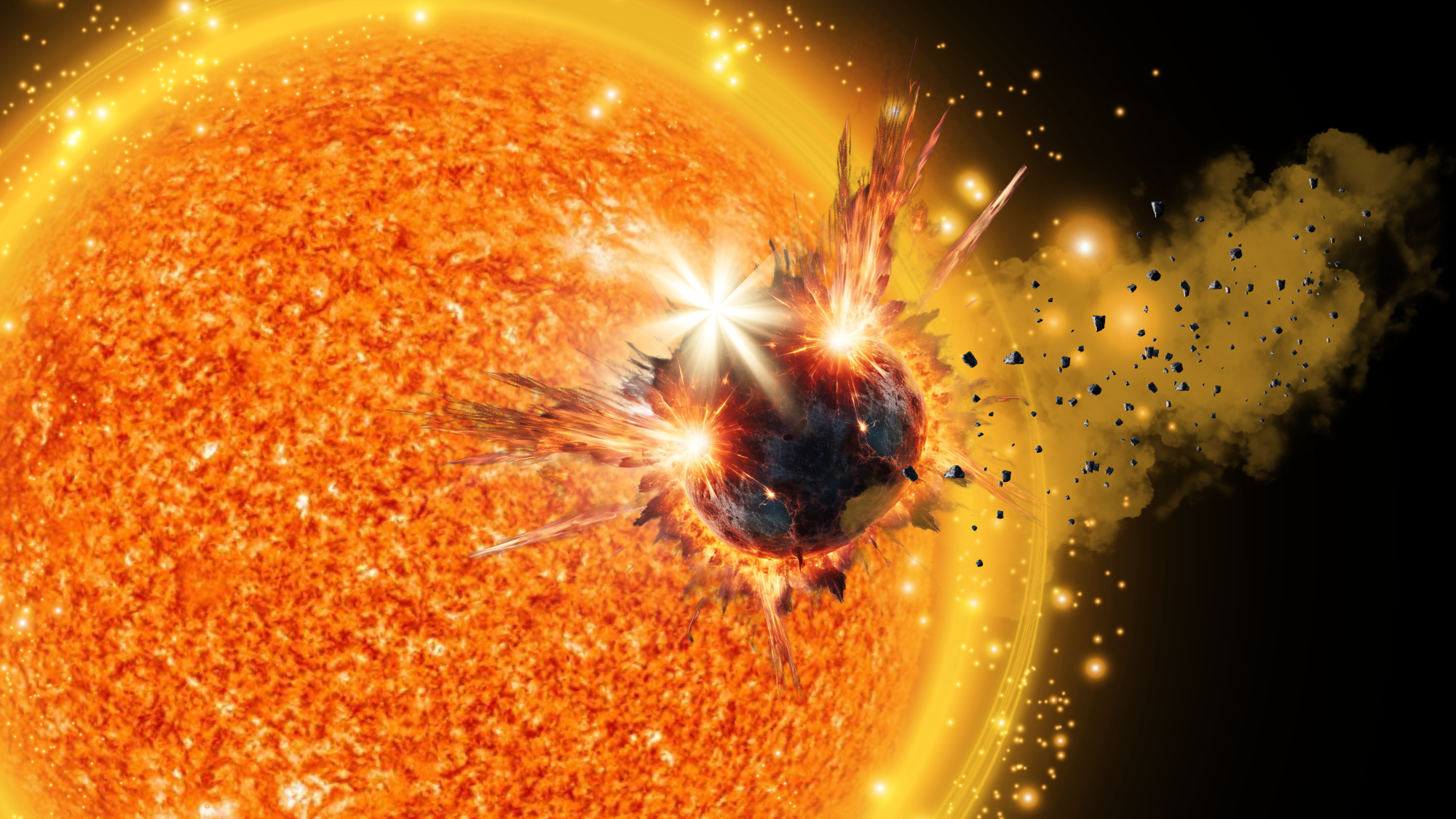
The Sun is our source of life. But according to new research, this hot and bright star might also be a cosmic cannibal. Scientists suggest that the Sun may have swallowed a super-Earth planet billions of years ago during its youth. And the really intriguing part is that evidence of this event could still be hidden within the star.
This idea is based on computer models and some unexplained features of the Sun. The researchers believe that the structural and chemical traces left by a planet’s ingestion could still be detectable today. So how could this be possible?
The team behind the study recalls that previous research proposed that a super-Earth could have migrated toward the young Sun and merged with it. Noting that their own work takes this idea a step further, the researchers question whether the Sun still carries observable evidence of this engulfment event. According to them, these traces might still be there.
This exciting research was published in the journal Monthly Notices of the Royal Astronomical Society on Thursday, September 10. So what does this discovery mean for us? How does it change what we know about the Sun’s history?

What Hidden Evidence Could Be Inside the Sun?
The researchers say that if the Sun really did swallow a planet, the event could have left specific traces in the star’s internal structure and chemical composition. These traces might manifest in the abundances of elements on the Sun’s surface or in its internal oscillations (helioseismology).
In particular, the ingestion of a super-Earth could cause some elements (such as heavy elements like iron and silicon) to show a different distribution than expected. These differences could be detected by analyzing the Sun’s spectrum or studying its internal oscillations.
These findings could radically change our understanding of the Sun’s formation and early evolution. They could also help us understand whether similar events have occurred in other planetary systems. After all, if our Sun swallowed a planet, such cosmic cannibalism might have happened elsewhere in the universe.
Why Is This Research So Important?
This research has the potential to illuminate a dark chapter in the Sun’s past. Until now, the idea of stars swallowing planets has remained mostly theoretical. However, this new study concretely demonstrates that this theory could have observable consequences. If these traces are indeed detected, it would significantly alter what we know about the evolution of both the Sun and other stars.
Additionally, this study could explain why the Sun has some unexplained properties. For instance, certain anomalies in the Sun’s internal structure or unexpected variations in surface element abundances could be remnants of this engulfment event.
| Parameter | Value / Information |
|---|---|
| Type of Planet Swallowed | Super-Earth |
| Time of Event | Billions of years ago, during the Sun’s youth |
| Journal of Publication | Monthly Notices of the Royal Astronomical Society |
| Publication Date | September 10, 2026 |
| Method Used | Computer modeling and solar observations |
| Potential Evidence | Chemical anomalies, differences in internal structure |
Why Is Investigating the Sun’s Past Difficult?
Investigating the Sun’s past billions of years ago is no easy task. The Sun’s surface is constantly changing, and we cannot directly look into its interior. Scientists use a method called helioseismology to study the Sun’s interior. This method involves analyzing oscillations on the Sun’s surface to gain information about its internal structure.
However, these oscillations can be influenced by many different processes within the Sun. This makes it difficult to distinguish the traces of a planet engulfment event from other effects. Nevertheless, the researchers believe they can overcome this challenge. With advanced computer models and more sensitive observation techniques, it may be possible to detect these traces.
This research also raises important questions about the evolution of exoplanets. If planets can be swallowed by their stars, it shows how dynamic and variable planetary systems can be. This could lead us to reassess the history of our own Solar System.

How Will This Discovery Impact Future Research?
Yildiz, the lead author of the study, says the next step is to see whether these fingerprints can be detected independently. This means other research groups would also confirm these findings and support them with different observations. If these traces are independently verified, it would solidify our knowledge of the Sun’s past.
Such a discovery would also require us to update our models of the evolution of stars and planetary systems. Perhaps many more stars in the universe have swallowed their own planets than we previously thought. This underscores the importance of new discoveries in space exploration once again.
The idea of a star like the Sun swallowing a planet might sound like science fiction. However, this research shows that such events could be real and more common in the universe than we imagine. This is an exciting development that changes our perspective on the cosmos.
In conclusion, the possibility that the Sun swallowed a super-Earth in its past offers important clues about both our star and the dynamic nature of the universe. These findings could be part of our steps toward solving the universe’s greatest mysteries.
So What Should We Do with This Information?
This research raises new questions for those working in space sciences. But even for an ordinary sky enthusiast, knowing that the Sun could have such a turbulent past is quite exciting. Discoveries like this remind us once again how dynamic and full of surprises the universe is.
If these traces are detected, it could also lead us to revise our theories about the formation of the Solar System. Perhaps planets like Earth managed to survive by escaping the wrath of their star. This shows once again how fragile and precious life is.

Conclusion: The Sun’s Secrets Unveiled
This research shows that the Sun is not just a source of energy, but also has a complex and dynamic past. If the Sun really did swallow a super-Earth, it could radically change what we know about both our star and the evolution of planetary systems.
In the coming years, observations aimed at detecting these traces will shed light on the Sun’s past. This could help us solve one of the universe’s greatest mysteries. Following these exciting developments is an opportunity not to be missed for space science enthusiasts.
Remember, every time you look at the Sun, you are seeing only a part of a story that spans billions of years. Keep following scientists to learn the full story. And who knows, maybe one day these secrets will be fully revealed.
Editor’s Take: The idea that the Sun might have swallowed a planet sounds a bit unsettling at first, but it’s actually a wonderful example of how dynamic and wild the universe can be. Discoveries like this remind us how lucky our existence is. If these traces are truly found, it will change not only our thoughts about the Sun but also about the evolution of all planetary systems. I will follow the scientists’ work on this with great curiosity.
Frequently Asked Questions
Could the Sun have actually swallowed a planet?
Yes, according to new research, it is possible. Scientists suggest that the Sun may have swallowed a super-Earth planet billions of years ago, and traces of this event could still be found within the star.
How could this evidence be detected?
Researchers think this evidence could be detected through anomalies in the Sun’s chemical composition or differences in its internal oscillations (helioseismology).
Why is this discovery important?
This discovery could radically change what we know about the Sun’s early evolution and the dynamics of planetary systems. It also suggests that similar events may have occurred in other star systems.
Sources:
Bir Yorum Yazın