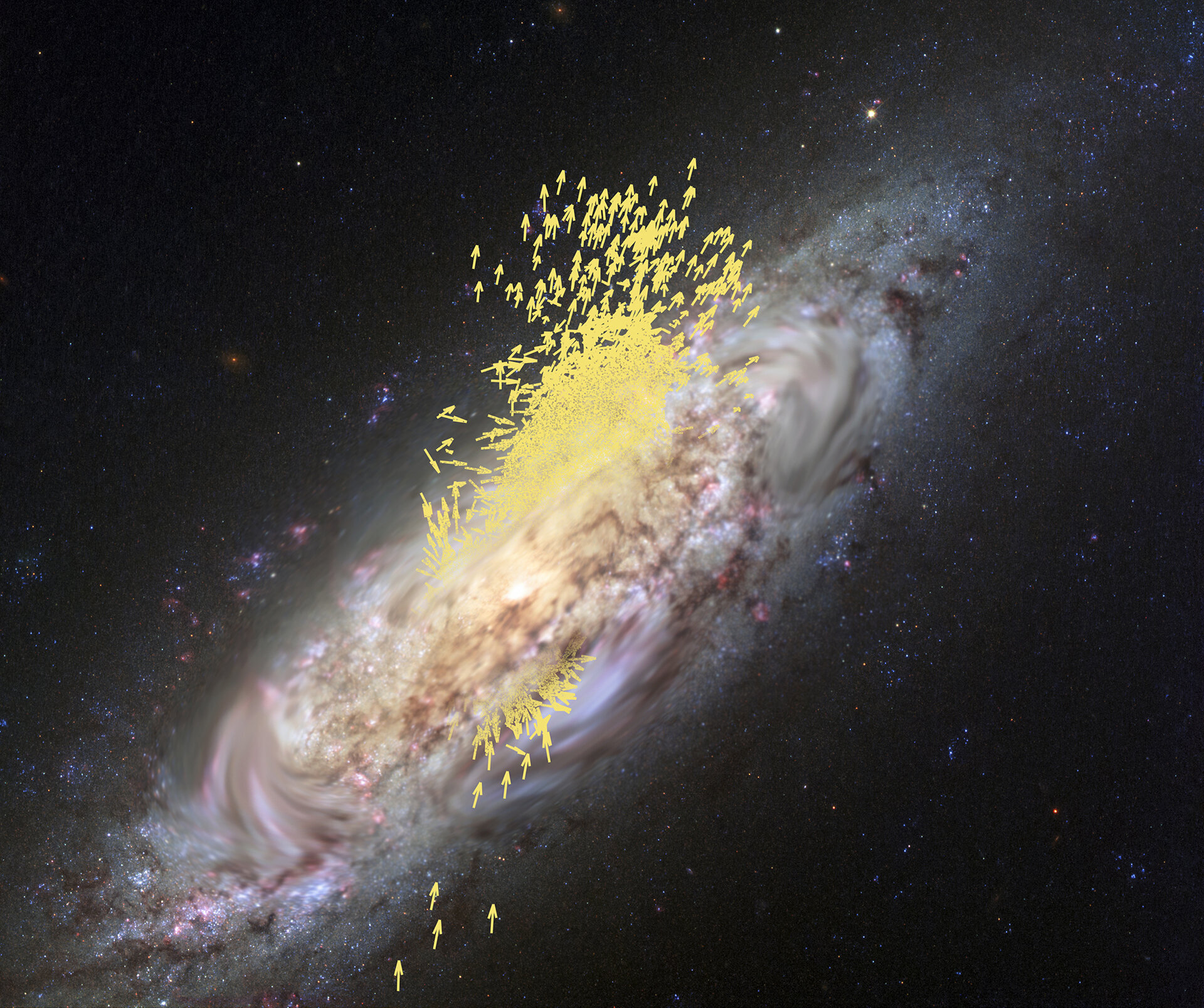
Quick Summary: Researchers studying the billions-of-years-long evolution of 25 Milky Way-like galaxies in simulations uncovered an intriguing result: galaxies with slowly rotating stellar halos had experienced head-on collisions in the distant past, causing their disks to reorient by roughly 90 degrees. This could help explain the unusual motions of stars in the Milky Way.
Did the Milky Way really change its orientation in the past?
When we look up at the night sky, the Milky Way appears calm and orderly. Modern astronomy, however, has shown that galaxies often have turbulent histories. A new study suggests that our own galaxy may have had a far more dramatic past than previously thought.
According to research reported by Space.com, the Milky Way may have undergone an orientation shift of about 90 degrees billions of years ago as a result of a major galactic merger. While the idea may sound unusual at first, researchers have found compelling clues that support it.
At the heart of the study is the Milky Way’s stellar halo. This vast region of old stars extends far beyond the galaxy’s bright spiral disk. When the European Space Agency’s Gaia mission measured the motions of stars in this region, it revealed something striking: halo stars were rotating much more slowly than stars within the galactic disk.
Astronomers have long sought to understand the reason for this difference. The new findings suggest the answer may lie in enormous collisions that took place in the distant past.
What do the key findings of the study show?
Although only limited numerical details have been shared publicly, the main framework of the research can be summarized in the table below.
| Parameter | Value |
|---|---|
| Galaxies studied | 25 |
| Disk reorientation | Approximately 90 degrees |
| Evolution timescale | Billions of years |
| Conference dates | July 20–24, 2026 |
| Presentation venue | University of Birmingham |
The most eye-catching figure here is undoubtedly 90 degrees. A change of that magnitude could significantly affect a galaxy’s appearance and internal dynamics.
Of course, this does not mean the Milky Way suddenly tipped over. The process may have unfolded over millions or even hundreds of millions of years. Difficult as it is to imagine on human timescales, galaxies are constantly evolving on cosmic timescales.
What questions does this discovery raise about the Milky Way’s past?
If the results are confirmed, astronomers may need to rewrite parts of the Milky Way’s evolutionary history. Many existing models assume that the galaxy’s overall orientation has remained largely stable over time.
In this new scenario, major mergers do more than simply add new stars—they can reshape the geometry of an entire galaxy. That would require scientists to reassess the distribution of stars, gas clouds, and dark matter.
The implications extend beyond the Milky Way. Other spiral galaxies throughout the universe may have undergone similar processes. If such reorientations are common, some fundamental assumptions about galaxy evolution may need to be revisited.
As often happens in space science, new data can challenge old ideas. Just as the Starship Flight 13 mission and Vikram-1’s historic achievement are pushing technical boundaries, galaxy research continues to test our understanding of the universe.
Meanwhile, Gaia’s treasure trove of data is likely to open the door to many more discoveries in the years ahead. Because astronomers can measure not only where stars are located but also how they move, they can reconstruct ancient events with unprecedented detail.

Which future observations will be decisive?
While the current results present a strong scenario, the scientific community will want additional evidence. In particular, the motions of different stellar populations within the halo can be studied in greater detail.
Next-generation telescopes and sky surveys will also play an important role. If researchers can identify the signatures of the Milky Way’s past mergers with greater precision, it will become much clearer whether the galactic disk truly changed its orientation.
One of the most fascinating aspects of this kind of research is that there is no need to travel through time to study the past. The stellar distributions and motions we observe today act as silent witnesses to events that occurred billions of years ago.
While the Chris Williams mission highlights humanity’s activities in space, this research tackles a much larger story: understanding the life history of an entire galaxy.
Frequently Asked Questions
Did the Milky Way really rotate by 90 degrees?
The study does not claim this has been conclusively proven. However, simulations and observations suggest that such a reorientation may have occurred following a major merger in the distant past.
What is a stellar halo?
A stellar halo is a vast, diffuse region of stars surrounding the Milky Way’s spiral disk. Many of the galaxy’s oldest stars reside there.
Why is this research important?
It helps us better understand the Milky Way’s formation history and offers findings that could influence models of how other spiral galaxies evolve.
Sources
Editor’s Perspective: We often think of the Milky Way as a fixed backdrop, but this study is a reminder that our galaxy is a dynamic structure that may have endured major upheavals in its past. The idea that such a dramatic story lies behind the stars we see every night is, to me, one of the most captivating aspects of astronomy.
Bir Yorum Yazın