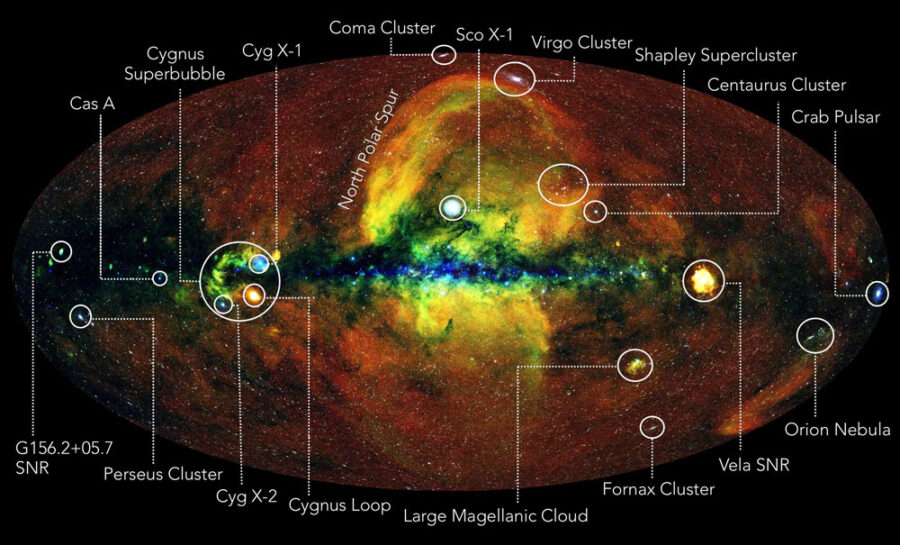
Quick Summary: eROSITA X-ray telescope’s second major data release (DR2) includes nearly 2 million cosmic X-ray sources. These sources, including active supermassive black holes, galaxy clusters, and supernova remnants, nearly double our high-energy map of the universe, offering astronomers a massive dataset to study black hole growth and the universe’s structure.
eROSITA’s Massive Data Release: What is DR2?
Astronomers have announced a colossal catalog that nearly doubles our knowledge of the hottest and most energetic objects in the universe. The second major public data release (DR2) from the German-led eROSITA X-ray telescope contains nearly 2 million X-ray-emitting objects, including supermassive black holes, galaxy clusters, stars, and other extreme cosmic phenomena.
According to an announcement from the Max Planck Institute for Extraterrestrial Physics (MPE), this unique dataset will help astronomers investigate how black holes grow, how galaxies evolve, and how the largest structures in the universe form. DR2, with these sources observed under uniform conditions, provides astronomers with a powerful dataset to study the high-energy universe.

What Does This Discovery Mean for Us?
The sheer size of this catalog means astronomers now have an unprecedented dataset to study the high-energy universe. With nearly 2 million sources observed under the same conditions, astronomers can trace how supermassive black holes grew over billions of years, map the distribution of galaxy clusters to better understand the universe’s large-scale structure, and search for rare or unusual objects that might have been missed before. Large and uniform surveys also make it easier to compare different classes of objects and identify long-term trends that smaller observations cannot reveal.
So, what’s inside these 2 million sources? Over 1.9 million are point-like sources, most of which are active supermassive black holes feeding at the centers of distant galaxies, or stars within the Milky Way. These black holes open a window for astronomers to see how galaxies grow and evolve over cosmic time. The stellar sources help researchers better understand everything from stellar activity to the life cycles of stars.
Why Are Galaxy Clusters and Supernova Remnants So Valuable?
About 64,000 sources are classified as extended objects, including massive galaxy clusters, nearby galaxies, and glowing remnants of exploded stars (supernovae). Galaxy clusters are particularly valuable because they trace the universe’s largest structures. By studying the distribution of these clusters, scientists can probe the influence of dark matter and dark energy on the universe’s evolution.
These extended objects are critical for understanding the universe’s large-scale structure. Galaxy clusters are massive gravitational structures that hold hundreds or even thousands of galaxies together. How these clusters form and evolve provides important clues about the universe’s dark matter and dark energy content.
| Parameter | Value |
|---|---|
| Total X-ray Sources | Nearly 2 Million |
| Point-like Sources | Over 1.9 Million |
| Extended Objects | About 64,000 |
| Main Source Types | Active Supermassive Black Holes, Galaxy Clusters, Stars, Supernova Remnants |
| Data Release | DR2 (Second Major Public Data Release) |
eROSITA’s Mission and Importance
eROSITA is conducting one of the most sensitive surveys of the universe in X-ray wavelengths. This mission, carried out in collaboration with the German Aerospace Center (DLR) and the Max Planck Institute for Extraterrestrial Physics, scans the sky to map the hottest regions of the universe. This data release, alongside discoveries like New Inhabitants of the Early Universe Through Webb’s Eyes: MACS J0308.9+2645, helps us understand both the early universe and its present-day structure.
The massive dataset provided by eROSITA is set to be groundbreaking in the world of astronomy. This catalog, which nearly doubles the number of previously known X-ray sources, will allow researchers to study the universe’s most energetic events in unprecedented detail. These data may also indirectly contribute to our understanding of events in our solar system, such as the Total Solar Eclipse on August 12, 2026: The Mysterious Corona to Be Seen for the First Time.

Black Hole Growth and the Universe’s Structure
One of the most exciting aspects of this catalog is the information it provides about the growth of supermassive black holes. Active supermassive black holes are massive objects found at the centers of galaxies that emit enormous amounts of energy as they consume surrounding matter. How these black holes grow to such enormous sizes is one of the biggest mysteries in modern astrophysics.
The data from eROSITA can help solve this mystery by comparing black hole activity across different cosmic epochs. Additionally, the distribution of galaxy clusters offers important insights into the universe’s dark matter and dark energy content. These data are critical for understanding how the universe’s large-scale structure formed.
Next-Generation Space Missions and Data Sharing
eROSITA’s release of this massive dataset to the public once again highlights the importance of open access in science. By making these data available to astronomers worldwide, it will accelerate discoveries. Such large data releases are part of a scientific progress that runs parallel to private sector space efforts, like Did Starship Sink in the Ocean During Its 13th Test Flight? Critical Statement from Elon Musk.
The DR2 data release will fundamentally change how astronomers study the high-energy universe. This dataset offers a unique opportunity to understand the evolution of both black holes and galaxy clusters. It also holds great potential for discovering rare and unusual objects.

Frequently Asked Questions
How many X-ray sources are in the eROSITA DR2 data release?
eROSITA’s DR2 data release contains nearly 2 million X-ray sources. Of these, over 1.9 million are point-like, and about 64,000 are extended objects.
What are these X-ray sources?
The sources include active supermassive black holes, galaxy clusters, stars within the Milky Way, and supernova remnants. These objects represent the hottest and most energetic regions of the universe.
Why is this discovery important?
This discovery nearly doubles the number of known X-ray sources, providing astronomers with a massive dataset on black hole growth, galaxy evolution, and the universe’s large-scale structure.
Editor’s Note: This massive data release from eROSITA genuinely excites me. Two million X-ray sources mean a giant window into the universe’s wildest and most energetic corners. Being able to study black hole growth mechanisms with such a large sample will lay the groundwork for groundbreaking discoveries in astrophysics in the coming years. Public access to such large datasets is one of the finest examples of collective scientific progress.
Bir Yorum Yazın