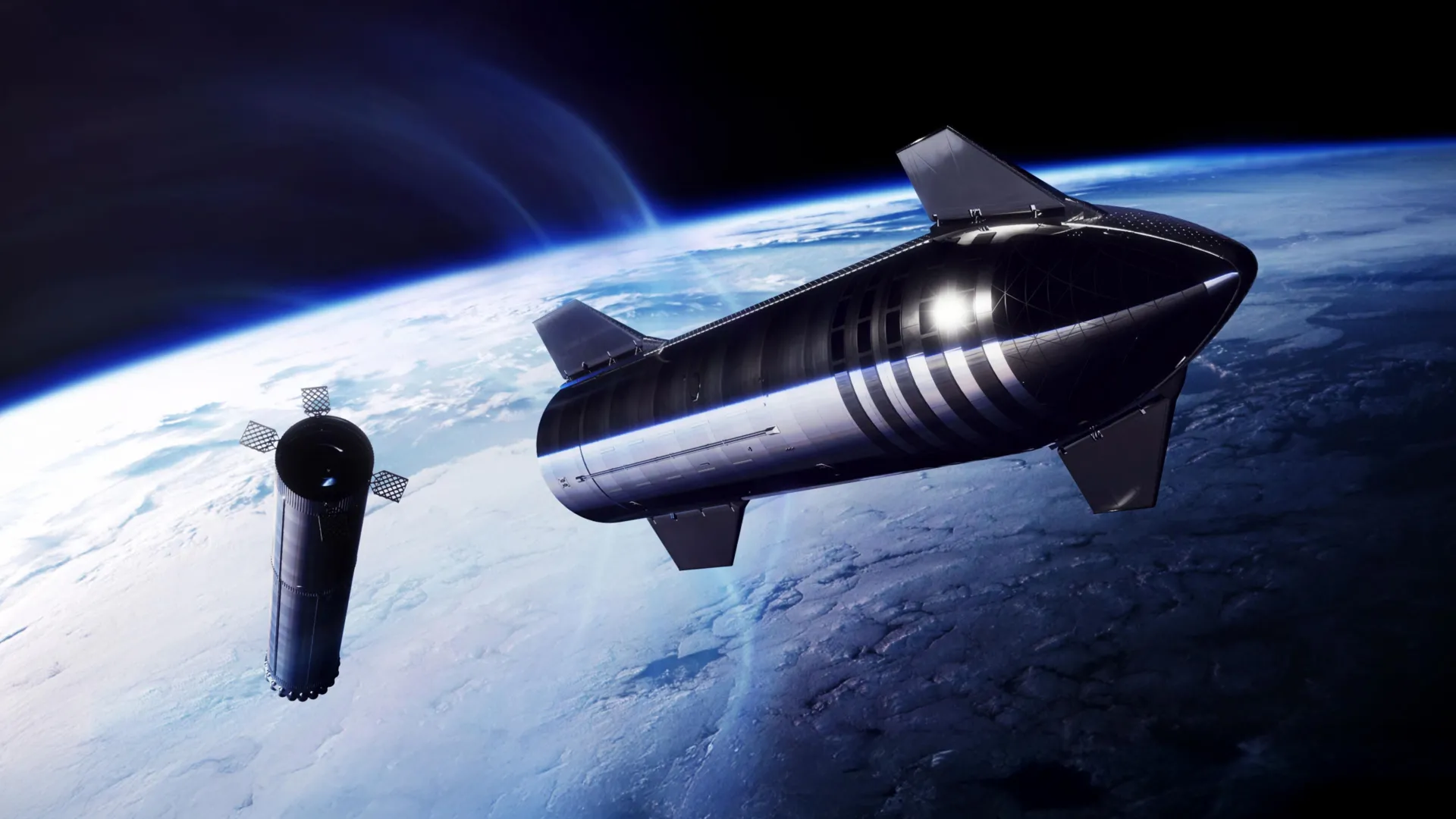
Quick Summary: An independent European study confirms that SpaceX’s Starship system could be as transformative as many expect, while also highlighting significant technical hurdles that still need to be overcome. The same research introduces a new winged, reusable super-heavy rocket concept for Europe, proposing a different path toward low-cost space launches.
Why is Europe looking for an alternative to Starship now?
Over the past few years, one of the most talked-about vehicles in the space industry has been SpaceX’s Starship system. Its fully reusable architecture, enormous payload capacity, and promise of dramatically reducing costs over the long term have attracted close attention not only in the United States but across Europe as well.
Now, an independent study conducted by European researchers takes a closer look at Starship’s strengths and weaknesses while outlining a different roadmap for Europe. The most intriguing aspect of the research is a new super-heavy launch vehicle concept that could potentially compete with Starship.
The study, reported by Universe Today, argues that Europe should consider bolder designs rather than relying solely on incremental improvements to existing rockets if it hopes to meet future heavy-lift launch requirements.

So what does the study say about Starship?
One of the study’s most notable conclusions is that Starship truly has the potential to transform space transportation. The researchers conclude that the system’s promised advantages are no longer merely theoretical and can be framed in meaningful engineering terms.
That said, not everything appears flawless. Starship still faces significant technical and operational challenges. Frequent reuse, maintenance procedures, in-orbit refueling, and sustaining a high operational tempo are among the factors that will ultimately determine the system’s economic success.
In reality, this is nothing new. Many revolutionary space systems throughout history encountered major engineering difficulties during their early years. Starship appears to be following a similar path.
As discussed in our earlier article, The Oldest Quasar in the Universe: Powered by a Trillion Suns, the astronomy community is watching Starship particularly closely because its massive transport capacity could enable extraordinarily ambitious scientific missions in the future.
How does Europe’s proposed system differ?
The most fascinating aspect of the research is the alternative launch architecture proposed for Europe. The study evaluates winged heavy-lift launch vehicles, an approach based on a different philosophy of reusability than conventional vertically landing rockets.
In SpaceX’s approach, rocket stages perform controlled vertical landings. The European concept explores whether aircraft-like systems could offer certain advantages. Such designs could potentially optimize maintenance, operational readiness, and reuse cycles in different ways.
Of course, this remains a concept. There is currently no approved development program or flight-testing campaign associated with the vehicle. Even so, the study offers an interesting glimpse into how Europe is thinking about the future of space transportation.
The European Space Agency and aerospace companies across the continent have shown growing interest in reusable systems in recent years. The driving force behind this trend is that the race to lower the cost of access to space has become a truly global competition.

What do the numbers tell us?
Although the ScienceDaily report does not provide detailed performance figures, the key information from the study can be summarized in the table below.
| Parameter | Value |
|---|---|
| Article publication date | July 10, 2026 |
| ScienceDaily access date | July 10, 2026 |
| Related academic publication year | 2025 |
| Journal | CEAS Space Journal |
| Volume | 18 |
| Issue | 1 |
| Pages | 121 |
| DOI | 10.1007/s12567-025-00625-8 |
The important point here is that this is not simply an opinion piece. Its publication in a peer-reviewed academic journal indicates that the methods and assumptions were evaluated by experts.
How could this competition affect the space industry?
It seems unlikely that a single company or a single nation will dictate the future of space transportation. History has repeatedly shown that competition accelerates innovation, which is why Europe’s work on alternative systems matters.
If multiple technological approaches pursue the same goal, the industry could develop solutions that are not only cheaper but also more reliable. As the cost of reaching space falls, scientific missions, commercial ventures, and even human exploration programs could advance more rapidly.
When considering observatories such as the James Webb Space Telescope or future giant space telescopes, the importance of heavy-lift launch vehicles becomes even clearer. A rocket capable of carrying tens or even hundreds of tons instead of just a few could fundamentally reshape mission design.
In this context, the future of large-scale observational projects discussed in astronomy stories such as Nearby Hungry Black Hole May Shed Light on the Early Universe is also directly tied to advances in launch technology.
Can Europe really catch up to Starship?
The short answer is that it remains unclear. SpaceX has done far more than propose a design—it has built numerous prototypes, conducted extensive testing, and continuously gathered real-world data. That provides a substantial advantage.
On the other hand, Europe’s engineering expertise should not be underestimated. Decades of experience from the Ariane programs provide a strong foundation for the next generation of launch systems.
The key question is how quickly Europe can move. In the space sector, technological leadership is earned not only through good designs but through testing and refining those designs in the real world.
What stands out to me is that Europe is not trying to build a direct copy of Starship. Instead, it is exploring a different architecture altogether. History has shown many times that the winning solution is not always the one that appears first, but sometimes the alternative approach that emerges later.

What can we expect in the future?
The next few years will be crucial. Starship’s operational successes—or the challenges it encounters—will influence not only SpaceX’s trajectory but also the direction of competing projects.
Whether Europe’s proposed concept evolves into a full-fledged program or remains at the research stage remains to be seen. Yet the study itself sends an important message: a new era of the space race has begun, and the challenge is no longer simply reaching space, but doing so sustainably and economically.
If you are following these developments, you may also be interested in our coverage of reusable spacecraft technologies, including The Final Pegasus Mission to Save Swift Has Begun and LINK Mission Makes a Historic Move for the Swift Telescope.
Sources
Editor’s Perspective: One of the most exciting aspects of the space industry is seeing different engineering cultures tackle the same problem with entirely different solutions. I find Europe’s decision to pursue its own path, rather than simply copying Starship, especially compelling. If these ideas eventually become real vehicles, the way we access space a decade from now could look very different from today.
Frequently Asked Questions
Is Europe’s new rocket already an active project?
No. The system discussed in the article is presented as a concept examined in an academic study and includes recommendations for future development.
What did the study conclude about Starship?
The researchers found that Starship could be as transformative as expected, while also facing technical and operational challenges that still need to be addressed.
Why is this concept important?
Because it demonstrates that Europe is exploring alternative ways to expand its heavy-lift launch capabilities and is developing different approaches to reusable launch systems.
Bir Yorum Yazın