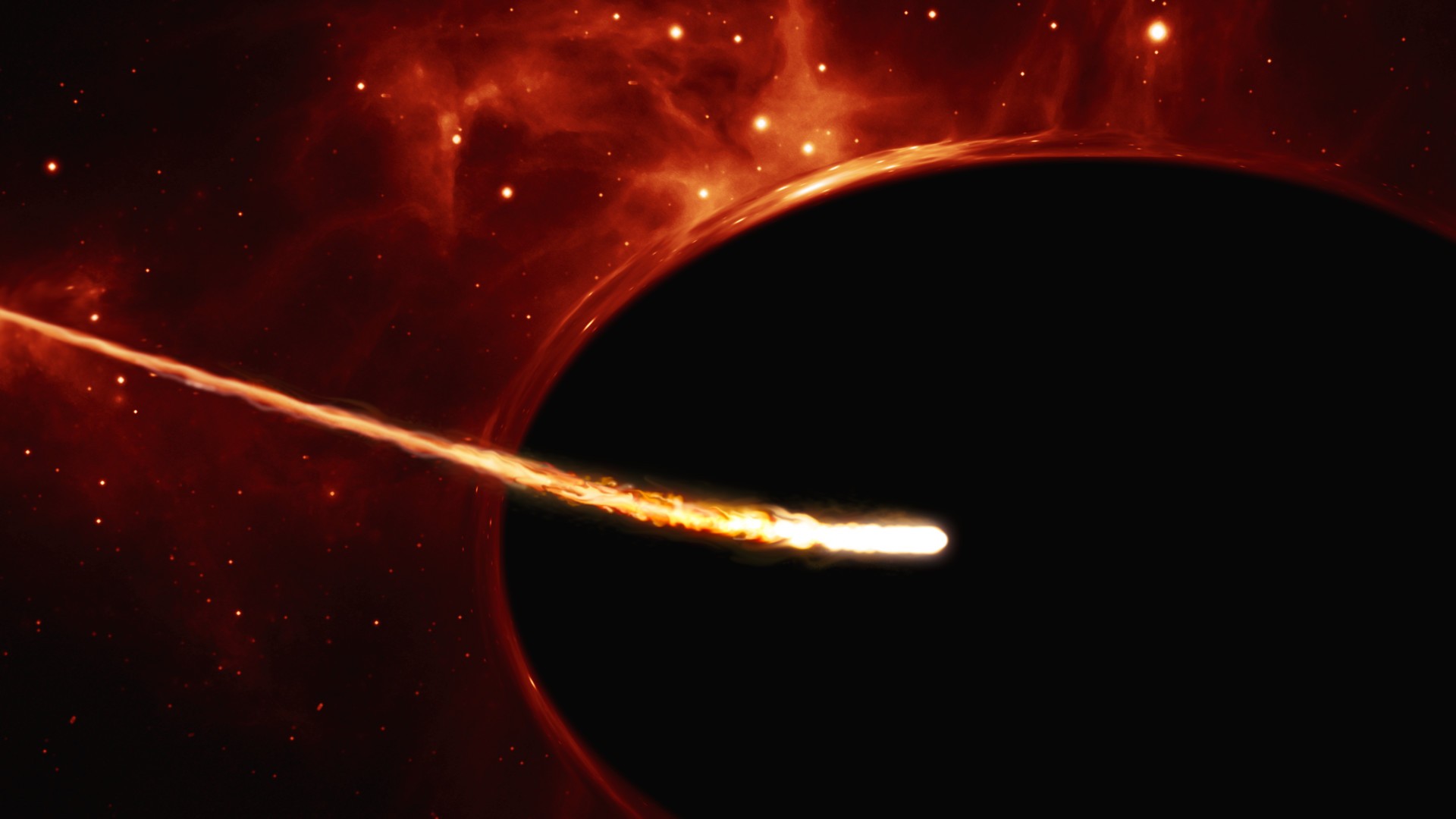
Quick Summary: Astronomers have discovered a star named S301 orbiting the supermassive black hole Sagittarius A* at the center of the Milky Way at a speed of 25,000 kilometers per second (8% of the speed of light). This is the fastest star in our galaxy and offers a unique opportunity to measure the black hole’s frame-dragging effect on spacetime.
Record-Breaking Star in the Grip of a Black Hole
Astronomers have discovered the fastest star ever found orbiting the giant black hole at the center of the Milky Way galaxy. This star is so fast that it reaches 25,000 kilometers per second—that’s more than 8% of the speed of light!
This impressive discovery was made by researchers from the Max Planck Institute for Extraterrestrial Physics in Germany. They named the star S301. It orbits the supermassive black hole Sagittarius A* (Sgr A* for short) at the heart of our galaxy on an incredibly tight path.
Felix Mang, author of the study, explained the significance of the discovery:
“What makes this star special is that it orbits Sagittarius A* on a very tight orbit; it takes only 8.7 years to complete one revolution and it approaches the black hole to within just 12 times the Earth-Sun distance. This is something we’ve never seen before.”
This discovery offers astronomers a brand-new way to study the black hole. Until now, Sgr A* was known to have a mass of about 4.3 million solar masses. A star like S301 could help us better understand the spacetime warping caused by this enormous mass.

A Unique Laboratory to Test Einstein’s Theory
Einstein’s general theory of relativity predicts that a rotating black hole drags spacetime along with it. This effect is called frame-dragging or the Lense-Thirring precession. This dragging should gradually alter S301’s orbit. Because the star comes so close to the black hole, these changes could become measurable within about a decade.
This is a fantastic opportunity to test Einstein’s theory. So far, this effect has been indirectly confirmed through satellites in Earth’s orbit and observations of some distant galaxies. But S301 could be the closest laboratory where we can directly observe this effect.
In fact, stars like this play a key role in understanding the extreme conditions around black holes. The orbits of these stars help us calculate the mass and spin of the black hole.
Why is this discovery so important?
S301 doesn’t just break a speed record; it also makes us question what we know about the nature of black holes. Here are a few points that make this discovery significant:
- Orbital period: S301 completes a lap around Sgr A* in just 8.7 years. This is one of the shortest known orbital periods.
- Closest approach: The star comes within just 12 times the Earth-Sun distance of the black hole. This puts it in the region where the black hole’s tidal forces are strongest.
- Speed: At 25,000 kilometers per second, it’s the fastest known star in the Milky Way.

In the Shadow of Black Holes: What Awaits Us in the Future?
The discovery of S301 opens a new window into understanding the extreme environments around black holes. By monitoring changes in this star’s orbit, astronomers will be able to measure Sgr A*’s spin and how it warps spacetime with much greater precision.
Furthermore, the existence of such stars provides clues about star formation processes near the black hole. Perhaps these stars formed from the disruption of another star in the black hole’s powerful gravitational field.
This discovery, along with technological advances in space exploration, shows how quickly we are progressing in understanding the most extreme corners of the universe. While we have witnessed historical moments like spacewalks, we are now one step closer to unraveling the mysteries of black holes.

The Numbers Behind the Discovery
Here are the key data you need to know about S301 and the black hole:
| Parameter | Value |
|---|---|
| Star’s Name | S301 |
| Maximum Speed | 25,000 km/s (8% of the speed of light) |
| Orbital Period | 8.7 years |
| Closest Approach to Black Hole | 12 times the Earth-Sun distance |
| Black Hole Mass | 4.3 million solar masses |
| Measurable Effect | Lense-Thirring precession (frame-dragging) |
Frequently Asked Questions
Is S301 really the fastest star in the Milky Way?
Yes, it has the highest speed among all stars discovered so far. Its speed of 25,000 kilometers per second puts it at 8% of the speed of light.
Why is this star so fast?
S301 passes very close to the supermassive black hole Sagittarius A*. The black hole’s immense gravitational force accelerates the star to incredible speeds.
How will this discovery affect Einstein’s theories?
This discovery provides a unique opportunity to test the frame-dragging effect predicted by Einstein’s general theory of relativity. Changes in the star’s orbit could confirm the accuracy of this theory.
Editor’s Note: This discovery genuinely excites me. A star whipping around a black hole at 8% of the speed of light is proof of how extreme the universe can be. Being able to test Einstein’s theories this closely could be a pivotal moment in the history of science. I hope that over the next decade we can observe changes in this star’s orbit and unravel a bit more of the mysteries of black holes.
Bir Yorum Yazın