Quick Summary: The Link spacecraft, launched on the planned final flight of the Pegasus rocket, aims to rescue the Neil Gehrels Swift Observatory as it gradually descends toward Earth. If the NASA-backed mission succeeds, Swift’s orbit will be raised, allowing it to continue studying the gamma-ray universe.
The final chapter of the Pegasus rocket begins
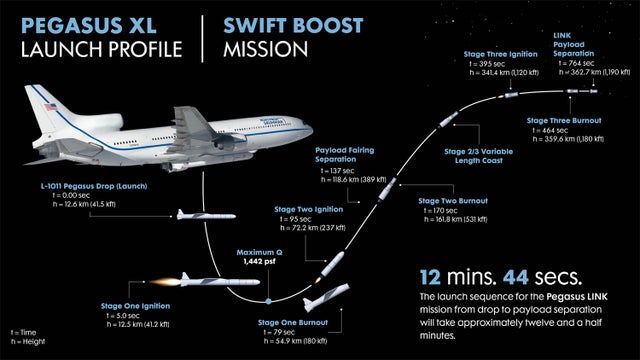
Pegasus, one of the most distinctive launch vehicles in spaceflight history, has likely embarked on its last mission. The air-launched rocket operated by Northrop Grumman separated from its L-1011 carrier aircraft on July 3 and delivered the Link spacecraft, developed by Katalyst Space, into low Earth orbit.
This mission is more than just a launch. It also serves as the closing act of a rocket program that has spanned decades. Pegasus first flew in 1990 and, while it once launched five to six times per year, it has been used only six times over the past 15 years.
Before liftoff, weather conditions and technical issues caused a three-day delay. Despite that setback, the Link spacecraft was successfully deployed into orbit.

Why does the Swift Observatory need saving?
NASA’s Neil Gehrels Swift Observatory is a major scientific instrument dedicated to studying gamma-ray bursts and other high-energy phenomena across the universe. Over the years, it has helped astronomers gather critical data on black holes, neutron stars, and powerful cosmic explosions.
However, Swift’s orbit is gradually decaying. Without intervention, the spacecraft could reenter Earth’s atmosphere and end its mission by late this year or early next year.
That is precisely where the Link mission comes in. The spacecraft will approach Swift, conduct detailed inspections, and then attempt the operations needed to raise the observatory’s orbit.
The concept is also significant for the future space economy. Instead of permanently losing aging satellites or spacecraft with degraded orbits, servicing them, refueling them, or adjusting their orbits is becoming increasingly attractive.
As the importance of long-duration space missions continues to grow, new observational tools are also coming online. For example, the Rubin Observatory’s effort to create the largest movie of the universe highlights how rapidly astronomical data collection is accelerating.
How will the Link mission unfold?
Following launch, the Katalyst Space team will spend roughly two weeks checking the spacecraft’s systems. During this phase, communications, attitude control, and other core systems will be verified.
Afterward, Link will begin its approach toward Swift. The rendezvous and inspection phase is expected to take between two and three weeks.
Approaching another spacecraft in orbit may sound straightforward, but the reality is far more complex. The speeds, positions, and orientations of two independently moving spacecraft must be matched with extreme precision. Even a minor error could affect mission success.
One of the most remarkable aspects of Katalyst Space is its development speed. The company adapted satellite-servicing technology originally intended as a low Earth orbit technology demonstration and prepared it for the Swift mission in a remarkably short time.
“This is absolutely an unprecedented development timeline.”
Those were the words of principal investigator Kieran Wilson during a prelaunch briefing. Indeed, bringing a spacecraft from contract award to launch readiness in just nine months is far from typical in the space industry.

Key mission data
I’ve gathered the main figures mentioned in the report in the table below. These numbers provide a clearer picture of the mission’s scale and timeline.
| Parameter | Value |
|---|---|
| Pegasus first flight | 1990 |
| Annual flight rate in the 1990s | 5–6 missions |
| Pegasus flights in the last 15 years | 6 missions |
| Time since the previous Pegasus launch | Since June 2021 |
| Swift orbital inclination | Approximately 21 degrees |
| Link development time | 9 months |
| Launch date | July 3, 2026 |
| Rocket release time | 04:36 (U.S. Eastern Time) |
| Time to orbit insertion | Approximately 13 minutes |
| Link spacecraft mass | 425 kilograms |
| NASA contract value | $30 million |
| Initial system checks | Approximately 2 weeks |
| Approach to Swift | 2–3 weeks |
Why was Pegasus chosen?
With so many commercial launch vehicles available today, Pegasus may seem like an unusual choice at first glance. The primary reason is Swift’s relatively uncommon orbit.
An orbital inclination of about 21 degrees is not an ideal target for every launch system. According to the report, Northrop Grumman also had a Pegasus rocket in storage that had originally been built for another customer and could be offered at a competitive cost.
As a result, the mission could meet its unique orbital requirements while giving a long-idle rocket one final opportunity to fly.
The story of Pegasus also reflects the broader evolution of space transportation. Once an innovative solution for launching small satellites, the air-launch approach now occupies a different niche in an era increasingly dominated by reusable rockets.
Could this mission influence future satellite servicing efforts?
In my view, this is the most exciting aspect of the mission. If Link successfully raises Swift’s orbit, it could help establish a new model for extending the operational life of spacecraft.
Every telescope or scientific spacecraft sent into space represents a major investment. Rather than losing a functioning asset simply because it has run out of fuel or its orbit has deteriorated, sending a servicing vehicle may prove to be a far more practical solution.
This approach is not limited to scientific missions. Communications satellites, Earth observation platforms, and even future commercial space stations could benefit from similar services.
At the same time, space operations are becoming increasingly sophisticated. In our recent coverage of the LINK mission’s historic move for the Swift telescope, we discussed some of the earliest signs of this transformation.
It’s also worth remembering that the search for new observational tools and potentially habitable worlds continues at full speed. Discoveries such as a potentially habitable planet candidate 25 light-years away demonstrate just how valuable long-lived space telescopes can be.

What’s next for NASA and Katalyst Space?
NASA confirmed just hours after launch that communication had been established with Link. However, the agency shared few details about the spacecraft’s overall status in its initial update.
Attention is now focused on the spacecraft’s on-orbit testing campaign. If those checks proceed smoothly, Link will begin its journey toward Swift and enter the mission’s most critical phase.
If successful, the mission will not only save an observatory. It will also provide a significant proof of concept for future orbital servicing and maintenance missions.
Pegasus’ final flight may therefore become not only a farewell to the past, but also a gateway to the future.
Sources
Editor’s Perspective: What struck me most about this story is that, instead of launching a brand-new telescope, we’re trying to save an existing scientific asset. Space exploration is no longer just about discovery; sustainability is becoming part of the conversation as well. If Link succeeds, it could open the door to second chances for many satellites and telescopes in the future.
Frequently Asked Questions
What is the goal of the Link mission?
Link aims to approach the Neil Gehrels Swift Observatory, raise its orbit, and extend its operational lifetime.
Why is the Pegasus rocket considered special?
Pegasus is one of the few air-launched rockets, released from an aircraft before ignition. It has held a unique place in space transportation since 1990.
Why is Swift at risk?
Swift’s orbit is gradually decaying. Without intervention, atmospheric drag could eventually cause it to reenter Earth’s atmosphere.
Bir Yorum Yazın