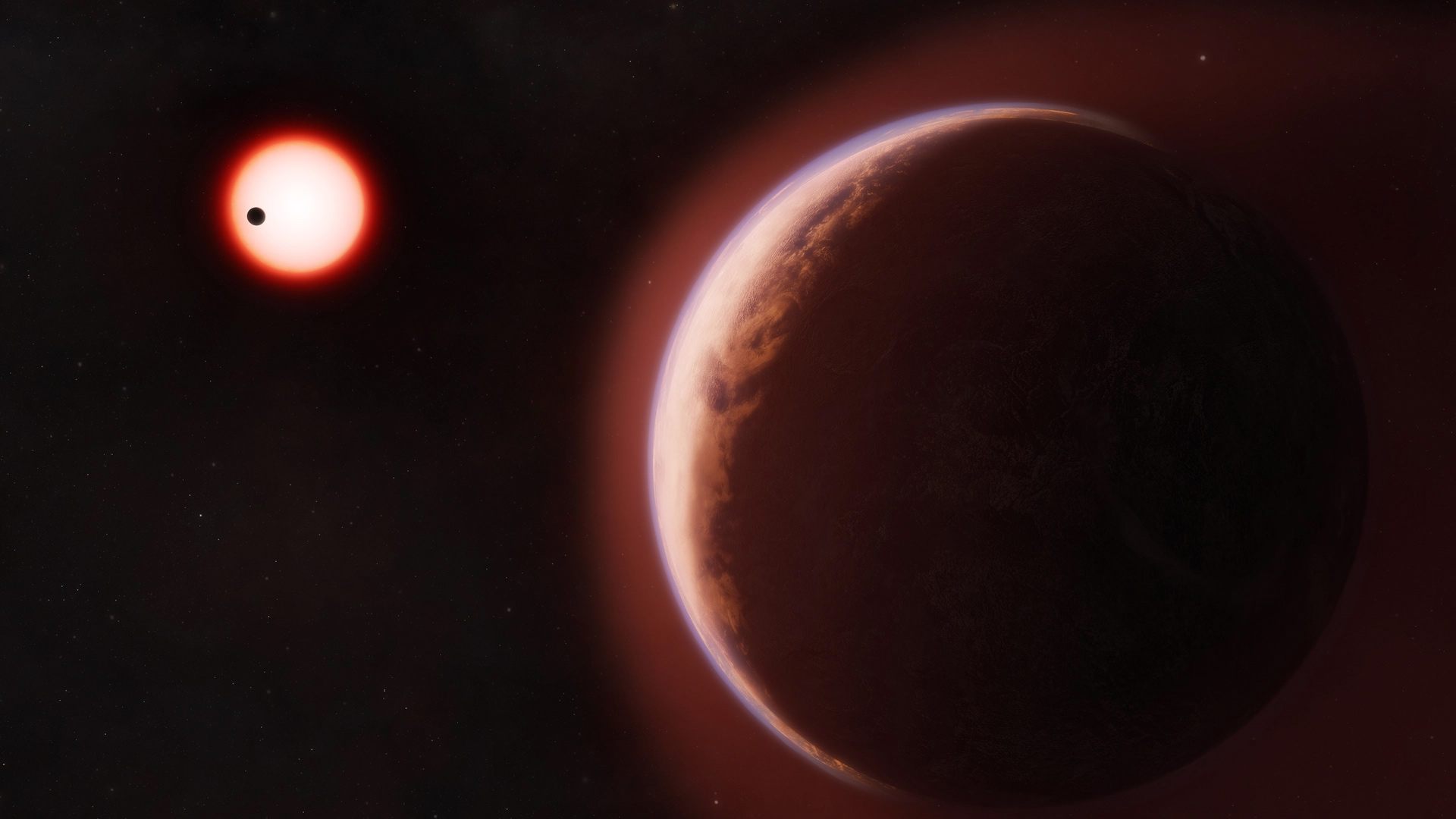
Quick Summary: Astronomers have confirmed that LHS 1140 b, a rocky planet located 48 light-years away, possesses an atmosphere. Helium escaping into space revealed the atmosphere’s presence on this world, which lies within its star’s habitable zone. The discovery suggests that life-friendly conditions beyond our Solar System may be more common than previously thought.
Why is LHS 1140 b generating so much excitement?
Some discoveries in space science do more than add another data point—they change the rules of the game. The announcement of LHS 1140 b by researchers at the Center for Astrophysics | Harvard & Smithsonian is one of those breakthroughs.
For the first time, scientists have confirmed an atmosphere around a rocky planet located in another star’s habitable zone. This has long been a major goal because understanding the surface conditions of a rocky world depends heavily on understanding its atmosphere.
LHS 1140 b is located about 48 light-years from Earth. While that may sound distant, on cosmic scales it is close enough for detailed observations with modern telescopes.
Lead author Collin Cherubim emphasizes that an atmosphere is one of the fundamental requirements for life as we know it. That is exactly why the discovery has attracted so much attention: a rocky planet in the habitable zone appears to have retained its atmosphere for billions of years.
“This is the first example of an atmosphere detected on a rocky planet in another star’s habitable zone.”

So how did scientists detect the atmosphere?
In most cases, it is impossible to see a planet’s atmosphere directly. Instead, researchers study the fingerprints left behind as starlight passes through it.
In the case of LHS 1140 b, the key clue was helium. A small portion of the helium gas in the planet’s atmosphere was escaping into space, and telescopes were able to detect that escape.
Although helium is invisible, it leaves strong signatures at specific wavelengths. That makes it a valuable tool in atmospheric studies. Researchers say the observed signal can only be explained by the presence of an atmosphere.
This technique has previously been used on gas giants. Achieving the same result for a rocky world with Earth-like characteristics represents a significant milestone.
Detecting an atmosphere does not mean life definitely exists on the planet. However, without an atmosphere, it is difficult even to discuss the possibility of life. That is why the discovery is seen as a critical threshold in the search for life beyond Earth.
Is this planet really Earth-like?
The term “Earth-like” appears frequently in scientific news, but it is often misunderstood. Being rocky or residing in the habitable zone does not automatically make a planet a second Earth.
What we currently know about LHS 1140 b is that it is a rocky world receiving an amount of stellar energy that could allow liquid water to exist. We now also know that it has an atmosphere.
What remains unknown is equally important. How thick is the atmosphere? Does it contain water vapor? What is its carbon dioxide content? What is the planet’s actual surface temperature?
Future observations will attempt to answer these questions. Next-generation space telescopes and highly sensitive observatories may reveal the atmosphere’s composition in much greater detail.
| Parameter | Value |
|---|---|
| Planet | LHS 1140 b |
| Distance from Earth | 48 light-years |
| Location | In the habitable zone of another star |
| Planet type | Rocky planet |
| Detected gas | Helium |
| Significance of the discovery | First rocky planet in the habitable zone with a confirmed atmosphere |
| Announcement date | July 21, 2026 |

How does this discovery affect the search for life?
One of the biggest challenges astronomers face is that planets that appear habitable may lose their atmospheres over time due to stellar winds or intense radiation. Without an atmosphere, surface conditions can become hostile to life.
LHS 1140 b tells a different story. Researchers believe the planet may have retained its atmosphere for billions of years. If confirmed, it could show that small rocky worlds are more resilient than previously thought.
This result matters far beyond a single planet. There may be thousands of similar worlds in the habitable zones of stars throughout the Milky Way. If a substantial fraction of them have atmospheres, the number of environments where life could emerge increases dramatically.
Of course, an atmosphere alone is not enough. Liquid water, the right chemical ingredients, and long-term stability are also required. Still, an atmosphere is one of the most fundamental items on that list.
For those following the search for life in the universe, this discovery may be even more valuable than sensational “life found” headlines. It provides strong evidence that the conditions necessary for life can genuinely exist elsewhere.
As we discussed in our earlier article, Has the Asteroid That Wiped Out the Dinosaurs Finally Been Identified?, the processes that shape a planet’s fate can sometimes be directly connected to its atmosphere.
What observations come next?
Scientists have now confirmed the atmosphere’s existence. The next step is to determine its chemical composition in detail.
If water vapor, methane, or other gases associated with biological processes are detected, LHS 1140 b could become one of the most intensely studied targets in exoplanet science.
This process requires patience. Given the enormous distances involved, collecting data is not easy. Even so, new telescope technologies continue to push the boundaries every year.
The growth of private space ventures and new launch systems is also helping these efforts indirectly. As discussed in New Date Announced for Starship Flight 13: July 23, heavy-lift launch systems could play a major role in deploying the large space observatories of the future.
Likewise, growing global competition in space technology is expanding scientific capabilities. One recent example is Vikram-1 Makes History: Private Rocket Success from India, highlighting how access to space is becoming possible for an increasing number of countries and companies.

A new turning point in space exploration?
Some discoveries in science are remembered years later as turning points. The atmosphere of LHS 1140 b may belong in that category.
For the first time, we can say with confidence that a rocky planet in another star’s habitable zone possesses an atmosphere. Even a few years ago, that would have sounded like a bold claim.
Many questions remain unanswered. But researchers are no longer dealing only with theoretical possibilities—they now have a real target to investigate.
Perhaps future observations will reveal the first signs of life on a world like this. Perhaps the results will be entirely different from expectations. Either way, LHS 1140 b has already become one of the most fascinating worlds in modern astronomy.
Sources
Center for Astrophysics | Harvard & Smithsonian
Frequently Asked Questions
Has life been found on LHS 1140 b?
No. Researchers detected an atmosphere, not life. However, because an atmosphere is one of the essential requirements for life, the discovery is highly significant.
How far away is the planet?
LHS 1140 b is located approximately 48 light-years from Earth.
How was the atmosphere discovered?
Scientists confirmed the atmosphere by analyzing the signatures left by helium gas escaping from the planet’s atmosphere into space.
Editor’s Perspective: I’ve followed space news for years, and some developments seem quiet at first glance yet turn out to be revolutionary in the long run. The atmosphere of LHS 1140 b feels like one of those moments to me. We’re no longer talking only about worlds that might be habitable—we’re beginning to discuss candidates that are confirmed to have atmospheres. That makes the search for life feel one step more tangible.
Bir Yorum Yazın