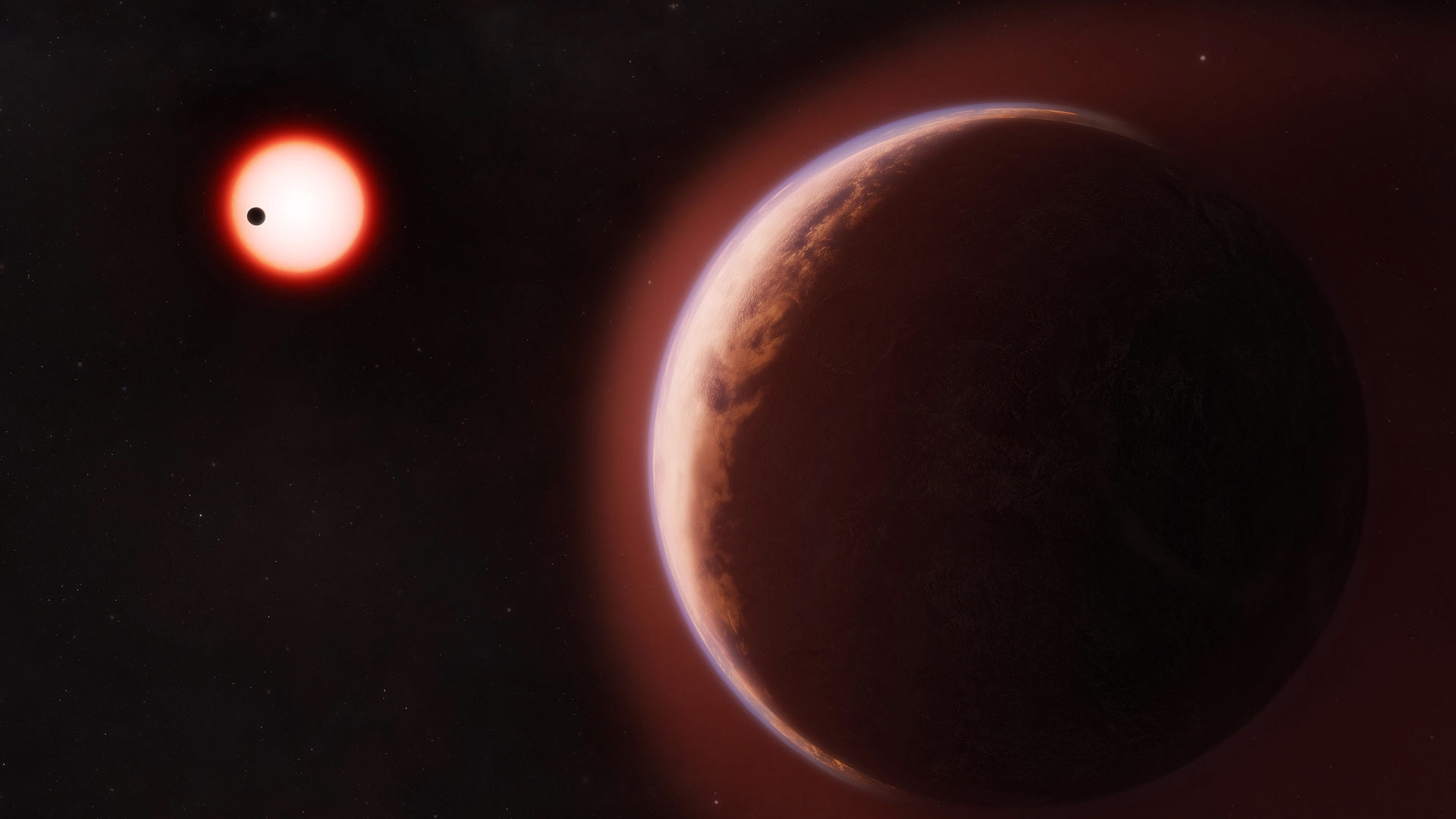
Quick Summary: Astronomers have directly detected helium in the atmosphere of LHS 1140 b, an Earth-like rocky exoplanet. The finding marks one of the first direct confirmations of an atmosphere around any rocky exoplanet. Even more intriguingly, the planet lies within its star’s habitable zone, making it a compelling candidate in the search for worlds that could host liquid water.
Why is LHS 1140 b exciting the scientific community?
One of the biggest challenges in the search for life beyond Earth is not simply finding a rocky planet. The real challenge is determining whether that planet has an atmosphere and whether its surface conditions could support life.
That is why the latest results from LHS 1140 b are drawing so much attention. Researchers announced that they have directly detected helium in the atmosphere of this rocky planet, located 48 light-years away. Study lead author Collin Cherubim, who recently completed his doctorate at Harvard University, says the discovery still feels surreal to him.
“We directly detected helium in the atmosphere, making this one of the first direct atmospheric detections for any rocky exoplanet. The fact that the planet is located in the habitable zone makes it especially exciting from the perspectives of astrobiology, habitability, and the search for life.”
This statement captures the significance of the discovery. Thousands of exoplanets have been found, but confirmed rocky worlds with directly verified atmospheres remain exceptionally rare.

What kind of world is this planet?
LHS 1140 b was first discovered in 2017. It is an exoplanet beyond our Solar System and orbits its star within the region known as the habitable zone.
The habitable zone refers to the range of distances where temperatures could theoretically allow liquid water to exist on a planet’s surface. Of course, being in the habitable zone alone does not guarantee life. Factors such as atmospheric composition, magnetic fields, chemistry, and stellar activity also play crucial roles.
Even so, LHS 1140 b appears to meet several important criteria at once. Its rocky nature resembles that of Earth. There is now strong evidence that it possesses an atmosphere. Its distance from its star also leaves open the possibility that liquid water could exist.
For these reasons, some researchers consider it one of the most promising exoplanet candidates discovered so far.
Recent exoplanet studies have produced a series of fascinating results. For example, research suggesting that sub-Neptune planets may hide magma oceans is reshaping ideas about planetary evolution. LHS 1140 b, meanwhile, sits at the heart of the habitability debate.
Why is helium in the atmosphere important?
Detecting an exoplanet’s atmosphere can be even more difficult than detecting the planet itself. The intense glare of the host star tends to overwhelm atmospheric signals.
By directly observing helium in the atmosphere, researchers demonstrated that the planet possesses a gaseous envelope. Helium is not a direct indicator of life. In fact, it exists only in trace amounts in Earth’s atmosphere.
The key point, however, is not the specific gas itself but the confirmation that an atmosphere exists. Atmospheres can shield planets from stellar radiation, regulate temperatures, and help liquid water remain stable over long periods.
In other words, without an atmosphere, the chances of habitability decrease dramatically. Mars provides a well-known example. Scientists believe it once had a much thicker atmosphere before losing most of it over time.
The fact that LHS 1140 b appears to have retained its atmosphere is one of the main reasons it has attracted so much scientific interest.

What do the numbers tell us?
The key data released so far can be summarized as follows:
| Parameter | Value |
|---|---|
| Planet Name | LHS 1140 b |
| Distance from Earth | 48 light-years |
| Year of Discovery | 2017 |
| Planet Type | Rocky exoplanet |
| Gas Detected in Atmosphere | Helium |
| Orbital Location | Habitable zone |
Even this table alone helps explain why the planet is considered special. Its relatively close distance is a major advantage for future, more detailed observations.
Does this discovery mean life has been found?
No. At least for now, that conclusion cannot be drawn.
Scientists have not announced the discovery of life. There have been no reports of oxygen, methane, or complex chemical imbalances that might indicate biological activity. At present, the confirmed result is the detection of helium in the atmosphere.
Even so, the discovery is extremely valuable. The first step in the search for life is identifying promising targets, and LHS 1140 b has now become one of them.
The James Webb Space Telescope and future next-generation observatories may be able to search for additional atmospheric gases. If water vapor, carbon dioxide, or other compounds are confirmed, the picture could become even more intriguing.
The mysteries of space extend far beyond planets. Our recent article on the discovery of long-sought black holes in Omega Centauri is another reminder of how many surprises the universe still holds.
What observations come next?
LHS 1140 b now appears likely to become one of astronomy’s highest-priority targets. With the atmosphere confirmed, the next question is how complex that atmosphere really is.
Researchers will want to study its thickness, temperature, and chemical composition in greater detail. If ocean-like regions exist on the surface, or if atmospheric traces linked to water are found, assessments of the planet could change dramatically.
Perhaps the most exciting aspect is that LHS 1140 b is relatively nearby. While 48 light-years sounds immense, it is considered an accessible target by exoplanet research standards.
To see how new technologies are transforming space exploration, one only needs to look at developments showing how NASA’s Artemis III lander tests are shaping future Moon missions. As our instruments improve, we gain increasingly detailed knowledge of distant worlds.

A new milestone in the search for life?
Some discoveries in science do not immediately answer our questions. Instead, they help us ask better ones. The atmosphere of LHS 1140 b may be one of those discoveries.
Today, we have no evidence of life. But we do have a rocky world in the habitable zone with a confirmed atmosphere. The combination of those three characteristics on a single planet is remarkably compelling.
Observations in the coming years could reveal whether LHS 1140 b truly possesses Earth-like conditions. It may ultimately become one of the strongest candidates in our effort to answer one of humanity’s oldest questions: Are we alone in the universe?
Sources
Frequently Asked Questions
Has life been discovered on LHS 1140 b?
No. Researchers have not found life. So far, only the presence of helium in the atmosphere has been confirmed.
Why is this planet considered potentially habitable?
The planet orbits within its star’s habitable zone, where temperatures could allow liquid water to exist.
Is helium in the atmosphere a sign of life?
No. Helium is not a direct biological indicator. However, it is important because it confirms the existence of an atmosphere.
Editor’s Perspective: Exoplanet headlines appear regularly, but this discovery stands apart. Directly confirming an atmosphere around a rocky world in the habitable zone transforms the search for life from an abstract concept into a measurable scientific objective. For anyone wondering whether worlds like our own exist elsewhere in the cosmos, LHS 1140 b looks set to remain a major topic of discussion for years to come.
Bir Yorum Yazın