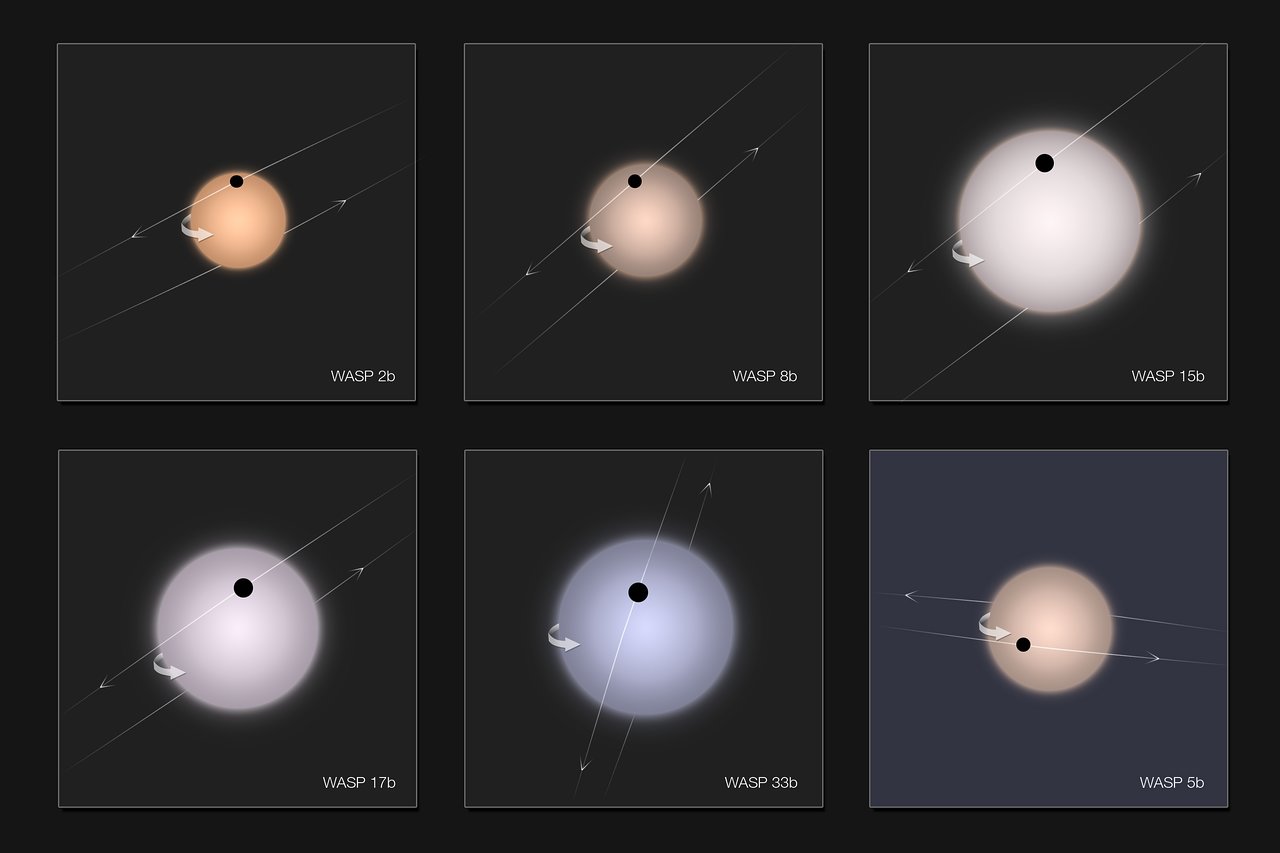
Quick Summary: Astronomers have discovered that GJ 3090 b, an exoplanet located 73 light-years from Earth, orbits its star in the exact opposite direction of the star’s rotation. This unusual behavior challenges current theories of planet formation, and how the planet ended up on such a “rebellious” orbit remains a major mystery.
A Planet Orbiting Its Star Backwards: GJ 3090 b
Space never ceases to amaze us. This time, the surprise comes from an exoplanet orbiting a small, cool red dwarf star about 73 light-years away. This world, named GJ 3090 b, orbits its star in such a way that it behaves like a rebel: It moves in the exact opposite direction of the star’s rotation.
This is truly baffling. According to all known models of planet formation, a planet’s orbit should align with the rotation direction of the star it formed from. So why is GJ 3090 b so different? The answer to this question highlights just how diverse and complex planetary systems in the universe can be.
The discovery was made by an international team led by researchers from the Astronomy Department at the University of Geneva (UNIGE) in Switzerland. Their findings show that the planet’s unusual orbit makes it one of the most extraordinary planets we’ve ever discovered.

How Does Such a Backward Orbit Form?
Planets are born from the vast disks of gas and dust that surround young stars. The material in these disks rotates in the same direction as the young star at the center. Therefore, planets forming from this disk are expected to orbit in the same direction. This is a fundamental rule of the system, much like the spin of a top.
But nature doesn’t always follow the rules. Scientists know that a planet’s orbit can be tilted or even completely flipped by the gravitational influence of a neighboring star or a massive planet. Such “violent” gravitational interactions can fling a planet’s orbit around like a slingshot. This mechanism is known as the “Kozai-Lidov effect.”
Here’s the intriguing part: GJ 3090 b has no massive companion that could have caused such an interaction. No gas giant, no brown dwarf, no other star. This planet is like a lone warrior. So how did its orbit end up so reversed?
“To our great surprise, GJ 3090 b not only has a highly inclined orbit, but it also orbits in the opposite direction to its star’s rotation.”
What Are the Characteristics of GJ 3090 b?
Discovered in 2022, GJ 3090 b is a planet that can be classified as a “hot Neptune” or a “super-Earth.” It orbits very close to its star, resulting in extremely high surface temperatures. Here are some key characteristics of this planet:
| Parameter | Value |
|---|---|
| Distance | 73 Light-Years |
| Orbital Period | ~1.5 Days |
| Mass | ~3 Times Earth’s |
| Radius | ~1.5 Times Earth’s |
| Orbital Inclination | ~180° (Retrograde) |
This table summarizes just how unusual the planet is. Particularly, the 180-degree orbital inclination — meaning it orbits completely backwards — is its most defining feature. This suggests the planet may have had a very turbulent history after its formation.
Retrograde orbits like this have been observed before in the universe. For instance, some hot Jupiters are known to orbit opposite to their star’s rotation. However, what makes GJ 3090 b different is that it has such a small mass yet still occupies such an orbit. This shows that these orbital disturbances are not limited to giant planets.
Why Is This Discovery Important?
This discovery highlights how incomplete our knowledge of planetary system formation and evolution still is. If a small planet like GJ 3090 b can end up on such a retrograde orbit without the help of a massive companion, it means there might be other dynamic processes we’ve been overlooking in our planet formation models.
Researchers are considering several possible scenarios to solve this mystery. One involves magnetic fields or internal turbulence within the disk where the planet formed, which could have gradually flipped its orbit over time. Another scenario suggests the influence of a transient star or massive object that interacted with the system in the past but no longer exists.
Discoveries like this can also help us solve mysteries within our own solar system, such as the complex water systems on early Mars. Understanding the diversity of the universe gives us a broader perspective on how our own planet and system formed.

What Does the Future Hold?
GJ 3090 b’s unusual orbit has caught the attention of astronomers. In the coming years, more detailed observations with powerful observatories like the James Webb Space Telescope (JWST) could provide further insights into the planet’s atmosphere and formation history.
Combined with research in other areas, such as using ghost particles to predict supernovae, these discoveries help us build a more holistic picture of how the universe works. Each new finding reminds us of how dynamic and unpredictable space truly is.
The story of GJ 3090 b is living proof of how complex planetary systems can be and how many surprises are still waiting to be discovered. It also underscores the importance of investments in space exploration, as every new observation reshapes our understanding of the cosmos.

Frequently Asked Questions About GJ 3090 b
Why is GJ 3090 b’s orbit backwards?
The exact reason for GJ 3090 b’s retrograde orbit is still unknown. However, scientists believe that complex gravitational interactions in the past or dynamic processes in the disk where the planet formed could have caused this.
Could this planet harbor life?
Because GJ 3090 b orbits very close to its star, its surface temperature is likely extremely high and inhospitable for life as we know it. Therefore, it is not expected to support life.
Why is this discovery important?
This discovery shows that our theories of planet formation and evolution are still incomplete. The existence of such a planet proves how diverse planetary systems can be and that there are many more surprises waiting to be discovered in the universe.
From the Editor’s Desk: Reading about GJ 3090 b, I can’t help but think: the universe is a rebel that constantly breaks its own rules. This planet reminds us how little we know and how much we have yet to learn. Maybe that’s why space exploration is so thrilling — every new discovery shows just how fragile our current knowledge is.
Bir Yorum Yazın