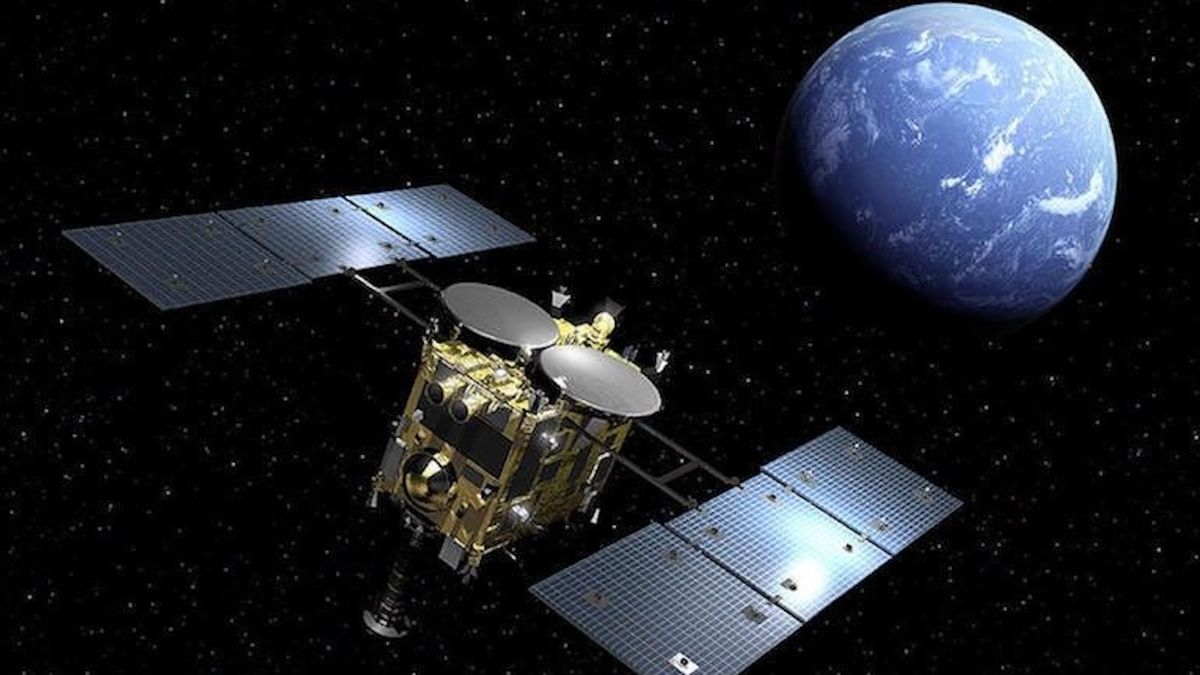
Quick Summary: JAXA’s Hayabusa2 spacecraft will pass within 1 to 10 kilometers of asteroid Torifune on July 5. The mission will test new reconnaissance methods designed to rapidly determine asteroid properties and could provide valuable data for future planetary defense strategies.
Why is Hayabusa2 back in the spotlight?
Japan Aerospace Exploration Agency’s (JAXA) famous Hayabusa2 spacecraft did not retire after completing its primary mission and delivering its sample capsule back to Earth. As it continues its long voyage through deep space, it is now preparing for a new and highly ambitious close flyby.
According to information reported by Space.com, Hayabusa2 will perform an extremely close pass of an asteroid named Torifune on July 5. During the encounter, the spacecraft will come within just 1 to 10 kilometers of the asteroid.
That may sound straightforward, but even on the scale of space, a distance of only a few kilometers is considered remarkably close. The spacecraft will accomplish this while traveling at several kilometers per second.
“We’re going to discover another beast to add to the zoo of asteroids.”
This striking analogy reflects how scientists describe the incredible diversity of asteroids. Every newly visited asteroid has the potential to reveal unexpected characteristics.
What is Hayabusa2’s ultimate target after this?
While the Torifune flyby is exciting, it is not the mission’s final destination. Hayabusa2’s extended mission aims to reach a tiny asteroid known as 1998 KY26 in 2031.
This asteroid is only about 11 meters wide. For comparison, a typical city bus would occupy a significant portion of that length.
If successful, 1998 KY26 will become one of the smallest asteroids ever visited by a spacecraft.
Even more intriguing, researchers are theoretically considering the possibility of attempting a landing on this tiny world. Such an effort would push the limits of operating on a celestial body with extremely weak gravity.
Projects like this always remind me of the quiet heroes of space exploration. While major rocket launches grab headlines, small spacecraft working for years in deep space can sometimes have an even greater scientific impact.
What has the spacecraft been doing during its long journey?
Hayabusa2 has not been idle during its extended mission. According to JAXA’s Satoshi Tanaka, the spacecraft has carried out a variety of scientific observations while traveling through deep space.
These include observations of zodiacal light and studies related to exoplanets. In other words, the spacecraft has continued producing science even while en route to its primary targets.
Although it briefly entered a protective safe mode last year, officials say its systems are generally performing well. That suggests one of the mission’s most significant challenges has already been overcome.
The ability of spacecraft to remain operational for decades is an impressive engineering achievement in itself. Fuel management, electronics durability, and communications infrastructure all play critical roles in making that possible.

How could this mission contribute to future asteroid defense?
Scientists are no longer interested only in discovering asteroids. They are also developing technologies that could one day allow humanity to respond to them if necessary.
To do that, we first need to understand the target. Two asteroids may look similar from the outside, yet have completely different internal structures.
The rapid reconnaissance approach that Hayabusa2 will test could shorten decision-making timelines in a potential threat scenario. A small scout spacecraft could be sent first to determine an asteroid’s characteristics, followed by the selection of the most effective defense strategy.
Just as the James Webb Space Telescope’s discoveries about the large-scale structure of the universe continue to raise new questions, James Webb’s observation of six galaxies gathered in a giant structure highlights the complexity of the cosmos. Asteroid research, meanwhile, represents a much closer and more practical side of that broader picture.
At the same time, the future of space missions depends on more than scientific instruments alone. Next-generation rockets and transportation systems are equally important. That is why developments such as Blue Origin’s New Glenn plans could help pave the way for more asteroid missions in the years ahead.
Sources
Frequently Asked Questions
Which asteroid will Hayabusa2 fly past?
The spacecraft will pass within 1 to 10 kilometers of asteroid Torifune on July 5, 2026.
How large is asteroid Torifune?
Scientists estimate that Torifune is approximately 450 meters wide.
What is Hayabusa2’s next major target?
The mission’s long-term objective is to reach asteroid 1998 KY26, which is about 11 meters in diameter, in 2031.
Editor’s Perspective: What fascinates me most about asteroid missions is how targets that seem tiny can open the door to enormous scientific questions. The Torifune flyby may last only a few minutes, but the experience gained here could one day help determine how we stop a celestial object threatening Earth.
Bir Yorum Yazın