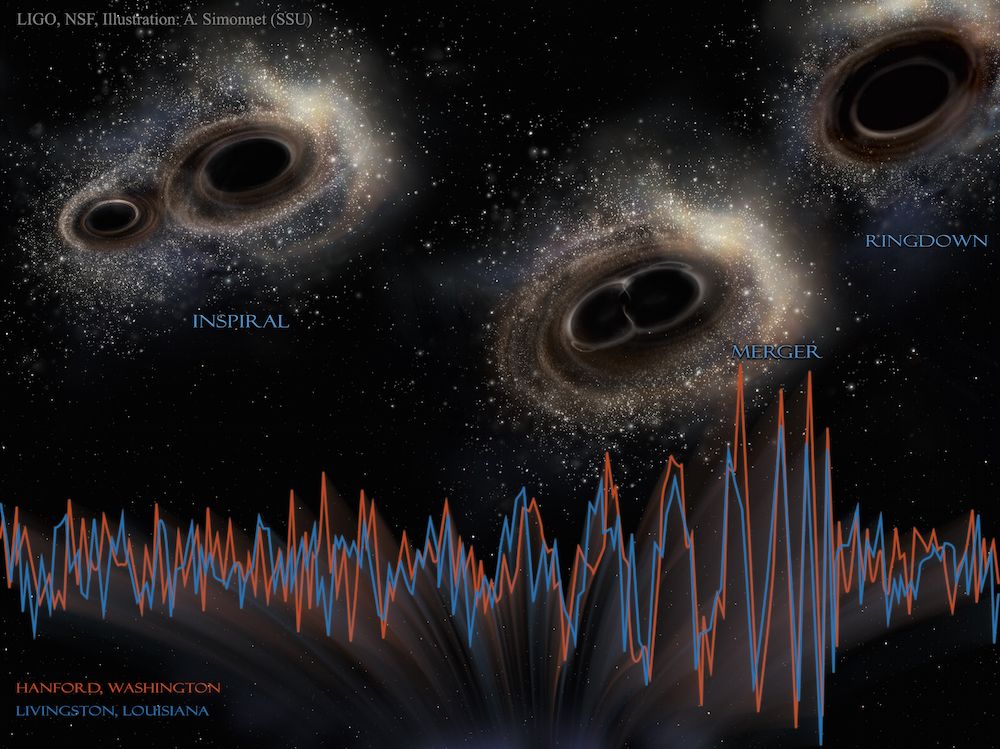
Quick Summary: Astronomers analyzing gravitational-wave data have found that merging black holes do not belong to a single population. New analyses point to three distinct subgroups across different mass ranges and suggest that some black holes may be the products of earlier mergers.
Are black hole mergers more complex than we thought?
The discovery of gravitational waves marked a turning point in our understanding of the universe. We can now do more than observe light—we can listen to ripples in spacetime itself. That ability is giving us access to information about colliding black holes that once seemed impossible to obtain.
New research highlighted by Phys.org does exactly that. Scientists reanalyzed the black hole mergers recorded so far and arrived at a striking conclusion: merging black holes do not appear to belong to a single family. The data suggest the existence of at least three distinct subpopulations.
At first glance, this may sound like a technical detail. In reality, it offers an important clue for understanding how black holes form, grow, and evolve within galaxies.

How did scientists find evidence for three distinct subgroups?
Researchers examined extensive datasets collected by gravitational-wave observatories using advanced statistical methods. They focused in particular on the mass distributions of merging black hole pairs.
The results revealed that black hole masses are not randomly distributed. Instead, they cluster within specific mass ranges, suggesting that different formation mechanisms may be at work.
One study found evidence for three separate subgroups of merging black holes distinguished by their primary masses. Another pointed to a scenario known as hierarchical mergers. In this picture, a black hole formed from an earlier merger later goes on to merge with yet another black hole.
In other words, some black holes are not born in a single step. They can emerge as the inherited products of previous mergers, adding new branches to a cosmic family tree.
What exactly is a hierarchical merger?
When a star dies, it can collapse into a black hole. For a long time, astronomers believed that most observed black holes formed this way. But as gravitational-wave catalogs expanded, some events began to challenge that simple picture.
This is where the idea of hierarchical mergers comes in. When two black holes merge, they create a larger black hole. If that new object remains in a dense star cluster or a region near a galactic center, it may later collide with another black hole.
If this process repeats several times, it can produce black holes far more massive than expected. Their spin rates and spin orientations can also leave distinctive signatures. Those are precisely the clues researchers are searching for.
Efforts to understand the origins of black holes have accelerated in recent years. Our earlier feature on a nearby feeding black hole that may shed light on the early universe also highlighted just how complex black hole evolution can be.
| Parameter | Value |
|---|---|
| Detected subpopulations | 3 |
| Dataset analyzed | GWTC-4 gravitational-wave catalog |
| Related scientific journal | Physical Review Letters |
| Leading scenario | Hierarchical black hole mergers |
| Research year | 2026 |

What does this discovery mean for us?
From a scientific perspective, the most exciting implication is the growing evidence that black holes are not all the same. If three distinct subpopulations truly exist, there may be multiple dominant mechanisms producing black holes throughout the universe.
This also affects models of galaxy evolution. How and where black holes form is closely tied to the development of star clusters. Mergers occurring in dense stellar environments leave different signatures from those originating in binary star systems.
Gravitational waves provide a unique tool here. Telescopes often cannot observe black holes directly, but the waves released during a merger allow us to measure the masses and spin properties of these otherwise invisible objects.
That is why some researchers describe gravitational waves as a kind of cosmic forensic tool. Long after an event has ended, the remaining signal preserves valuable clues about a black hole’s history.
What might we learn in the future?
The catalog we have today represents only the earliest years of gravitational-wave astronomy. Observatories such as LIGO, Virgo, and KAGRA are expected to detect many more mergers in upcoming observing runs.
As the number of events grows, statistical uncertainties will shrink. Researchers will be able to determine more clearly whether there are truly three subgroups—or whether even more categories emerge.
Future-generation observatories will also be capable of detecting weaker and more distant signals that remain beyond our reach today. That could open a window onto black hole populations formed in much earlier epochs of cosmic history.
The origins of extremely massive black holes remain one of astronomy’s major mysteries. Our previous report on the oldest known quasar in the universe showed how rapidly giant black holes could grow in the early cosmos. New gravitational-wave findings may help solve that puzzle.

Can we build a family tree for black holes?
This may be the most intriguing aspect of the research. If hierarchical mergers are common, it could become theoretically possible to reconstruct a kind of family tree for black holes.
A black hole’s spin, mass, and merger history are interconnected pieces of information. With enough data, scientists may be able to identify which objects are descendants of earlier mergers.
It may sound like science fiction, but gravitational-wave astronomy continues to push new boundaries every year. Just a few decades ago, the idea of directly listening to black hole mergers would have seemed like a bold prediction.
Progress in space exploration is not limited to observatories. The effort to develop more powerful tools continues as well. For example, Europe’s new super-heavy rocket concept designed to rival Starship is among the projects that could enable major scientific missions in the future.
The new study stands out as an important step in the long journey toward understanding the distribution of black holes throughout the universe. Researchers do not yet have all the answers, but the results suggest that the universe’s invisible inhabitants form a far more diverse population than previously imagined.
Sources
Editor’s Perspective: For years, black holes were often described as objects defined by just a handful of basic properties. Gravitational waves are showing us that every merger carries a unique history. What excites me most is the possibility that we may one day reconstruct black hole family trees—because that would mean beginning to read the hidden history of the universe itself.
Frequently Asked Questions
What do the three subpopulations represent?
They refer to statistical signals indicating that the mass distribution of merging black holes can be divided into three distinct groups.
What is a hierarchical merger?
It is a process in which a black hole formed from an earlier black hole merger later participates in another merger.
Why are gravitational waves important?
They allow scientists to measure the masses and spin properties of black holes that emit no light.
Bir Yorum Yazın