Quick Summary: Scientists studying 4.6-billion-year-old meteorite dust collected from Antarctica have discovered that magnetic fields also played a critical role in the Sun’s formation. These magnetic fields, found to be 12 times stronger than Earth’s, helped transport gas in the protoplanetary disk toward the star.
Baby Photo of the Sun: What Do 4.6-Billion-Year-Old Dust Grains Reveal?
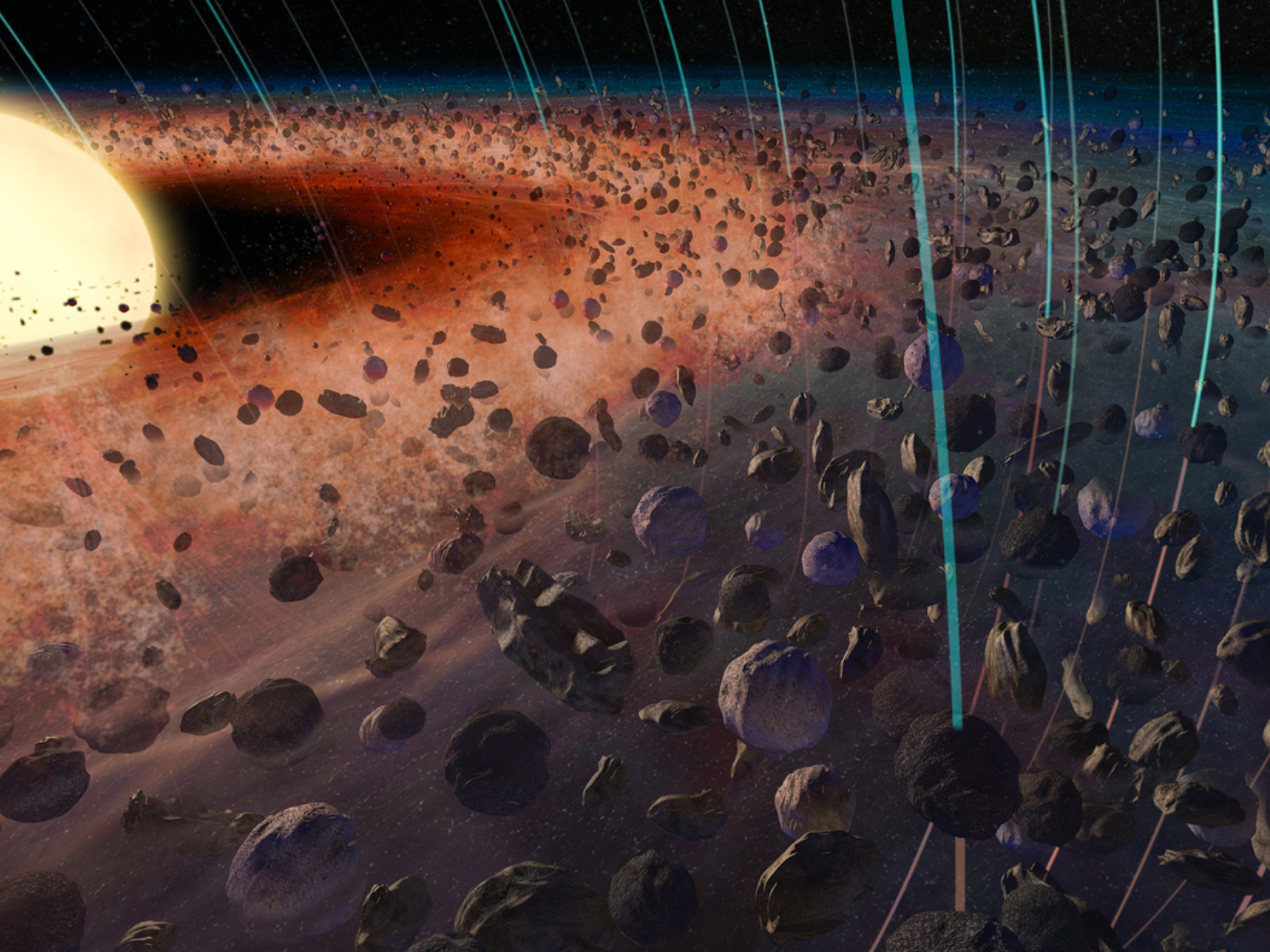
The birth of the Solar System is one of the most fascinating processes in the universe. About 4.6 billion years ago, a massive cloud of gas and dust—what astronomers call a solar nebula—began to collapse inward. Following this collapse, the cloud flattened into a rotating, donut-shaped disk with a young star emerging at its center. Planets formed from particles in this dusty disk that gradually stuck together.
But what truly drove this process? Until now, the scientific community believed gravity was the primary architect of this early period. However, new research adds an unexpected player to the picture: magnetism. And the evidence for this claim lies hidden in tiny dust grains within a meteorite recovered from Antarctica’s glaciers.

A 4.6-Billion-Year-Old Letter from Antarctica
The protagonist of this story is a meteorite named DOM 08006. Discovered in Antarctica in 2008, this rock contains some of the oldest materials in the Solar System. When researchers examined the dust grains inside the meteorite, they noticed these grains carried traces of magnetic fields. These traces indicate that the magnetic field present during the Solar System’s formation was a full 12 times stronger than Earth’s magnetic field.
This finding raises several questions for scientists. Magnetic fields are powerful forces capable of influencing the motion of gas and dust clouds. So, what role did this strong field play in the young Sun’s formation?
How Did Magnetic Fields Help the Star Grow?
According to Borlina, one of the study’s authors, the role of these magnetic fields was crucial. Gravity pulls gas and dust toward the central star, but due to angular momentum, some of this material can be ejected outward. This is where magnetic fields come into play. Borlina says, “We think these kinds of magnetic fields helped transport gas from the protoplanetary disk inward toward the central star,” adding, “Gravity is also playing a role. But we are now showing that, if you want to fully understand how the sun and planets formed, you should include magnetic fields in the ingredients that make them.”
In other words, the magnetic field acted like a funnel, potentially accelerating the flow of gas from the disk toward the star. This allowed the Sun to gain mass more quickly, thereby setting the stage for planet formation.

Why Does This Discovery Matter to Us?
This study not only illuminates the Sun’s past but also helps us understand how other star systems form in the universe. If magnetic fields play such a critical role in star formation, it’s likely that other planetary systems have undergone similar processes. This could mean the number of habitable planets may be greater than previously estimated.
Moreover, these findings indicate that computer models simulating star formation need to be updated. Models must now account for the influence of magnetic fields. This suggests that future research will be even more exciting.
| Parameter | Value |
|---|---|
| Meteorite Name | DOM 08006 |
| Discovery Location | Antarctica (2008) |
| Age | 4.6 Billion Years |
| Magnetic Field Strength | 12 Times Earth’s |
| Published Journal | Proceedings of the National Academy of Sciences |
What Do We Know About the Formation of the Solar System?
The formation of the Solar System began about 4.6 billion years ago with the collapse of a molecular cloud. Matter concentrated at the center of this cloud formed the Sun, while the remaining material around it gave rise to planets, asteroids, and comets. This process took millions of years, with planets growing as dust grains in the disk stuck together.
However, many questions remain unanswered. For example, how the material needed for planet formation was distributed in the disk is still not fully understood. This new study shows that magnetic fields influenced this distribution, potentially speeding up planet formation. This could fundamentally change our understanding of the Solar System’s formation.

How Does This Discovery Affect Our Understanding of Other Star Systems?
When studying distant star systems, astronomers often focus on protoplanetary disks. The structure and evolution of these disks are seen as key to planet formation. If magnetic fields played such a decisive role in the Solar System’s formation, similar effects are expected in other systems. This could change how astronomers interpret their observations.
For instance, some peculiar structures observed in disks around young stars (such as rings, gaps, etc.) have been attributed to planet formation. However, magnetic fields might also play a role in creating these structures. While this makes the job of planet hunters a bit more challenging, it also opens the door to new discoveries.
How Did Scientists Reach These Conclusions?
The research team analyzed dust grains from the DOM 08006 meteorite using highly sensitive instruments. The magnetic minerals within these grains record the direction and strength of the magnetic field from the time they formed. Just as a compass needle points to a magnetic field, these minerals carry traces of the magnetic field from billions of years ago.
This technique, known as “paleomagnetism,” is typically used to study Earth’s history. However, this study demonstrated that it can also be applied to understand the formation of the Solar System. This means more meteorites can be examined using similar methods in the future.
What’s Next? What Do Future Studies Aim For?
While this study expands our knowledge of the Solar System’s formation, many questions remain. For example, how much influence magnetic fields had on planet formation and how these fields changed over time will be primary focuses of future research. Additionally, the extent to which these findings can be applied to other star systems is a topic of interest.
Scientists hope that next-generation observatories, especially NASA’s Roman Space Telescope, will be able to observe the effects of magnetic fields directly by studying such disks in greater detail. This could usher in a new era in understanding the Solar System’s formation. We previously covered NASA’s Roman Telescope’s launch to illuminate the dark universe and JWST’s studies tracking planet formation; these new observations are a continuation of that work.
“Gravity is also playing a role. But we are now showing that, if you want to fully understand how the sun and planets formed, you should include magnetic fields in the ingredients that make them.”
— Borlina, Lead Author of the Study
Conclusion: The Sun’s Birth Story Is Being Rewritten
This discovery shows how incomplete our understanding of the Solar System’s formation has been. The role of magnetic fields must now be incorporated into all future star formation models. This will allow us to paint a more realistic picture of “star births,” a topic often featured in science fiction films.
On the other hand, this study reminds us once again how complex and interconnected the universe is. Gravity, magnetism, and many other forces worked together to build the order we live in. Such discoveries will continue to shed light on both our past and our future.
From the Editor’s Desk: This study is like a letter from the depths of space. Being able to read a process that happened 4.6 billion years ago from inside a rock in Antarctica is truly breathtaking. The role of magnetic fields in star formation reminded me once again what an engineering marvel the universe is. These findings will help us understand not just the Sun, but perhaps the formation of billions of stars across the cosmos. I hope this discovery inspires young astronomers and encourages more people to explore these mysterious processes.
Frequently Asked Questions
How significant is the role of magnetic fields in the Sun’s formation?
According to new research, magnetic fields may have played a critical role alongside gravity by helping transport gas in the protoplanetary disk toward the star. This could have allowed the Sun to gain mass more quickly.
Which meteorite was this discovery made on?
The discovery was made on a meteorite named DOM 08006, found in Antarctica in 2008. The dust grains inside the meteorite carry traces of the magnetic field from 4.6 billion years ago.
How does this study affect our understanding of other star systems?
This study suggests that magnetic fields may play a universal role in star formation. This could change how we interpret disk structures observed in other star systems and necessitate updates to planet formation models.
Bir Yorum Yazın