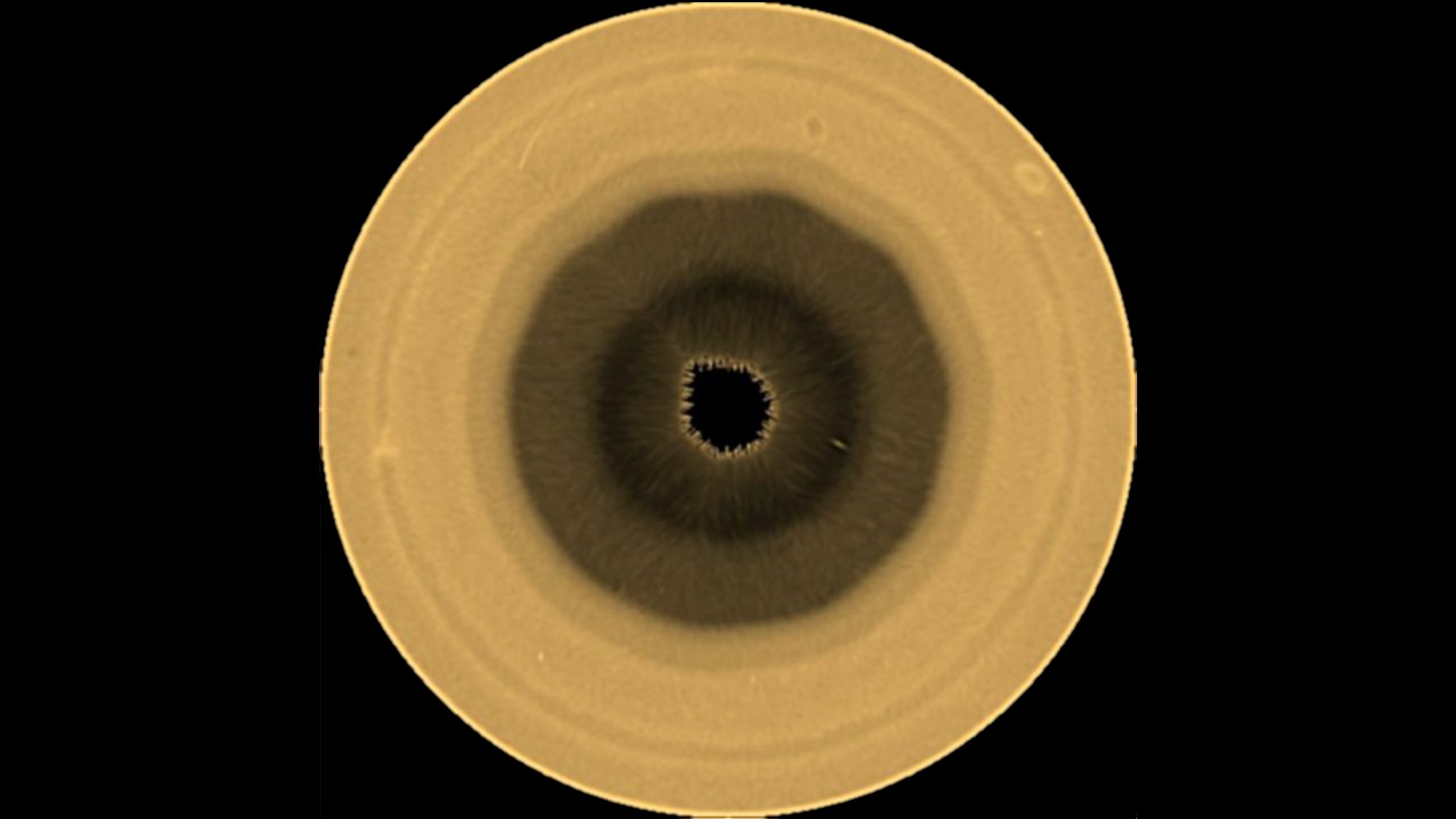
Quick Summary: Astronomers have discovered a massive 10-sided (decagonal) cloud structure at Saturn’s south pole, spanning approximately 167,820 kilometers. Revealed in 2023 images from NASA’s Hubble Space Telescope, this structure shows that the known hexagonal cloud at the north pole is not unique. So how did this mysterious formation come about?
An Unprecedented Formation at Saturn’s South Pole
Saturn, the most striking planet in the Solar System, continues to astonish scientists with its atmosphere as much as its rings. A new study published recently has revealed the existence of a colossal structure never seen before at the planet’s south pole: a giant 10-sided cloud pattern. This discovery shows that the long-known hexagonal cloud at Saturn’s north pole is not, in fact, unique in the universe.
The team, led by planetary scientist Agustin Sanchez-Lavega from the University of the Basque Country in Spain, noticed this surprising structure while examining images taken by NASA’s Hubble Space Telescope in 2023. Sanchez-Lavega described the discovery as “a definite surprise”. Since the day they discovered the northern hexagon, the research team had been searching for a similar formation at the south pole, but until now, they had found no trace.
What Do We Know About Saturn’s Atmosphere?
Saturn’s atmosphere boasts one of the most dynamic and complex structures in the Solar System. The planet’s rapid rotation and internal heat generate violent winds and massive storms in its atmosphere. The hexagonal structure at the north pole was first discovered by the Voyager spacecraft in the 1980s. Since then, it has been continuously observed by the Cassini mission and ground-based telescopes.
This new discovery shows that Saturn’s atmospheric dynamics are far more complex than previously thought. The presence of polygonal cloud structures at both poles suggests that such formations may be a common phenomenon in Saturn’s atmosphere. This could necessitate a revision of atmospheric physics models.
Sanchez-Lavega and his team plan to conduct further observations to understand how this structure changes over time and why it has 10 sides. In particular, a better understanding of the physical processes behind the formation of such polygonal structures could also shed light on atmospheric phenomena on Earth, such as jet streams and hurricanes.
While this discovery expands our knowledge of Saturn’s atmospheric behavior, it also serves as a reminder of how diverse and surprising planetary atmospheres in the universe can be. Next-generation observatories, such as NASA’s Roman Telescope, a dark universe hunter, will allow us to study such atmospheric phenomena in much greater detail in the future.
Why Is This Discovery Important?
This discovery provides significant insights not only about Saturn but also about atmospheric science in general. Polygonal cloud structures arise from the complex interactions of jet streams and vortices in planetary atmospheres. Understanding such structures can help us better model weather systems on Earth and the impacts of climate change.
Moreover, this discovery demonstrates just how dynamic Saturn’s atmosphere is and how many secrets it still holds waiting to be uncovered. Future observations will more clearly reveal how this 10-sided structure formed and how it evolves over time.
Scientists plan to investigate whether similar atmospheric phenomena occur on other gas giants (Jupiter, Uranus, Neptune). If these structures are common, it could fundamentally change our theories about the evolution of planetary atmospheres.
In conclusion, the 10-sided cloud structure discovered at Saturn’s south pole is a testament to how diverse and astonishing atmospheric phenomena in the Solar System can be. This discovery also underscores the importance of next-generation observatories like NASA’s Roman Telescope in studying such events.
From the Editor’s Desk: The hexagonal structure at Saturn’s north pole has fascinated me for years, and now a 10-sided cousin popping up in the south is truly mind-boggling. This discovery shows how little we know about the universe and how every new observation can surprise us. I hope one day we can fully understand the formation of these structures, because it will not only change our view of Saturn but also the very foundations of atmospheric science.
Frequently Asked Questions
What is the 10-sided structure discovered at Saturn’s south pole?
It is a massive cloud pattern located at Saturn’s south pole, approximately 167,820 km wide. This 10-sided structure was discovered in 2023 images from the Hubble Space Telescope.
Why wasn’t this structure seen before?
Due to Saturn’s axial tilt, the southern hemisphere was not visible from Earth from 2012 to 2023. Therefore, the structure could only be revealed with Hubble’s 2023 observations.
Why is this discovery important?
This discovery shows that the hexagonal structure at Saturn’s north pole is not unique. Such polygonal cloud structures are thought to help us learn more about atmospheric dynamics.
Bir Yorum Yazın