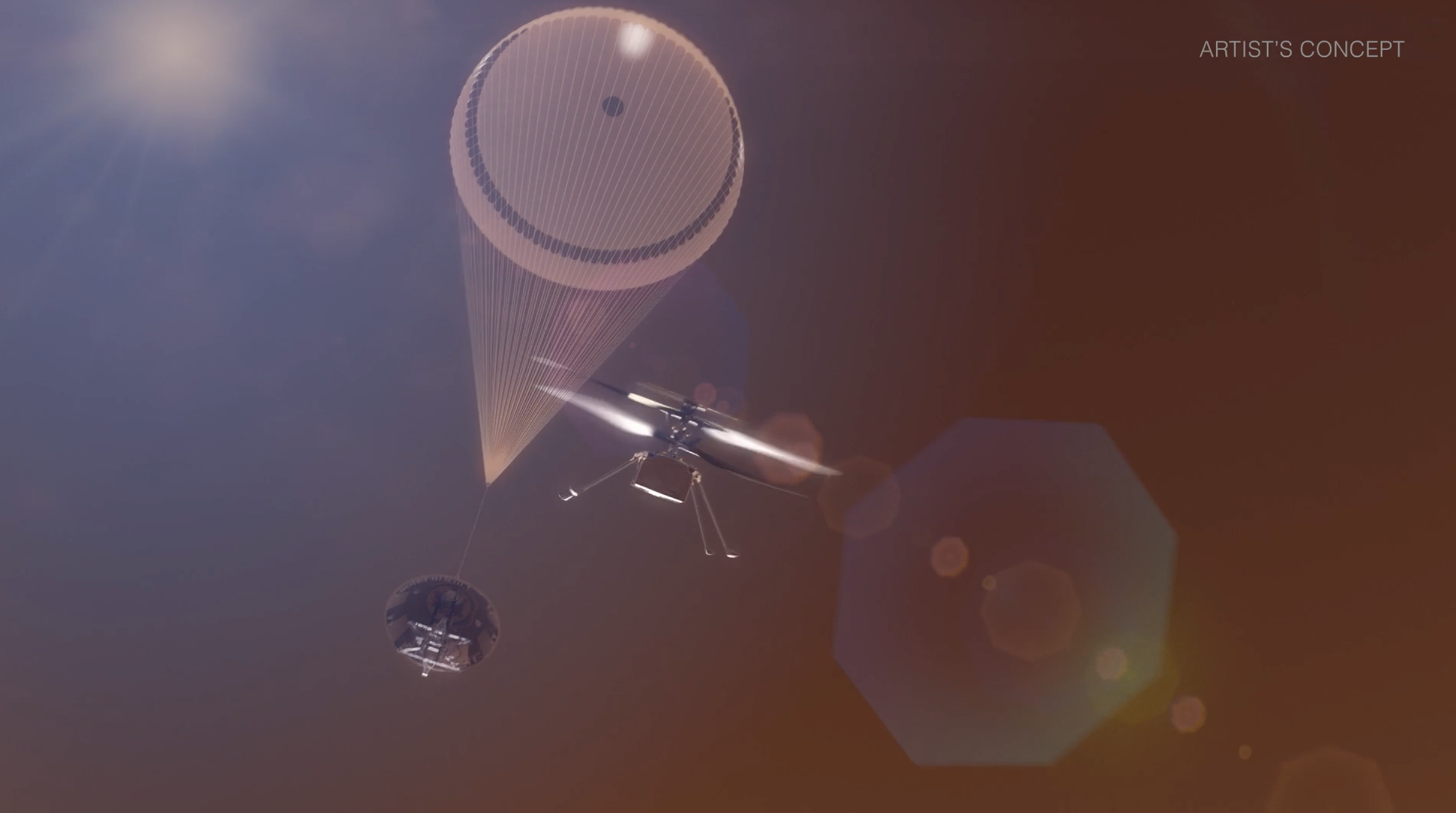
Quick Summary: NASA has awarded a key contract for its Skyfall mission, which is targeted for Mars in 2028. The mission will carry three helicopters, and the spacecraft will be protected during atmospheric entry by a specialized aeroshell. Skyfall could become NASA’s first nuclear-powered interplanetary spacecraft.
Why is NASA’s Skyfall mission attracting attention?
The idea of using helicopters for Mars exploration is no longer just an experiment—it is evolving into a new way of conducting planetary science. The biggest reason is the extraordinary performance of Ingenuity, which far exceeded expectations.
NASA now wants to build on that success. The agency has officially launched the hardware development phase for its new Mars mission, Skyfall. According to information reported by Space.com, NASA awarded Firefly Aerospace a $13 million subcontract to design and manufacture the mission’s protective aeroshell system, one of its most critical components.
This system will shield the spacecraft as it enters the Martian atmosphere at high speed. Given the extreme heat and aerodynamic forces encountered during descent, this component could play a decisive role in the mission’s success.
Even more intriguing is that Skyfall is being planned as NASA’s first nuclear-powered interplanetary spacecraft. If development stays on schedule, the mission will begin its journey to Mars in 2028.

So what exactly will Skyfall do on Mars?
Information released so far indicates that the mission will be centered around three helicopters. Their design is heavily inspired by Ingenuity.
Ingenuity arrived on Mars alongside the Perseverance rover and proved that controlled flight was possible in the planet’s thin atmosphere. Originally expected to complete only a handful of flights, it remained operational far longer and provided scientists with valuable data.
Skyfall is being built on that experience. Using three separate helicopters could allow researchers to explore wider areas without relying on a single aircraft. It also provides redundancy, enabling the mission to continue even if one vehicle encounters problems.
Steep slopes, crater walls, and regions that wheeled rovers struggle to reach are among the most promising targets for aerial exploration. For that reason, it would not be surprising to see helicopters become far more common in future Mars missions.
Just as the Webb Space Telescope opened new doors by studying the universe from a different perspective, James Webb’s fourth anniversary marked with an image of Centaurus A reminds us how new observation techniques can drive major scientific breakthroughs. A similar transformation may be underway for Mars helicopters.
Why was Firefly Aerospace selected?
Firefly Aerospace has become an increasingly familiar name in recent years, particularly through its lunar missions and rocket development programs. NASA’s choice reflects more than a manufacturing decision—it signals confidence in the company’s track record.
Firefly plans to apply engineering experience gained from its Blue Ghost lunar lander project to Skyfall. Technical expertise from its Alpha and Eclipse rocket programs will also contribute to the effort.
“With our Blue Ghost lunar mission, we demonstrated that we can carry out off-world missions at lower cost and on shorter timelines. We are now applying that experience and our proven technologies to reduce costs and accelerate missions to the Moon, Mars, and beyond.”
The statement came from Ray Allensworth, Firefly’s Vice President of Spacecraft. It suggests the company aims to be more than a supplier and hopes to take on larger roles in future deep-space missions.

What do the mission’s numbers tell us?
Not all of the mission’s technical details have been released yet. Even so, the available figures provide useful clues about the scale of the project.
| Parameter | Value |
|---|---|
| Planned launch year | 2028 |
| Number of helicopters headed to Mars | 3 |
| Firefly contract value | $13 million |
| NASA management center | JPL (California) |
| Mission type | Nuclear-powered interplanetary spacecraft |
The three-helicopter concept stands out in particular. Mars missions are often designed with redundancy in mind. Multiple aircraft could reduce risk while also increasing the amount of scientific data collected.
In space exploration, seemingly small technical decisions can sometimes have major consequences. The discovery of a hidden planet in TESS data through the application of Einstein’s theories is a good example. We discussed a similar case in our earlier article, The planet hidden in TESS data revealed thanks to Einstein.
Why is nuclear power attractive for Mars missions?
Mars is farther from the Sun than Earth, making solar panels less than ideal in some situations. Dust storms in particular can significantly reduce power generation.
Nuclear power systems, by contrast, can provide long-lasting and more stable energy. NASA has previously relied on radioisotope power systems for missions such as Curiosity and Perseverance.
Skyfall’s nuclear-powered design could help the mission operate longer and perform effectively under more challenging conditions. Details on how this will be implemented are expected to become clearer in the coming years.
An important advantage of this approach is the expansion of exploration capabilities. More power means more communications, more data, and more operational flexibility.

Could this mission change the future of Mars exploration?
Until now, Mars exploration has relied primarily on rovers. Aircraft, however, offer an entirely different perspective. A flight lasting only a few minutes can survey kilometers of terrain.
If a three-helicopter mission proves successful, future concepts could include larger aircraft or even autonomous exploration fleets. Scientists may gain the ability to study difficult-to-access regions in far greater detail.
This also serves as a valuable test for future crewed missions to Mars. Mapping surface conditions from the air before humans arrive could provide significant advantages.
As the methods used in the search for life continue to diversify, exciting discoveries are emerging. Studies such as the recent super-Earth discovered just 25 light-years away show how different technologies can drive major scientific advances.
Skyfall has not yet begun its journey. However, NASA’s decision to initiate funding and hardware development shows that the mission is moving beyond the concept stage and becoming a tangible project.
Sources
NASA Jet Propulsion Laboratory
Editor’s Perspective: I still remember watching Ingenuity’s first flight; seeing rotor blades spin on another world felt like something out of science fiction. To me, Skyfall’s three-helicopter approach signals the beginning of a new era in Mars exploration. If the mission succeeds, future maps of Mars may be shaped largely by data gathered from the skies above the Red Planet.
Frequently Asked Questions
When will the Skyfall mission launch?
According to NASA’s current plan, the mission will begin its journey to Mars in 2028.
How many helicopters will be part of the Skyfall mission?
The mission is expected to send three Ingenuity-inspired helicopters to Mars.
What is Firefly Aerospace’s role?
The company will design and manufacture the aeroshell system that protects the spacecraft during entry into the Martian atmosphere.
Bir Yorum Yazın