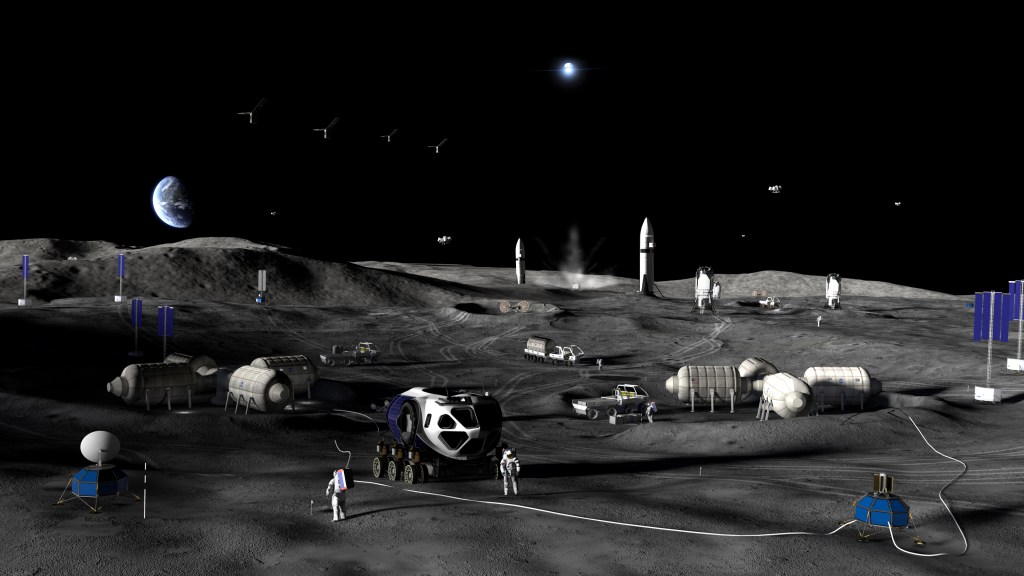
Quick Summary: NASA has announced that it will reveal the latest developments in its Moon Base project on June 30, 2026. Focused on the Moon’s south pole, the initiative aims to enable a permanent human presence on the lunar surface, expand scientific research, support commercial activities, and lay the groundwork for future crewed missions to Mars.
Why does NASA want to build a Moon Base?
NASA is preparing for a new era focused not on brief visits to the Moon, but on establishing a long-term human presence there. The agency’s Moon Base initiative is designed to move beyond short astronaut stays and toward regular missions supported by permanent infrastructure.
According to a NASA announcement published on June 24, 2026, the agency continues to develop systems that will make sustainable exploration activities on the lunar surface possible. Alongside scientific research, the project also places significant emphasis on economic and commercial opportunities.
NASA’s vision is quite clear. The Moon is no longer viewed simply as a destination to visit; it is increasingly seen as an operational hub where people can work, conduct research, and develop new technologies.
This approach appears to be an expanded version of the goals first outlined during the early years of the Artemis program. Establishing a permanent presence on the Moon will allow critical technologies to be tested in real conditions before humans are sent to Mars.

What new developments could NASA be about to announce?
NASA’s brief information release states that further details will be shared on June 30. The agency also confirmed that NASA Administrator Jared Isaacman will present updates directly during the virtual event.
Although technical details have not yet been disclosed, experts expect the announcement to focus on several key areas, including surface habitats, power systems, robotic support vehicles, and the utilization of lunar resources.
The Moon’s south pole has become a major focus for space agencies in recent years. The primary reason is the strong evidence suggesting the presence of water ice in some permanently shadowed craters. In the future, that water could provide drinking supplies as well as raw materials for producing oxygen and rocket fuel.
NASA’s concept artwork also highlights a variety of surface systems distributed across the south polar region. These systems are intended to support both human and robotic operations.
The idea of a lunar base is not new. However, many earlier concepts remained on paper due to technological and economic limitations. Today, the picture looks different thanks to reusable rockets, advanced life-support systems, and growing private-sector investment.
The rapid expansion of space infrastructure is an important part of this transformation. As we previously reported in SpaceX Launches 24 Starlink Satellites from California, orbital communications networks continue to grow. Future lunar missions are expected to benefit from similar communications infrastructure.
Why is the Moon’s south pole so valuable?
The Moon’s equatorial regions have been studied for decades. In contrast, the south polar region offers a number of particularly compelling opportunities.
Some craters there have not received sunlight for billions of years. As a result, scientists believe frozen water reserves may have been preserved within them. At the same time, nearby elevated areas receive sunlight for extended periods, providing advantages for power generation.
Together, these two factors create a highly attractive scenario. Access to water and solar energy ranks among the most fundamental requirements for sustaining a permanent human presence.
NASA’s Moon Base strategy is built around exactly this logic. Astronauts will not only conduct research there but also help establish the logistical foundation for future missions.

How will the Moon Base support future Mars missions?
NASA specifically emphasizes that lunar missions will form the foundation of the journey to Mars. The reasoning is straightforward.
Mars expeditions will require complex operations lasting months or even years. Humans will need to live in enclosed habitats for extended periods, manage resources efficiently, and work on a distant world.
The Moon provides a much closer testing ground. If a system fails, intervention is far easier than it would be on Mars.
For that reason, every power system, habitat module, and robotic vehicle deployed on the Moon also serves as a proving ground for future Mars technologies.
Looking at the history of space exploration, major achievements have typically occurred step by step. Humanity first reached low Earth orbit and then the Moon. Now the focus is shifting toward building permanent infrastructure.
Likewise, the development we previously covered in SpaceX Sends Its First Starfall Capsule Into Space highlighted the growing importance of technologies that support long-duration operations beyond Earth.
What we know about the project so far
Although NASA’s latest announcement is limited in technical detail, the key information released to the public can be summarized as follows.
| Parameter | Value |
|---|---|
| Announcement date | June 24, 2026 |
| Update event | June 30, 2026 |
| Event time | 2:30 PM EDT |
| Target region | Lunar South Pole |
| Primary objective | Permanent human presence and infrastructure |
| Supported activities | Scientific and commercial operations |
| Long-term goal | Crewed Mars missions |
This table may not seem particularly detailed from a technical perspective. However, NASA’s current release is only an initial progress announcement. More substantial details are expected during the virtual event.
What can we expect in the years ahead?
The success of the Moon Base project will not depend solely on NASA. International partners and private space companies are expected to play major roles as well.
Establishing regular transportation to the lunar surface, generating power, building communications networks, and constructing habitats is far too large a task for any single organization. As a result, numerous technology companies and research institutions are likely to become involved.
One of the most fascinating aspects of space exploration is its ability to produce unexpected discoveries. As seen in our earlier report, Meteorite Reveals a Lost Moon-Sized World, new technologies often lead to scientific findings that were never part of the original plan.
Permanent research centers on the Moon could lead to similar surprises. Geological investigations may provide new clues about the history of the early Solar System. Some scientists even believe that the Moon’s far side could one day become an ideal location for giant radio telescopes.

For now, one thing is certain: the Moon has once again become the center of the space race. This time, however, the goal is not simply to plant a flag. The objective is to establish a lasting presence and take the first steps toward humanity’s expansion throughout the Solar System.
Sources
Editor’s Perspective: The idea of a Moon Base feels like a new threshold in space exploration. Reaching the Moon was remarkable, but learning how to stay there is an entirely different challenge. If NASA succeeds, we may one day look back on this period as the true starting point of humanity’s journey to Mars.
Frequently Asked Questions
Where does NASA plan to build the Moon Base?
NASA considers the Moon’s south polar region its top target. The area is attracting attention because of its potential water ice reserves and favorable energy conditions.
What is the purpose of the Moon Base?
The goal is to establish a sustainable human presence on the Moon, expand scientific research, support commercial activities, and prepare for future Mars missions.
When will NASA share the new details?
According to NASA, the updates will be announced during a virtual event scheduled for June 30, 2026.
Bir Yorum Yazın