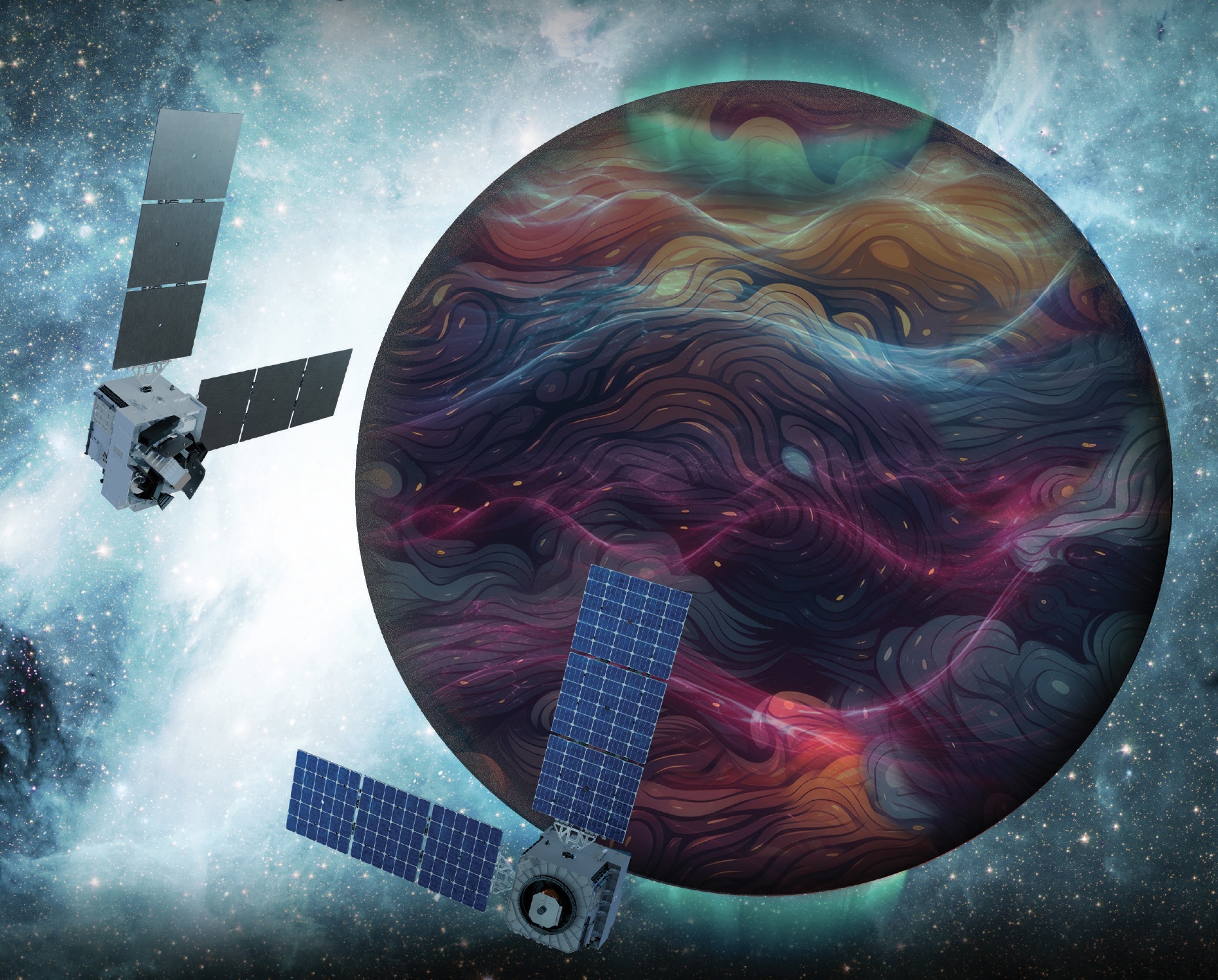
Quick Summary: With its new DAPHNE mission, NASA will investigate how solar-driven space weather events affect Earth’s atmosphere and ionosphere. By monitoring auroras, atmospheric waves, and energy transfer in the upper atmosphere, the mission aims to improve our understanding of processes that influence communications, navigation, and space operations.
Why is NASA launching a new space weather mission?
The Sun is more than just a star that provides light and heat. It continuously emits charged particles and magnetic fields, and occasionally unleashes powerful eruptions. Collectively, these phenomena are known as “space weather.”
NASA’s newly announced DAPHNE (Dynamic Atmosphere-Ionosphere Explorer) mission is focused on understanding how these space weather events affect Earth’s upper atmosphere. In particular, the mission centers on the complex interactions between the atmosphere and the ionosphere.
At first glance, this topic may seem far removed from everyday life. In reality, many technologies—from GPS systems and satellite communications to aviation operations and the movement of satellites in low Earth orbit—can be affected by space weather.

What exactly will the DAPHNE mission study?
Earth’s atmosphere is not a single layer. It consists of multiple regions extending from the surface into space. The ionosphere is a unique part of this system where electrically charged particles are abundant due to solar radiation.
Scientists have long studied how influences from space interact with natural processes occurring within the atmosphere. DAPHNE is designed to provide more detailed answers to this question.
Researchers will focus on several key areas:
- Changes occurring in the upper atmosphere during auroral activity
- The role of atmospheric waves in transporting energy
- Causes of variations in ionospheric density
- The effects of solar activity on the upper atmosphere
- Energy exchange between the atmosphere and the space environment
In NASA’s mission artwork, auroras and atmospheric waves are represented using different colors. This is no coincidence. The mission is specifically intended to reveal how these dynamic processes are interconnected.
How does space weather affect daily life?
When people hear the term space weather, most think only of the northern and southern lights. Its impacts, however, extend much further.
Powerful solar flares and coronal mass ejections can trigger disturbances in Earth’s magnetic field. These disruptions may interfere with radio communications, reduce GPS accuracy, and cause temporary issues for some satellite systems.
Satellites in low Earth orbit face another challenge. When solar activity increases, the upper atmosphere can expand. This rise in atmospheric density increases drag on satellites, causing their orbits to change more rapidly than expected.
For that reason, understanding space weather is about more than scientific curiosity. It is also closely tied to the reliability and security of modern technological infrastructure.

What scientific advances are expected from DAPHNE?
According to NASA, the mission will provide new observations that clarify the links between the atmosphere and the ionosphere. These data will help researchers better understand not only influences arriving from space, but also how waves generated within the atmosphere alter higher-altitude regions.
Space weather forecasting is still far less advanced than conventional weather prediction. One reason is the sheer complexity of the system. Solar activity, Earth’s magnetic field, atmospheric waves, and ionospheric processes all continuously influence one another.
Data from DAPHNE could improve the accuracy of these models. As a result, satellite operators, space agencies, and communications networks may benefit from more reliable forecasts in the future.
One particularly interesting aspect of the mission is that it focuses not only on space, but also on the atmosphere itself. Space weather research is often framed primarily around the Sun. DAPHNE instead treats Earth’s upper atmosphere as an active participant in the process.
Key facts about the mission
NASA has not yet released every technical detail, but the mission’s objectives and research priorities are already clear.
| Parameter | Information |
|---|---|
| Mission Name | DAPHNE (Dynamic Atmosphere-Ionosphere Explorer) |
| Agency | NASA |
| Announcement Date | June 18, 2026 |
| Research Area | Space weather and upper-atmosphere interactions |
| Primary Focus | Atmosphere and ionosphere |
| Phenomena Studied | Auroras, atmospheric waves, energy transfer |
| Expected Contribution | Improved space weather forecasts and atmospheric models |
Why is the relationship between the atmosphere and ionosphere so important?
The boundary between the atmosphere and the ionosphere is not as sharply defined as many people assume. Some waves that originate in lower atmospheric layers can travel hundreds of kilometers upward. Likewise, energy arriving from space can affect lower-altitude regions.
This two-way interaction has been studied for decades. However, existing observations are still insufficient to explain many details. DAPHNE’s new measurements may help fill those gaps.
During periods of intense auroral activity, enormous amounts of energy are released into the upper atmosphere. How that energy is distributed, where it becomes concentrated, and how it alters atmospheric structure remain active areas of research.
This is where DAPHNE becomes especially exciting. Rather than examining a single phenomenon in isolation, the mission seeks to study multiple interconnected physical processes within the same framework.

How could this mission contribute to future space activities?
Humanity is operating more satellites than ever before and planning increasingly complex missions. As lunar programs, commercial space stations, and new communications networks continue to expand, a better understanding of the space environment becomes increasingly important.
Even small improvements in space weather forecasting could deliver major economic and operational benefits. Reliable data are essential for maintaining satellite orbits, reducing communication disruptions, and improving precision navigation systems.
The information gathered by DAPHNE will not be useful only to scientists. As the space economy grows, these measurements could also play an important role in practical operational decision-making.
NASA’s new mission represents a significant step toward understanding the invisible connections between Earth and space. The auroras we see in the sky are more than a spectacular light show—they are the visible expression of a vast exchange of energy between the atmosphere and space. DAPHNE is preparing to reveal what happens behind the scenes.
Sources
- NASA – NASA Mission to Study Space Weather Impacts of Earth’s Atmosphere
- NASA Official Website
- NASA Heliophysics
Frequently Asked Questions
What is the primary goal of the DAPHNE mission?
The mission aims to understand energy transfer processes and atmospheric changes by studying the effects of space weather on Earth’s atmosphere and ionosphere.
Why is space weather important?
Space weather can affect GPS systems, satellite communications, radio transmissions, and certain space operations.
Will DAPHNE study auroras as well?
Yes. Auroras are among the key phenomena that will be investigated during the mission.
Bir Yorum Yazın