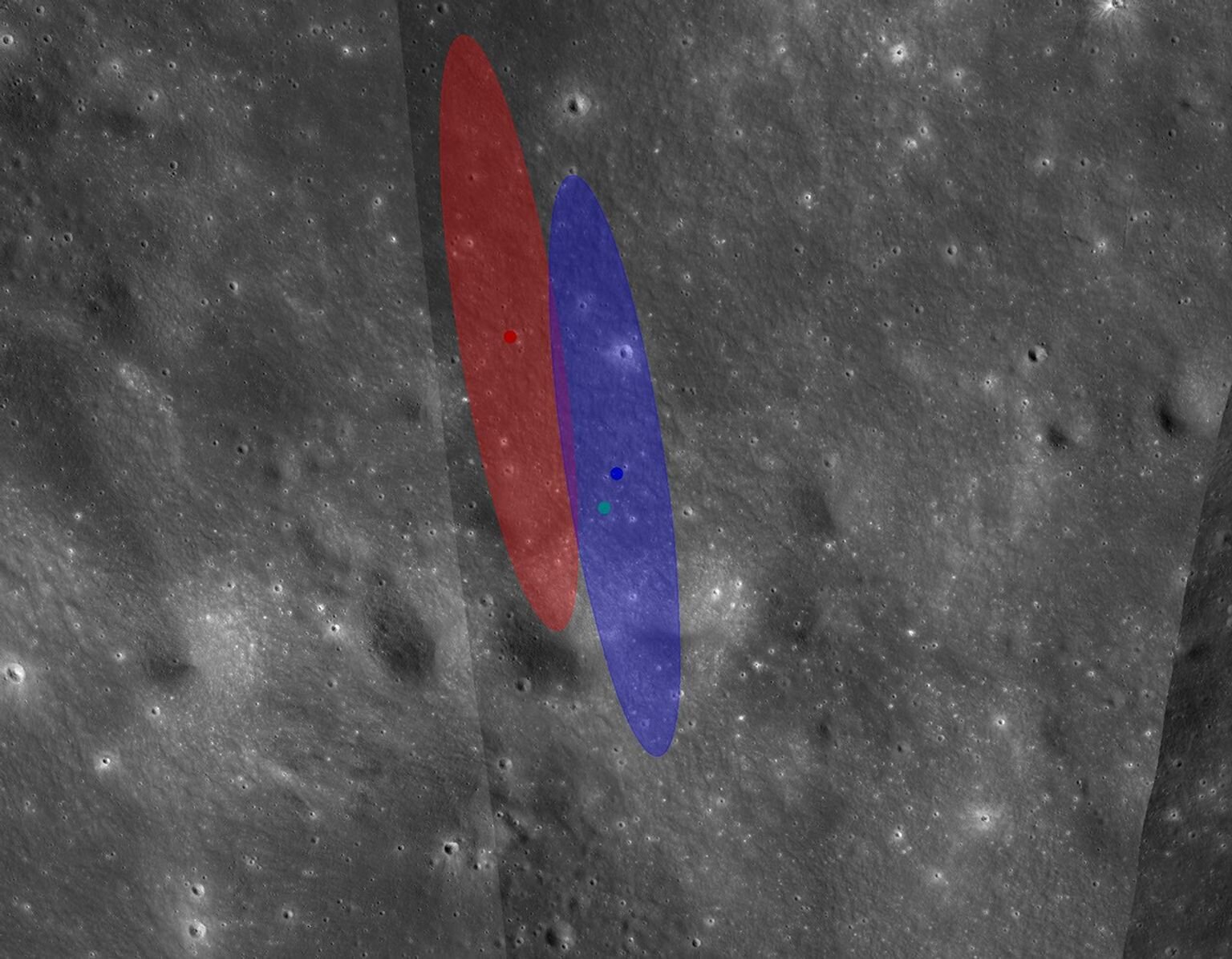
Quick Summary: NASA’s Lunar Reconnaissance Orbiter (LRO) imaged the crater formed when the upper stage of a SpaceX Falcon 9 rocket crashed into the lunar surface on August 5, 2026, capturing the images on August 11-12. The new images reveal detailed information about the crater’s size and structure resulting from the impact.
Rocket Debris Strikes the Moon: Falcon 9’s Unusual Journey
In space exploration, unexpected events sometimes offer unique opportunities for scientists. NASA’s Lunar Reconnaissance Orbiter (LRO) recently seized such an opportunity. The upper stage of a SpaceX Falcon 9 rocket, which had been out of control since the launch of the Firefly Blue Ghost 1 mission in January 2025, crashed into the lunar surface on August 5, 2026. This impact created a new crater on the Moon, and LRO managed to capture high-resolution images of it on August 11-12.
This event also highlights the serious issue of space debris. After completing its mission, the Falcon 9 upper stage drifted toward the Moon instead of returning to Earth. Space agencies and private companies must implement stricter measures to prevent such accidents. However, this incident provides scientists with a unique natural experiment to study the Moon’s geological structure.
Images captured by LRO’s Narrow-Angle Camera show the crater covering an area about a quarter mile wide. The images reveal detailed information about the crater’s structure and the distribution of material around it. This data could provide important clues about the composition of the Moon’s surface layers.
LRO’s Mission and Contributions to Lunar Research
The Lunar Reconnaissance Orbiter has been mapping the Moon’s surface in detail since 2009. The spacecraft measures surface topography, mineral composition, and radiation levels, providing crucial data to scientists. LRO’s Narrow-Angle Camera can capture even the smallest details on the lunar surface.
This mission is critical for understanding the Moon’s geological evolution. Thanks to LRO, new information has been gathered about water ice at the lunar poles, volcanic activity, and impact craters. The imaging of the Falcon 9 crater is one of the significant contributions of this mission.
Such developments in space exploration are also promising for humanity’s return to the Moon and Mars missions. Each new discovery makes future missions safer and more efficient. In this context, LRO’s work also sheds light on major projects like the Artemis program.
This event also demonstrates the active role that private space companies play in lunar missions. SpaceX, Firefly Aerospace, and other companies are carrying scientific payloads to the Moon as NASA’s commercial partners. These collaborations help accelerate space exploration and reduce costs.
What Does This New Crater on the Moon Tell Us?
Every crater on the lunar surface is like a time capsule. This new crater created by Falcon 9 shows both the imprint of human activity on the Moon and the dynamics of its geological structure. Scientists are using the crater’s data to analyze how fragile the Moon’s surface layers are and how impacts shape them.
Such accidents also remind us how risky and unpredictable space exploration can be. Despite technological advances, the harsh conditions of space are always full of unexpected surprises. However, scientists are quite adept at turning these surprises into opportunities.
While the new images from LRO enhance our understanding of the lunar surface, they also underscore the importance of space debris management. Stricter protocols are expected to be implemented in future missions to prevent such accidents. For now, the scientific community will continue to study this unique crater.
For those interested in space exploration, this event is both exciting and thought-provoking. This new mark on the lunar surface will go down in history as a lasting testament to humanity’s presence in space. Along with other astrophysical developments like the [discovery of a black hole star](https://galaktikuzay.com/kara-delik-yildizi-gokbilimciler-yeni-bir-astrofiziksel-nesle-kesfetti), the secrets of the universe are being unveiled one by one.
From the Editor’s Desk: A rocket crashing into the Moon might sound alarming, but scientists are experts at turning such events to their advantage. The crater left by Falcon 9 is like a window into the Moon’s depths. Still, we must acknowledge the need for greater care regarding space debris. Hopefully, this accident will serve as a lesson for future missions, and the Moon’s natural beauty will be preserved.
Frequently Asked Questions
Why did the Falcon 9 rocket crash into the Moon?
The Falcon 9 upper stage lost control after the Firefly Blue Ghost 1 mission because it had not fully depleted its fuel, and it was captured by the Moon’s gravitational field, crashing into the surface.
How did LRO image the crater?
NASA’s Lunar Reconnaissance Orbiter captured high-resolution images of the crater with its Narrow-Angle Camera between August 11-12, 2026.
What damage did the impact cause to the Moon?
The impact created a crater approximately 400 meters wide on the lunar surface. This has provided scientists with valuable data about the Moon’s geological structure.
Bir Yorum Yazın