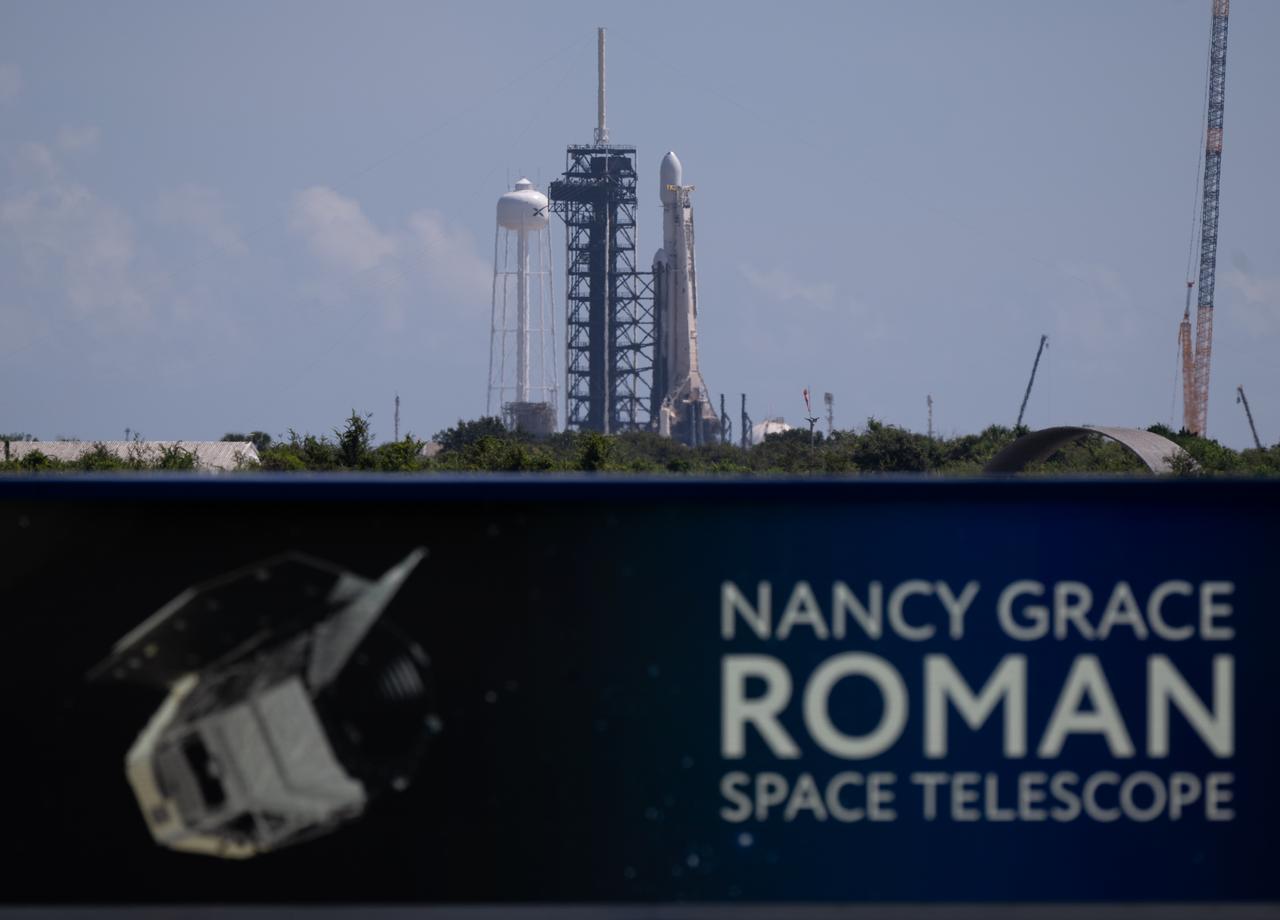
Quick Summary: NASA’s Nancy Grace Roman Space Telescope is set to launch into space on August 30, 2026, aboard a SpaceX Falcon Heavy rocket. Roman will investigate dark energy and dark matter, count exoplanets, and measure the universe’s expansion rate. The launch will be streamed live by NASA.
Why Is the Roman Telescope So Important?
The new star of space exploration, the Nancy Grace Roman Space Telescope, has taken its place on the launch pad. On Saturday, August 29, 2026, the telescope was raised to a vertical position inside the nose cone of a SpaceX Falcon Heavy rocket at Launch Complex 39A at Kennedy Space Center. It will depart for space tomorrow morning, Sunday, August 30, at 07:26 EDT.
This mission is not just another telescope launch; it’s a giant leap that will shed light on two of the universe’s greatest mysteries: dark energy and dark matter. It will also conduct a census of planetary systems and gather groundbreaking data across many fields of astrophysics.

So What Will the Roman Telescope Do?
Roman is named after Nancy Grace Roman, NASA’s first chief astronomer, often referred to as the ‘Mother of Hubble.’ Unlike Hubble and James Webb, this new telescope boasts an exceptionally wide field of view, allowing it to scan vast portions of the sky and map the universe.
One of the mission’s primary goals is to study the influence of dark energy on the universe’s expansion. Scientists believe this mysterious energy is behind the accelerating expansion of the universe. By observing billions of galaxies, Roman will measure how this expansion has changed over time.
Dark matter, on the other hand, constitutes a large fraction of the universe’s mass but cannot be observed directly. Roman will map the distribution of dark matter using gravitational lensing, a technique that measures how light from distant galaxies is bent by dark matter in the foreground.
Roman: The Exoplanet Hunter
Another crucial mission for Roman is discovering exoplanets. Using the microlensing method, it will detect brightness variations caused by planets passing in front of their host stars. This technique is particularly effective at finding small, Earth-like planets.
Thousands of exoplanets have been discovered so far, but Roman’s wide field of view could multiply that number. Scientists estimate Roman could find hundreds of thousands of new planets by observing toward the center of the Milky Way. This will revolutionize our understanding of how planetary systems form and evolve.

Launch Process and Live Stream
The launch will be streamed live by NASA, with minute-by-minute coverage. NASA and SpaceX have scheduled the launch for Sunday, August 30, at 07:26 EDT (14:26 Turkey Time). The Falcon Heavy is one of the most powerful operational rockets ever built and will deliver Roman to the correct orbit.
Final checks on all systems were completed before launch. Weather conditions are also being evaluated for suitability. NASA and SpaceX teams are prepared to postpone the launch if any issues arise.
Roman Telescope Technical Specifications
| Parameter | Value |
|---|---|
| Launch Date | August 30, 2026 |
| Launch Time (EDT) | 07:26 |
| Launch Vehicle | SpaceX Falcon Heavy |
| Launch Complex | LC-39A, Kennedy Space Center |
| Mirror Diameter | 2.4 meters |
| Field of View | 0.28 square degrees (100 times wider than Hubble) |
| Primary Mission Duration | 5 years (10-year goal) |
| Orbit | Sun-Earth L2 Lagrange Point |
| Science Objectives | Dark energy, dark matter, exoplanets |
Roman vs. Other Telescopes
Roman fills a niche distinct from Hubble and the James Webb Space Telescope. While Hubble focuses on narrow regions, Roman will survey wide areas. James Webb will conduct deep observations in infrared wavelengths. Roman’s wide field of view will enable rapid mapping of large portions of the sky.
Working together, these three telescopes will uncover the universe’s deepest secrets. Targets discovered by Roman will guide Webb’s detailed follow-up studies. This collaboration will offer scientists a holistic view of the universe’s formation and evolution.

What Does This Discovery Mean for Us?
The data Roman collects will help us understand the fate of the universe. The nature of dark energy will determine whether the universe will expand forever or eventually collapse. The answers to these questions are vital for humanity’s understanding of its place in the cosmos.
Additionally, the exoplanets Roman discovers could shed light on how common life might be in the universe. If Earth-like planets are abundant, it strengthens the possibility that we are not alone. That thought alone is thrilling.
This NASA mission also exemplifies successful collaboration with the private sector. SpaceX’s Falcon Heavy will carry Roman into space, demonstrating that space exploration is no longer solely the domain of governments. We previously touched on the details of this collaboration in our article [NASA’s Roman Telescope Launches: In Pursuit of Thousands of Alien Worlds](https://galaktikuzay.com/nasanin-roman-teleskobu-firlatiliyor-binlerce-uzayli-dunyanin-pesinde-2).
What Happens After Launch?
Following launch, Roman will travel to the Sun-Earth L2 Lagrange point, about 1.5 million kilometers away. This location keeps the telescope in Earth’s shadow, providing a cold and stable environment. The journey will take approximately 30 days.
Once at L2, Roman will spend several months calibrating its instruments and capturing its first light images. Scientific observations are expected to begin in early 2027. The first images could be as groundbreaking as Hubble’s initial deep field images.
During this process, as we mentioned in our article [JWST Watched 72 Stars: Planet Formation Is a Race Against Time](https://galaktikuzay.com/jwst-72-yildizi-izledi-gezegen-olusumu-zamana-karsi-bir-yaris), the first observations from telescopes are always eagerly anticipated. Roman’s initial data could fundamentally change what we know about the dark universe.
Frequently Asked Questions
When will the Roman Telescope launch?
The Roman Telescope will launch on Sunday, August 30, 2026, at 14:26 Turkey Time (07:26 EDT) aboard a SpaceX Falcon Heavy rocket.
What is the main mission of the Roman Telescope?
Roman will study dark energy and dark matter, discover exoplanets, and measure the universe’s expansion rate.
Where will the Roman Telescope go?
Roman will be placed at the Sun-Earth L2 Lagrange point, about 1.5 million kilometers from Earth.
From the Editor’s Desk: The launch of Roman truly excites me. Understanding a mystery like dark energy, which makes up 68% of the universe, will be one of humanity’s greatest scientific achievements. And when I think about it, Nancy Grace Roman, after whom this telescope is named, fought for years to champion women’s place in science. Now, a telescope bearing her name will unveil the deepest secrets of the universe. This is a triumph of science and perseverance.
Bir Yorum Yazın