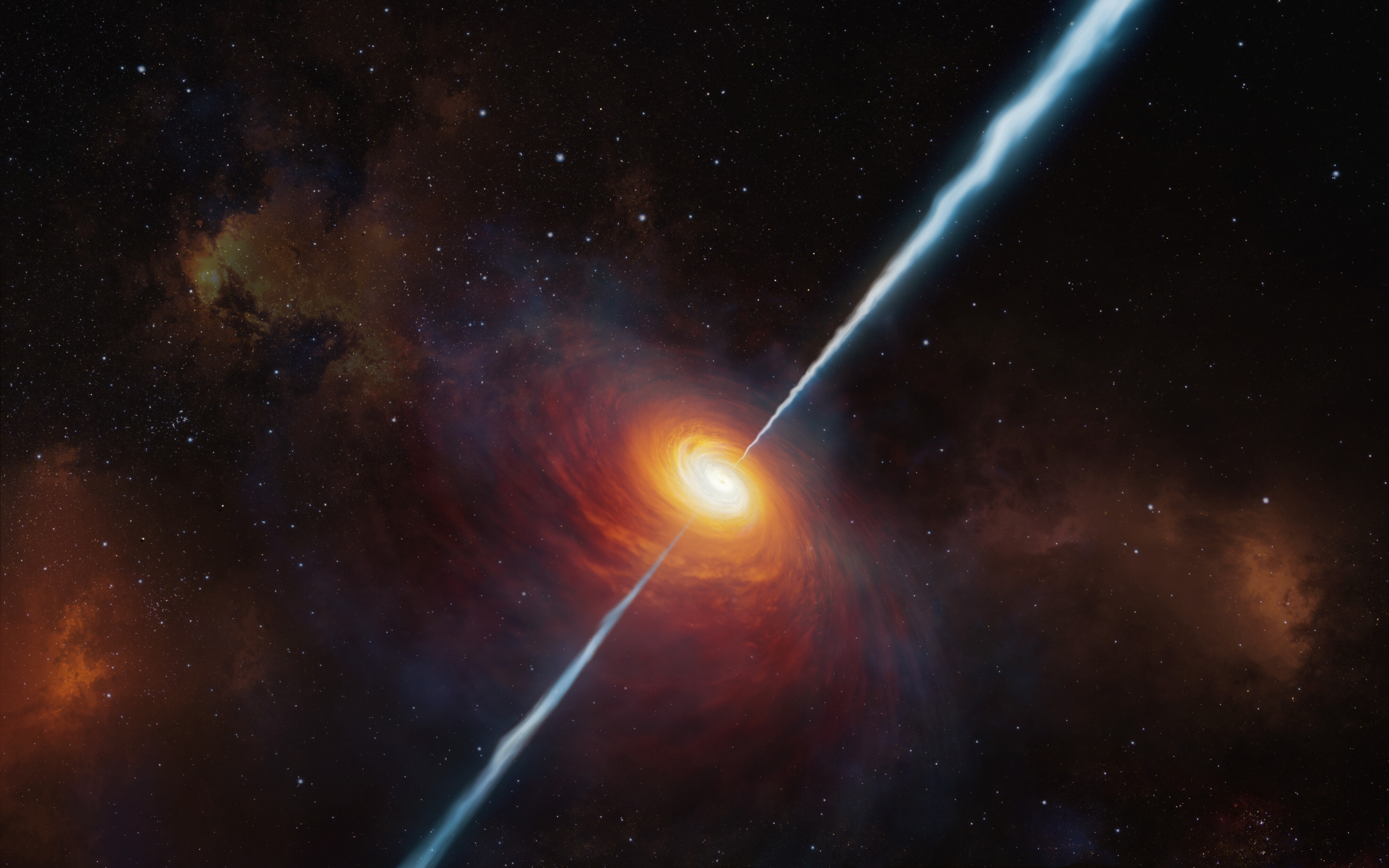
Quick Summary: The supermassive black hole at the center of the galaxy SDSS J110546.07+145202.4 increased its radio brightness by a factor of 20 in a short period and has remained bright for years. Scientists believe this unusual behavior offers a valuable opportunity to understand how the first giant black holes after the Big Bang fed and grew.
Why are astronomers so focused on this galaxy?
The universe sometimes delivers its biggest surprises not through the most distant objects, but through relatively nearby neighbors. The spiral galaxy SDSS J110546.07+145202.4 is one such case.
At the center of this galaxy, located about 1.8 billion light-years away, a supermassive black hole displayed an unusual change that caught astronomers’ attention a few years ago. Radio signals from the galaxy became roughly 20 times stronger in a short span of time.
Even more intriguing, this increase in brightness does not appear to be temporary. Researchers say the event began around eight years ago, and the system still shows no clear signs of fading.
According to research reported by Space.com, this behavior resembles a feeding pattern that scientists have previously observed mostly in young supermassive black holes from the early universe.
What might we learn in the coming years?
With next-generation radio telescopes and multiwavelength observations, researchers will be able to monitor this system in much greater detail. If the brightness remains elevated, scientists may be able to identify the physical mechanisms driving the phenomenon.
It is also possible that other galaxies with similar characteristics will be discovered. If that happens, astronomers will be able to test whether they are looking at an entirely new class of active galaxies.
In space exploration, some of the most significant discoveries emerge from unexpected exceptions. We see examples of this across many fields, from Mars missions to black hole research. In fact, in our article NASA Takes the First Step Toward the Skyfall Mars Helicopter, we explored how ideas that break from conventional approaches can open new doors in science.
This galaxy may play a similar role. Sometimes, instead of looking billions of light-years into the distance, a relatively nearby cosmic neighbor can reveal the story of the universe’s earliest epochs.
FAQ
Why is SDSS J110546.07+145202.4 important?
The black hole at the galaxy’s center exhibits extreme feeding behavior similar to that seen in supermassive black holes from the early universe. As a result, it may serve as a nearby laboratory for understanding the distant cosmos.
What does the 20-fold increase in radio brightness mean?
The increase suggests intense energy production around the black hole and likely indicates that large amounts of matter are flowing toward the center.
Why hasn’t the black hole faded yet?
Scientists do not yet know the exact reason. However, a continuous supply of infalling matter could be responsible for maintaining its long-lasting brightness.
References
Editor’s Perspective: Black hole stories often feel distant and inaccessible. What excites me about this case is that we may not need to look all the way back to the first galaxies billions of light-years away to understand the mysteries of the early universe. Sometimes the oldest chapters of cosmic history appear unexpectedly in the heart of a much closer galaxy.
Bir Yorum Yazın