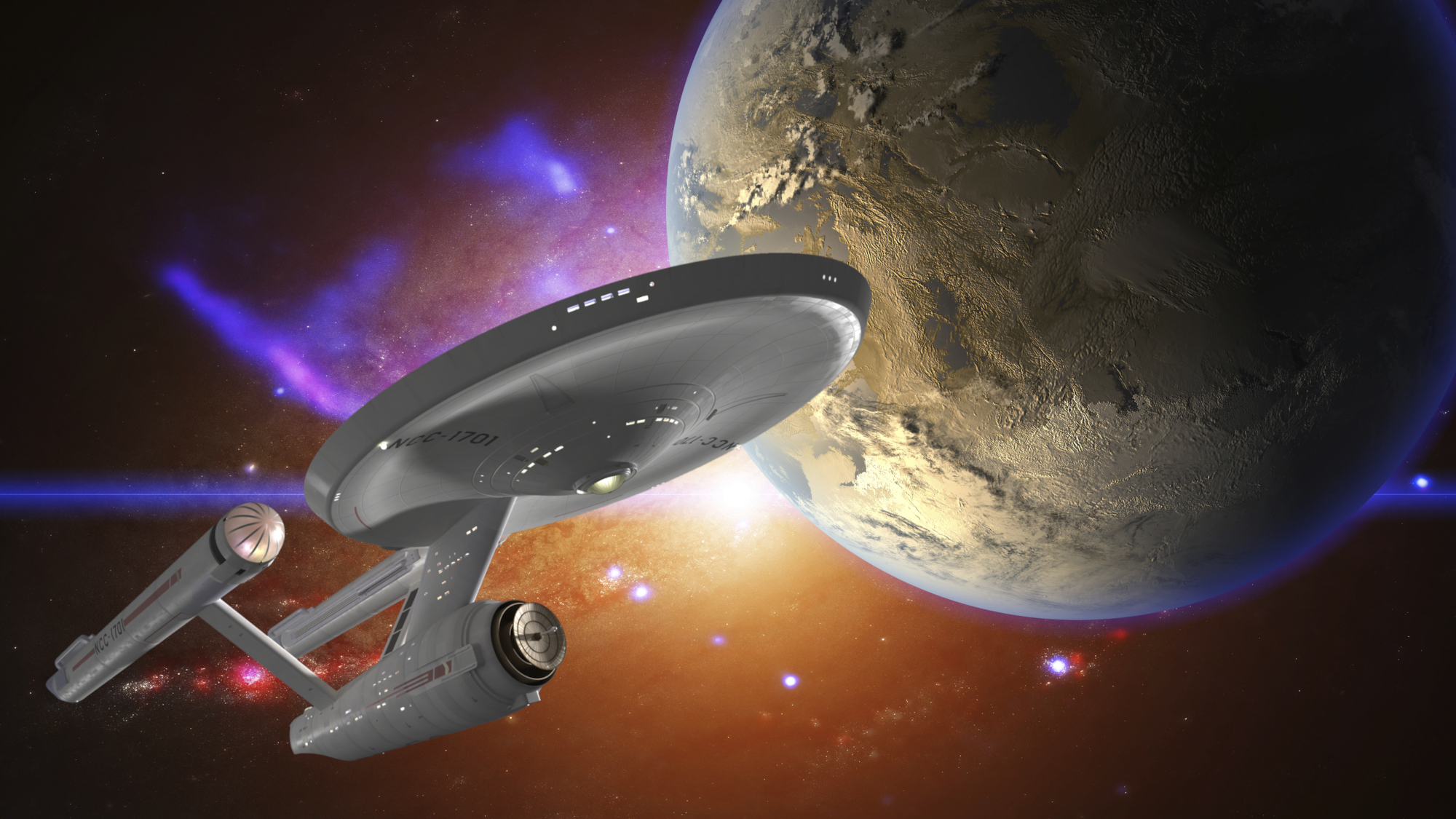
Quick Summary: Premiering on September 8, 1966, Star Trek introduced fictional exoplanets to pop culture 60 years ago. Today, astronomers have discovered over 6,000 real exoplanets. Are these real worlds stranger than Star Trek’s imagined planets like Vulcan or Risa?
Star Trek’s Imaginary Worlds vs. Real Exoplanets
Thursday, September 8, 1966, seemed like an ordinary day. But that evening, a series airing on American television radically changed both science fiction and the imagination of millions: Star Trek. At that time, not a single planet outside our solar system had been discovered. So worlds like “Vulcan,” “Risa,” or “Omicron Ceti” were entirely the product of screenwriters’ imaginations.
In the 60 years since, the situation has completely changed. Today, astronomers have confirmed more than 6,000 planets outside our solar system (known as exoplanets). Each one tells a different story: scorching hot Jupiters, tidally locked rocky worlds, even planets with diamond rain. So, are these real worlds more extraordinary than the strange worlds Star Trek imagined? Let’s take a look together.
Is Vulcan Real? The Mystery of 40 Eridani A
One of the first planets that comes to mind when thinking of Star Trek is Vulcan, Spock’s cool and logical homeworld. In the series, Vulcan orbits the star 40 Eridani A. This star actually exists and is about 16 light-years away from Earth. That’s why, in 2018, astronomers announced the possible discovery of a planet around this star and naturally named it “Vulcan.”
However, the excitement was short-lived. Subsequent analyses showed that the detected signal was actually caused by the star’s own activity. So, for now, Vulcan remains a fictional world. But this hasn’t dampened scientists’ hopes. Real exoplanet hunters continue to search for planets in the habitable zones around stars like 40 Eridani A.

Why Are Real Exoplanets Weirder?
Star Trek screenwriters invented desert planets, ocean worlds, and skies with twin suns to impress viewers. But nature turned out to be far more creative than fiction. For example, on a planet called HD 189733b, it’s thought that rain falls as glass particles. Another planet, WASP-12b, is so hot that carbon atoms in its atmosphere might form diamond crystals.
Additionally, some exoplanets orbit so close to their stars that their year lasts just a few hours on Earth. These “hot Jupiters” bear no resemblance to any world Star Trek imagined. Some planets might even act like giant mirrors, reflecting their star’s light and shining in the night sky.
Then there are tidally locked planets. These worlds always show the same face to their star, just as the Moon always shows the same face to Earth. One side could be in perpetual daylight and scorching heat, while the other is in endless night and freezing cold. Even Star Trek never depicted such an extreme world.
| Parameter | Value |
|---|---|
| Confirmed Exoplanets | 6,000+ |
| Distance to Vulcan’s Star (40 Eridani A) | 16 Light-Years |
| Precipitation Type on HD 189733b | Glass Particles |
| Possible Atmospheric Composition of WASP-12b | Diamond Crystals |
| Shortest Exoplanet Year | A Few Hours |
How Did Fiction Influence Science?
Star Trek’s contribution to exoplanet research isn’t limited to imagination. The series inspired many astronomers and planetary scientists to enter the field. For example, NASA’s Kepler and TESS telescopes are working to realize Star Trek’s vision of “strange new worlds.” In fact, some scientists don’t hesitate to name the planets they discover after Star Trek characters.
This interaction shows that science fiction is not just entertainment but also a powerful tool that sparks scientific curiosity. Perhaps without Star Trek, our interest in exoplanets wouldn’t be as intense today. In a related context, in our article [Did the Moon Form in Just 5 Hours? A Fresh Look at the Giant Impact Theory](https://galaktikuzay.com/ay-sadece-5-saatte-mi-olustu-dev-carpisma-teorisine-yeni-bakis), we explored a similar intersection of imagination and science regarding the formation of the solar system.

So, What Do These Discoveries Mean for Us?
The fact that exoplanets are so diverse and strange makes the question of whether we are alone in the universe even more exciting. If there are so many different worlds, the likelihood of life adapting to various conditions also increases. The idea of “diverse life forms” in Star Trek might actually be even more colorful in reality.
However, for now, the data we have shows that most of these worlds are extremely inhospitable to life. Still, each new discovery increases our chances of finding a habitable world. In the future, with tools like the James Webb Space Telescope, we’ll be able to analyze the atmospheres of these planets to search for signs of life. This brings us one step closer to the “first contact” scenario Star Trek imagined.
On the other hand, the rise of private space companies is also accelerating progress in this field. For example, in our news piece [Isar Aerospace Made History: First Private Rocket to Reach Orbit from European Soil](https://galaktikuzay.com/isar-aerospace-tarih-yazdi-avrupa-topraklarindan-yorungeye-ulasan-ilk-ozel-roket), we discussed the role of the private sector in space exploration. Such developments could lead to more resources being allocated to exoplanet research.
Star Trek’s Legacy and Vision for the Future
The 60th anniversary of Star Trek is not just a series milestone; it’s also proof of science fiction’s power to inspire science. The series encouraged millions to look to space with its philosophy of “boldly going.” Our discovery of more than 6,000 exoplanets today demonstrates how powerful that philosophy has been.
Yet real exoplanets have gone far beyond Star Trek’s imagination. Glass rains, diamond hearts, tidally locked worlds… All of these prove that the universe is actually the best science fiction writer. Perhaps in the next 60 years, if we find signs of life on one of these worlds, Star Trek’s vision of “strange new worlds” will be fully realized.

Conclusion: A Universe Stranger Than Fiction
In conclusion, Star Trek expanded our imagination 60 years ago, but real exoplanets have far surpassed that imagination. Science can be weirder than fiction, and that’s a truth worth exploring. Maybe one day, we’ll find a real “Vulcan.” But until then, we’ll continue to follow the surprises the universe has to offer. As we noted in our news piece [Isar Aerospace Reached Orbit on Second Attempt: Europe’s New Power](https://galaktikuzay.com/isar-aerospace-ikinci-denemede-yorungeye-ulasti-avrupanin-yeni-gucu), the pace of these discoveries continues to accelerate.
From the Editor’s Desk: As someone who grew up watching Star Trek, this story made me feel both nostalgic and excited. The fact that worlds imagined 60 years ago are now being discovered for real proves how forward-thinking science fiction can be. But what’s truly mind-boggling is that the real universe is even stranger than fiction. Imagine a planet where it rains glass… That’s more impressive than even Star Trek’s wildest scenario. Science keeps pushing the boundaries of our imagination, and I thoroughly enjoy being part of this journey.
Frequently Asked Questions
Is the planet Vulcan from Star Trek real?
No, the planet Vulcan is fictional. However, in 2018, astronomers announced the possible discovery of a planet around the star 40 Eridani A and named it “Vulcan.” Later, it was understood that the signal was caused by stellar activity.
Are real exoplanets weirder than Star Trek’s worlds?
Yes, many real exoplanets have far stranger features than fictional worlds. For instance, HD 189733b is thought to have glass particle rain, and some planets are tidally locked, always keeping one face turned toward their star.
How many exoplanets have been discovered?
So far, more than 6,000 exoplanets have been confirmed. This number continues to grow rapidly with advancing technology.
Bir Yorum Yazın