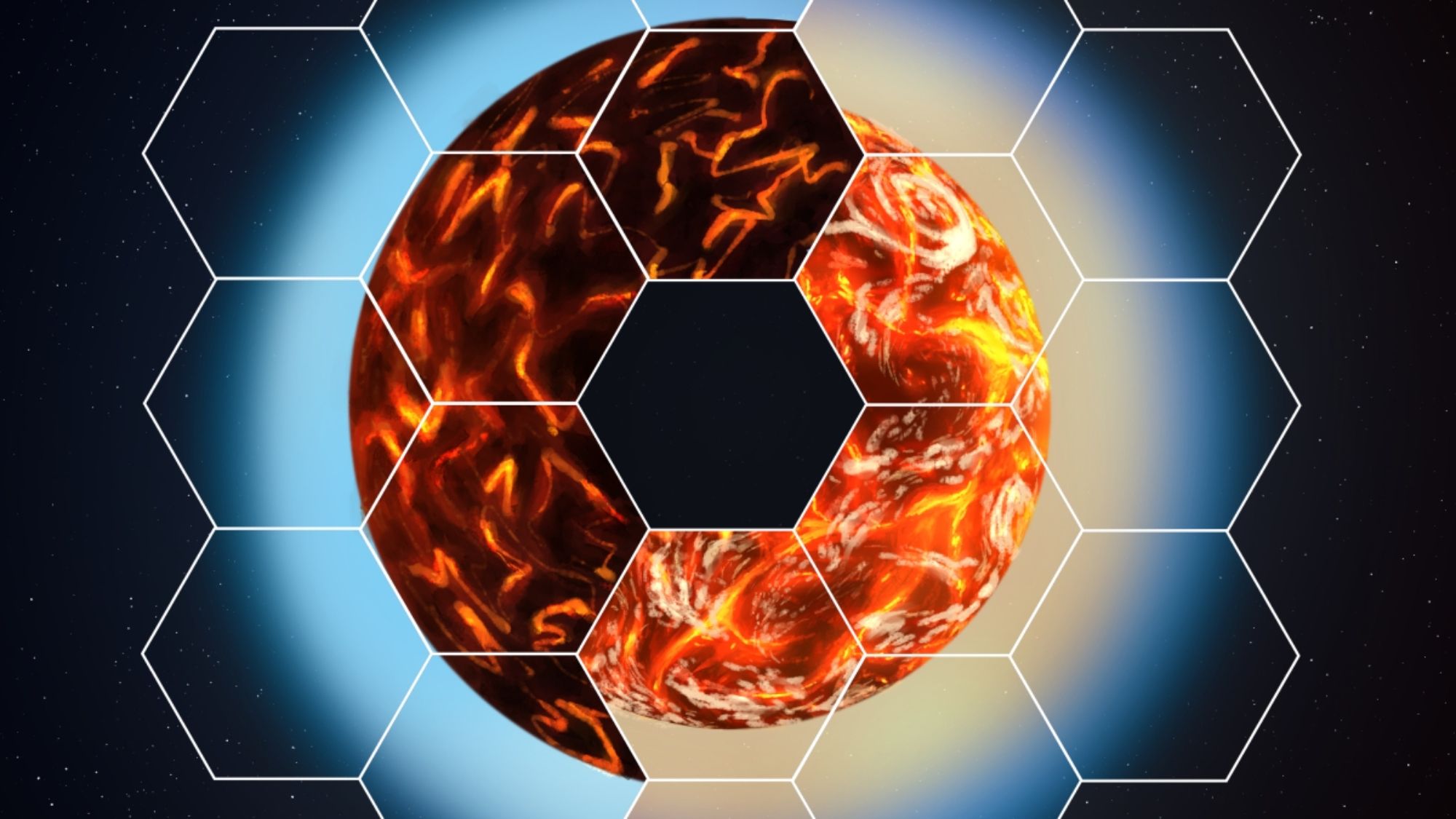
Quick Summary: A new study suggests that some sub-Neptune exoplanets could develop clouds of vaporized rock in their atmospheres, trapping heat inside the planet and potentially turning the surface into a global ocean of molten magma. The findings raise important questions about habitability and how planetary atmospheres are interpreted.
What is happening on sub-Neptune planets?
For years, astronomers have been trying to understand a mysterious class of planets known as sub-Neptunes. Larger than Earth but smaller than Neptune, these worlds are among the most common members of exoplanet catalogs. Even so, their internal structures and surface conditions remain poorly understood.
New research highlighted by Space.com suggests these planets may be far stranger than previously thought. Researchers at Arizona State University calculated that intense heat buildup could occur beneath the atmospheres of some sub-Neptune planets.
In this scenario, the atmosphere acts like a giant insulating blanket. Clouds made of vaporized rock and dense layers of gas make it harder for heat from the planet’s interior to escape into space. As a result, temperatures rise and rocky surfaces can reach their melting point.
“On some of the planets we modeled, this additional heat is powerful enough to melt the surface, allowing a magma ocean to form.”
This statement from study team member Matthew Nixon shows that the idea is more than a theoretical curiosity. If the models are correct, some sub-Neptunes may conceal enormous seas of molten rock beneath their atmospheres.

How do clouds of vaporized rock form?
On Earth, clouds are made of water droplets. But on some exoplanets, conditions are so extreme that even rocks can vaporize. At temperatures approaching thousands of degrees, minerals turn into gas and are carried into the upper atmosphere.
These gases can later condense into unusual cloud layers. According to the researchers, these clouds are not merely an atmospheric curiosity. They are also an important mechanism that alters the planet’s energy balance.
The extra energy trapped in the atmosphere causes temperatures near the surface to climb. As a result, the rocky layer begins to melt. Beyond a certain point, the surface can transform from solid land into a planet-wide magma ocean.
The image that comes to mind is the lava worlds often seen in science fiction. The difference is that this would not be a single volcanic region, but oceans of molten rock on a planetary scale.
Interpreting exoplanet atmospheres is already a highly complex process. If there is a continuous exchange of gases between the atmosphere and a magma ocean, the chemical signatures detected by telescopes may change as well. That could make it more difficult for scientists to determine a planet’s true composition.
Why is GJ 1214b back in the spotlight?
One of the standout examples in the study is GJ 1214b, a planet orbiting a red dwarf star about 48 light-years away.
At one time, GJ 1214b was thought to be a relatively cool, water-rich world. However, observations made by the James Webb Space Telescope in 2025 significantly changed that picture.
Those observations revealed metallic vapors and carbon dioxide haze in the atmosphere. The results suggested that the planet is not a classic water world. Now, new modeling strengthens the possibility that a completely molten surface may lie beneath its thick atmosphere.
In recent years, the James Webb Space Telescope has revolutionized exoplanet science. Yet this study serves as a reminder that interpreting the telescope’s data requires caution.
If the atmosphere is continually replenished by gases rising from a magma ocean, the observed chemistry may not directly reflect the planet’s true interior structure.

What do the numbers tell us?
The key data released from the study can be summarized as follows.
| Parameter | Value |
|---|---|
| Example planet | GJ 1214b |
| Distance from Earth | 48 light-years |
| Relevant observation year | 2025 |
| Study publication date | July 8, 2026 |
| Scientific journal | Astrophysical Journal Letters |
| Star type | Red dwarf |
Although the dataset may seem limited at first glance, the implications are substantial. Sub-Neptunes are among the most common planets in the galaxy. If this mechanism is widespread, some long-standing assumptions about many worlds may need to be reconsidered.
How does this discovery affect hopes for habitability?
Whenever news breaks about an exoplanet, the same question is usually asked: Could life exist there?
The answer suggested by this research is not especially encouraging. According to scientists, even if temperatures are not high enough to generate a magma ocean, the boundary region between the atmosphere and the solid surface may still be too hot for liquid water to exist.
In other words, the basic conditions required for habitability become much harder to achieve. Environments lacking liquid water and experiencing extreme surface temperatures are not expected to support life as we know it.
This could become an important filtering criterion in exoplanet research. In the future, scientists may need to examine not only whether a planet lies in a star’s habitable zone, but also how effectively its atmosphere traps heat.
In many ways, this reflects a broader trend across astronomy, from black holes to planet formation. Systems that appear simple at first often reveal far greater complexity under closer observation. For example, in our article Hidden Population Revealed in Black Hole Collisions, we explored how unseen processes can reshape scientific observations.
What observations come next?
This study raises new questions rather than delivering a final verdict. Scientists will now examine additional sub-Neptunes to determine how common these signatures may be.
The James Webb Space Telescope will continue to play a leading role. Future space telescopes and advanced observing instruments could also provide a clearer picture of the relationship between planetary atmospheres and surfaces.
Advances in space-access technology may indirectly support this effort as well. Projects such as Europe’s New Super-Rocket Concept to Rival Starship could make it easier to launch the large observatories of the future.
Researchers also believe that understanding the evolution of sub-Neptunes is important for unraveling the history of young planetary systems. As in our article Nearby Hungry Black Hole May Shed Light on the Early Universe, seemingly unrelated topics often connect within the larger story of the cosmos.
Study team member Luis Welbanks says their work brings scientists one step closer to answering what these mysterious worlds are actually made of. Sub-Neptunes are no longer seen merely as smaller cousins of giant gas planets. Each new observation suggests they may follow their own unique set of physical rules.

Sources
Editor’s Perspective: Sub-Neptunes have always struck me as one of the most stubborn puzzles in exoplanet research. The fact that a planet once considered a water world is now being discussed in terms of molten rock oceans shows just how quickly the universe can overturn our expectations. In my view, James Webb’s study of more planets in this class over the coming years will be one of the most exciting developments in exoplanet science.
Frequently Asked Questions
What is a sub-Neptune planet?
Sub-Neptunes are a class of exoplanets larger than Earth but smaller than Neptune, and they are extremely common throughout the galaxy.
Why is GJ 1214b attracting attention?
This planet was once thought to be a water world. New observations and models suggest it may instead host a magma ocean beneath its thick atmosphere.
Could life exist on these planets?
According to current research, extreme temperatures and possible magma oceans greatly reduce the likelihood of conditions suitable for life as we know it.
Bir Yorum Yazın