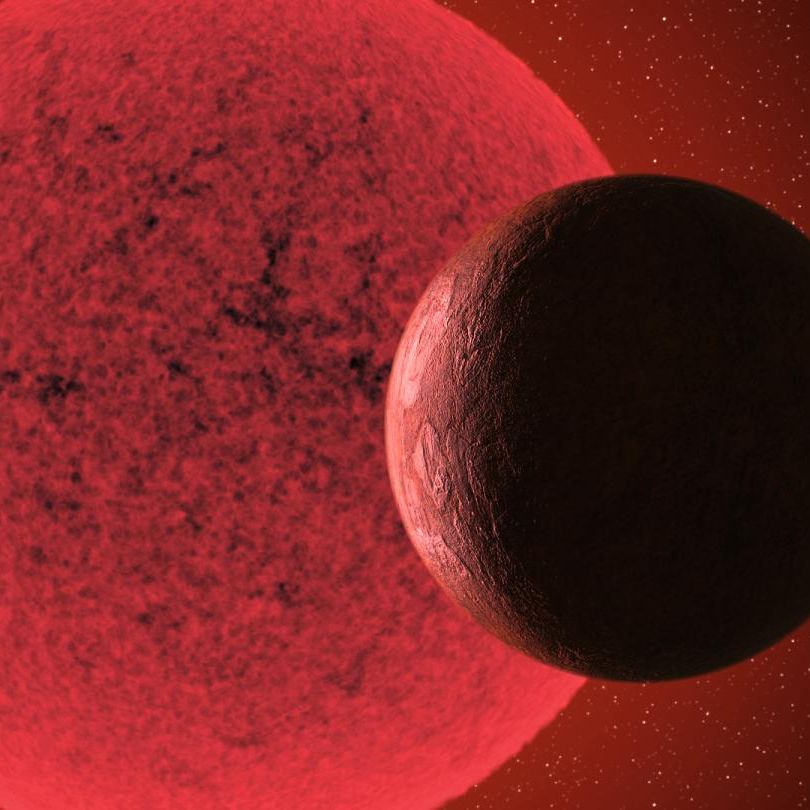
Quick Summary: The mass of the rocky exoplanet GJ 3378b has been recalculated and found to be smaller than previously believed. Its orbital period has also been revised from 25 days to 21 days. This change places the planet within its star’s habitable zone, strengthening the possibility of liquid water and potentially life.
In the search for life beyond Earth, sometimes even a small correction in the numbers can change the entire picture. That is exactly what happened with a nearby exoplanet called GJ 3378b. When it was first announced, it did not seem especially promising from a habitability standpoint. With new data, however, it has once again become a focus of scientific interest.
Located just 25 light-years away, GJ 3378b orbits one of the red dwarf stars that astronomers frequently target in their search for potentially habitable worlds. New analyses have updated both its mass and orbital characteristics, and the results are striking.
Why is GJ 3378b back in the spotlight?
When GJ 3378b was first discovered in 2024, researchers estimated that it could have a mass roughly five times that of Earth. If correct, such a world might have been able to retain a thick, dense atmosphere for billions of years.
But for a super-Earth that massive, another issue emerged. If the atmosphere became too dense, surface conditions could turn hostile to life. Extreme pressures might create an environment very different from anything life on Earth is accustomed to.
A new study led by researchers at the University of California, Irvine has changed that picture. Updated calculations suggest that GJ 3378b has a mass of about 2.3 Earth masses.
That still qualifies it as a super-Earth. However, it now appears less likely to possess an excessively thick atmosphere. As a result, its surface conditions may be more favorable for habitability.

Has it really entered the habitable zone?
The most notable detail is not just the revised mass estimate. The research team also took a fresh look at the planet’s orbit.
Initial measurements suggested that GJ 3378b completed one orbit around its star in roughly 25 days. The new analysis indicates that the actual period is 21 days.
At first glance, a difference of four days may not seem significant. In exoplanet science, however, even a small change can have major consequences. The amount of energy a planet receives from its star depends directly on its orbit.
According to the updated calculations, GJ 3378b now falls within its star’s habitable zone. This is the range of distances where temperatures could allow liquid water to exist on a planet’s surface.
Of course, being in the habitable zone does not automatically mean life exists there. It does, however, significantly increase the chances that one of life’s essential ingredients—liquid water—could be present.
Why are red dwarf stars so important?
The star orbited by GJ 3378b is a red dwarf. Most stars in the Milky Way belong to this category.
According to researchers, red dwarfs make up roughly 70% to 75% of all stars in our galaxy. In elliptical galaxies, that figure can rise to as much as 90%.
That makes them impossible to ignore in the search for life elsewhere in the universe. They are extraordinarily common, and observations show that rocky planets frequently form around them.
In addition, their habitable zones are located much closer to the star. This makes planets within those zones easier to detect.
We previously explored a similar topic in our article on a potentially habitable planet candidate 25 light-years away. Nearby star systems remain among the most valuable targets for future detailed observations.

If everything sounds so promising, where’s the catch?
Although red dwarfs generate excitement in the search for life, they also come with significant risks.
These stars can produce powerful flares on a regular basis. High-energy radiation from the star can gradually strip away the atmospheres of nearby planets.
If GJ 3378b has been exposed to intense stellar outbursts for long periods, its surface conditions may not be as favorable as they currently appear.
For this reason, scientists do not focus solely on the habitable zone. Atmospheric composition, magnetic fields, stellar activity, and surface conditions all play important roles in evaluating a planet’s potential habitability.
This is also what makes exoplanet research so exciting. Every new piece of data has the potential to reshape the picture.
| Parameter | Value |
|---|---|
| Planet Name | GJ 3378b |
| Distance from Earth | 25 light-years |
| Discovery Year | 2024 |
| Updated Mass Estimate | 2.3 times Earth’s mass |
| Previous Mass Estimate | Previously believed to be about 5 Earth masses |
| Original Orbital Period | 25 days |
| Updated Orbital Period | 21 days |
| Star Type | Red dwarf |
| Red Dwarf Share in the Milky Way | 70%–75% |
| Share in Elliptical Galaxies | Up to 90% |
What future observations could this discovery enable?
At just 25 light-years away, GJ 3378b is relatively close on cosmic scales. That makes it a strong candidate for future telescope observations.
If researchers can analyze its atmosphere, they may be able to search for traces of water vapor, carbon dioxide, or gases potentially linked to biological processes.
Such measurements remain challenging today, but next-generation observatories are becoming increasingly sensitive. Targets that seemed unreachable only a few years ago are now moving toward the top of observation lists.
At this point, it is hard not to think about the long-term future of interstellar exploration. For example, our discussion of when New Horizons might reach interstellar space highlights just how patient humanity must be in its effort to understand distant planetary systems.
At the same time, the continuity of space missions remains crucial. Our recent coverage of the final Pegasus mission launched to save Swift showed how valuable scientific infrastructure is for sustaining long-term observations.

Could GJ 3378b host life?
At the moment, no one can answer that question with certainty. What we have are encouraging signs.
The planet’s lower estimated mass reduces the likelihood of a crushingly dense atmosphere. Its position within the habitable zone is also a positive sign for the potential presence of liquid water.
However, we do not yet know the true nature of its atmosphere. We do not know its surface temperature. We also do not know whether it possesses a strong magnetic field.
Even so, it is clear that GJ 3378b is rising rapidly on scientists’ list of priorities. Its proximity, rocky composition, and updated orbit make it one of the most intriguing exoplanet candidates of the coming years.
Perhaps the most interesting aspect of this story is that no new planet was discovered. Scientists simply looked at the same planet again and arrived at a different conclusion. Sometimes that is exactly how science advances: better data, more accurate interpretations, and a changing understanding of the universe.
Sources
Editor’s Perspective: What excited me most about the GJ 3378b story was not a new telescope or a brand-new discovery, but the reinterpretation of existing data. Sometimes what moves the search for life forward is not a revolutionary breakthrough, but a handful of numbers calculated more accurately. It is a reminder of why science remains so fascinating.
Frequently Asked Questions
How far is GJ 3378b from Earth?
The planet is located about 25 light-years away, making it one of our relatively nearby cosmic neighbors.
Why is GJ 3378b considered potentially habitable?
New calculations indicate that the planet lies within its star’s habitable zone, increasing the possibility that liquid water could exist there.
Has life been discovered on GJ 3378b?
No. No evidence of life has been detected so far. Researchers only believe that conditions suitable for life may exist there.
Bir Yorum Yazın