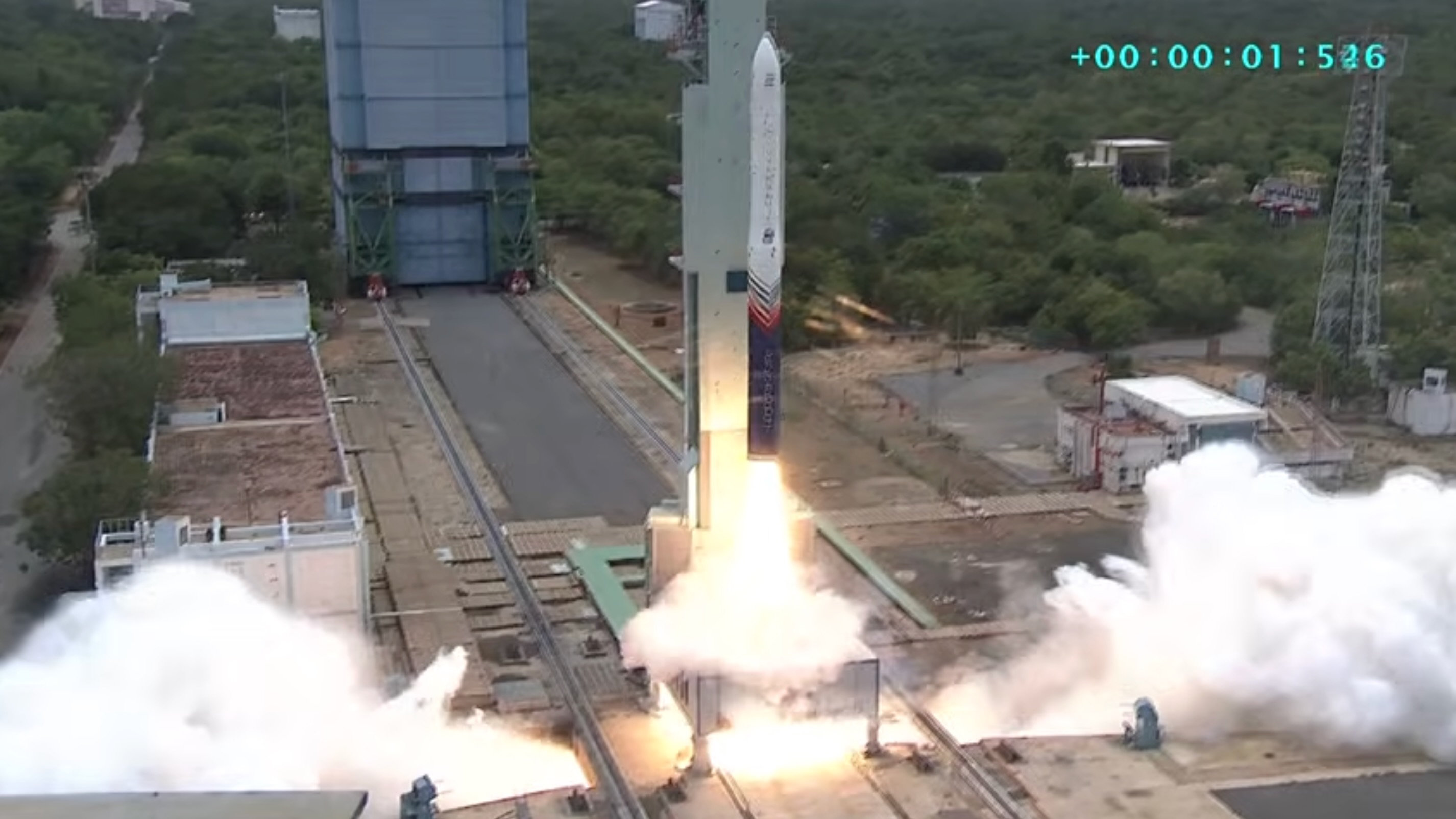
Quick Summary: India-based Skyroot Aerospace successfully reached a 450-kilometer low Earth orbit on the maiden flight of its Vikram-1 rocket. The achievement makes the company the first private Indian rocket operator to reach orbit and marks a major milestone in the country’s commercial space race.
A new chapter opens for India’s private space sector
One of the most challenging moments in spaceflight has always been a rocket’s first launch. Systems refined for years on drawing boards and test stands face their true examination only on launch day. That is why Skyroot Aerospace’s Vikram-1 mission was viewed as more than just a launch—it was one of the most important tests yet for India’s rapidly expanding private space ecosystem.
The mission, carried out on July 18, 2026, was announced by the company under the name “Aagaman,” a Sanskrit word meaning “arrival.” The outcome exceeded expectations. Vikram-1 successfully reached its planned orbit, becoming the first rocket developed by a private Indian company to achieve orbital flight.
The accomplishment sends a powerful message not only for Skyroot Aerospace but also for India’s growing commercial space industry. Alongside government-backed missions, private companies can now place their own vehicles into orbit.

What happened during the launch?
Vikram-1 lifted off from the Satish Dhawan Space Centre, India’s primary spaceport. In the final minutes before launch, engineers detected a technical issue, leading to a delay of approximately 35 minutes.
Given how minor issues can escalate into major risks during a maiden flight, the team’s caution was hardly surprising. Company executives had stated before launch that they were optimistic, while also acknowledging the failures that often accompany first attempts with new rockets.
The rocket eventually lifted off according to schedule and closely followed its planned flight profile. Its three solid-fuel stages performed as expected, after which a liquid-fueled upper system responsible for orbital insertion took over.
Operating for roughly six minutes, this stage carried out the final maneuvers needed to place the payloads into their target orbit. About 15 minutes after liftoff, the company confirmed that the mission had successfully reached its planned 450-kilometer low Earth orbit.
What payloads did Vikram-1 carry?
On their first missions, companies typically aim to showcase their technology while building confidence among potential customers. Vikram-1 provided a strong example of that approach.
The mission carried two small satellites. One was developed by Skyroot Aerospace, while the other belonged to Indian startup Grahaa Space.
Additional payloads from various organizations were also sent into space aboard the rocket. Systems provided by Dcubed and Cosmoserve Space were included in the mission manifest as well.
One of the more unusual details involved symbolic payloads. Postcards signed by several individuals, including Indian Prime Minister Narendra Modi, were flown aboard the rocket. While such items may hold limited scientific value, they often help generate public interest in space missions.

Key mission data
The technical details of the launch help explain why the mission is so significant. The main figures reported for the flight are summarized in the table below.
| Parameter | Value |
|---|---|
| Launch Date | July 18, 2026 |
| Launch Delay | 35 minutes |
| Number of Solid-Fuel Stages | 3 |
| Upper Stage Burn Time | Approximately 6 minutes |
| Time to Reach Orbit | Approximately 15 minutes |
| Target Orbit | 450 km low Earth orbit |
| Number of Small Satellites Carried | 2 |
Why is this achievement attracting global attention?
One of the most visible trends in the space industry today is the growing role of private companies alongside government agencies. SpaceX’s transformation of the U.S. launch market remains the best-known example, but similar developments are now unfolding in other countries.
For decades, India’s space efforts were led primarily by the national space agency ISRO. Thanks to regulatory changes and a more favorable investment environment, private ventures are now stepping into the spotlight.
Skyroot Aerospace has become one of the most prominent representatives of that movement. Its orbital success does more than validate the company’s technology—it demonstrates that commercially developed Indian rockets can compete in the global marketplace.
The small-satellite market continues to expand rapidly. Universities, research institutions, and private operators are all looking for affordable launch options. Vehicles like Vikram-1 are designed to meet precisely that demand.
This milestone is a reminder that the commercial space race is no longer dominated by just a handful of nations. As new players enter the field, costs decline and access to space becomes more widely available.

Where is India’s space ecosystem heading?
India has taken several notable steps in space exploration in recent years. Lunar missions, planetary science programs, and commercial satellite initiatives all highlight the country’s ambitions in the sector.
If Skyroot Aerospace can deliver regular and reliable launches, it could become an important option for international customers as well. A successful first flight does not mean every challenge has been solved. The real test is whether the achievement can be repeated consistently.
Space history shows that many rocket programs encounter unexpected difficulties after their initial success. For that reason, the industry’s attention will now turn to Vikram-1’s future missions.
At the same time, the growth of space startups extends far beyond launch services. Small satellites, space-based communications systems, and deep-space technologies are all attracting new investment.
If you’re interested in planetary science, developments surrounding the first rocky planet with an atmosphere found in the habitable zone also demonstrate how quickly space research is advancing.
Likewise, for readers fascinated by surprises within our Solar System, the feature an asteroid near Earth turned out to be a comet contains several intriguing details.
On the human exploration front, the NASA Artemis III lunar lander test is also worth reading to understand how future plans for returning to the Moon are taking shape.
What comes next?
Skyroot Aerospace’s biggest challenge now is proving it can sustain regular launch operations following this first success. Customers are not looking for a rocket that reaches orbit once—they need a service that can do so consistently and reliably.
If the company can maintain that performance, India’s share of the commercial space market could grow significantly. Small-satellite operators now have another launch option available to them.
As competition increases across the space sector, launch costs are expected to fall and more research projects may become viable. The beneficiaries could be not only companies, but also the scientific community and countries seeking greater access to space.
Sources
Editor’s Perspective: Seeing a rocket reach orbit on its very first attempt is always impressive. Skyroot’s achievement reminds me that the space race is no longer solely the story of superpowers; as new companies and nations enter the arena, we’re heading into a far more diverse and exciting era of exploration.
Frequently Asked Questions
Why is Vikram-1 considered a historic achievement?
Because it became the first privately developed Indian rocket to reach orbit, ushering in a new era for India’s commercial space sector.
What orbit did Vikram-1 reach?
According to the company, the rocket was successfully inserted into a low Earth orbit approximately 450 kilometers above Earth.
How many satellites were carried on the mission?
The mission carried two small satellites, one belonging to Skyroot Aerospace and the other to Grahaa Space.
Bir Yorum Yazın