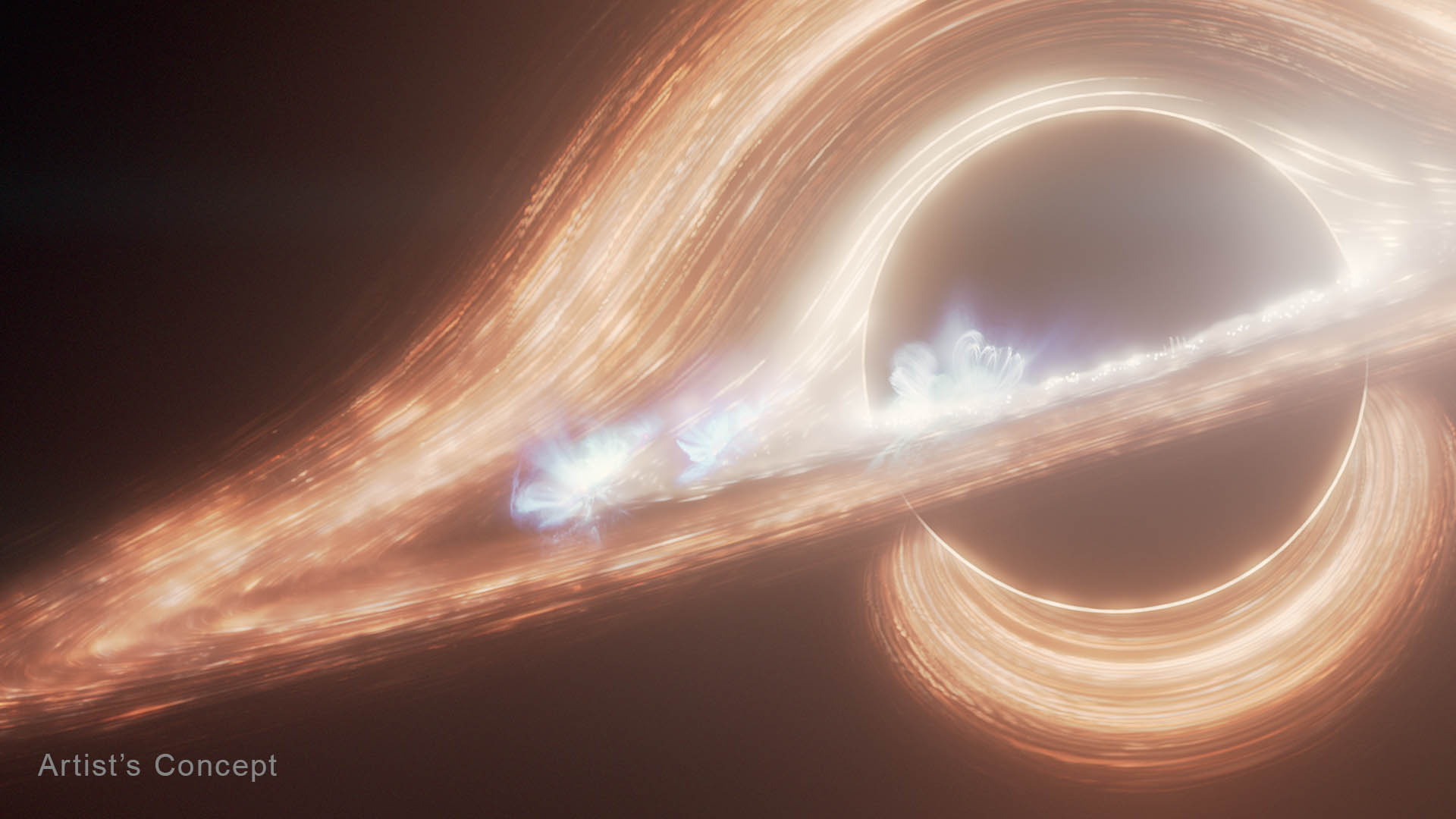
Quick Summary: The James Webb Space Telescope has detected water and cosmic dust around an aging star just 0.55 light-years from Sagittarius A*, the supermassive black hole at the center of the Milky Way galaxy. This discovery proves that water molecules can survive extreme radiation and harsh conditions even in the immediate vicinity of black holes.
Water in the Shadow of a Black Hole: How Is It Possible?
Even in the most extreme corners of space, the building blocks of life find a way. The James Webb Space Telescope (JWST) has achieved what seems like a miracle at the heart of the Milky Way. Astronomers have found water and cosmic dust around an aging star just 0.55 light-years from Sagittarius A* (Sgr A*), the supermassive black hole at the center of our galaxy.
This is the first clear evidence that molecules can survive despite the black hole’s immense gravitational pull and the intense radiation it emits. But how is this possible? Normally, at such a close distance, radiation would be expected to tear all molecules apart.
Macarena Garcia Marin, an astronomer at the European Space Agency (ESA) and co-author of the study, emphasizes the significance of the discovery:
“The detection of water is particularly exciting because it shows that molecular material can survive in an environment dominated by intense radiation.”

IRS 3: The Final Gift of a Dying Star
The hero of this discovery is IRS 3, one of the brightest mid-infrared sources at the galactic center. This star is in the asymptotic giant branch (AGB) phase, the final stage of stellar evolution. During this period, the star expels vast amounts of gas and dust through powerful stellar winds. In a sense, IRS 3, as it dies, scatters the raw materials from which new stars and planets could form.
Such dying stars act like the universe’s recycling centers. The material they shed forms the building blocks for the next generation of stars and planets. Water and dust are critical for star and planet formation. The material shed by IRS 3 could lay the foundation for new solar systems in the future.
However, the neighborhood IRS 3 calls home is far from hospitable. The center of the Milky Way is packed with stars and exposed to intense radiation. Scientists have long wondered whether molecules and newly formed dust could survive in such harsh conditions. JWST has now provided a clear answer: Yes, they can survive.
How Did the Webb Telescope Make This Discovery?
The team used Webb’s Mid-Infrared Instrument (MIRI) to study IRS 3 in detail. MIRI can peer through dust and gas clouds in the universe to observe even the coldest and most distant objects. This allowed them to capture the signatures of water molecules in the region near the black hole.
The observations do not specify exactly how much water is present in the region, but they definitively confirm its existence. This shows that molecular life is possible even in an extreme environment like the galactic center. This finding aligns with Webb’s earlier discoveries in the early universe; in both cases, the telescope is finding the building blocks of life in unexpected places.
Sagittarius A* has a mass of about 4 million solar masses. This colossal black hole dominates everything around it. However, this new discovery shows that regions near black holes are not as sterile as once thought. Perhaps the regions in the universe where life can emerge are far more diverse than we imagine.

Why Is Water So Important?
Water is considered a fundamental building block of life in the universe. All known life forms on Earth depend on water, and the presence of water provides crucial clues about a planet’s habitability. But water also plays a critical role in star and planet formation.
When interstellar dust grains become coated with water ice, they can stick together to form larger structures. This process lays the groundwork for planet formation. Therefore, the presence of water near the black hole suggests that planet formation might also be possible in this region.
When considered alongside the findings of eROSITA, which mapped the universe’s high-energy landscape, this discovery once again reveals just how dynamic and complex the center of our galaxy is. Both studies show that extreme conditions, rather than preventing life, might host different forms of it.
Can Planets Form Near Black Holes?
This question is one of the most exciting aspects of the discovery. If water and dust can survive this close to a black hole, it is theoretically possible for these materials to come together and form planets. However, this would be an extremely challenging process due to the intense gravitational forces and radiation.
Still, this discovery shows that the galactic center is not as barren a region as once believed. Perhaps life in the universe is sprouting in the most unexpected places. While black hole stars might solve Webb’s red dot mystery, this new finding also highlights how rich the regions near black holes could be.
Scientists are planning new observations to study the distribution of water and dust around IRS 3 in greater detail. These observations will help us better understand how molecules survive in this harsh environment and how they contribute to future star formation.

Key Data from the Discovery
| Parameter | Value |
|---|---|
| Observed Star | IRS 3 (AGB star) |
| Distance from Black Hole | 0.55 Light-Years |
| Black Hole Mass | ~4 Million Solar Masses |
| Instrument Used | JWST / MIRI |
| Detected Substances | Water and Cosmic Dust |
Why Is This Discovery So Important?
This discovery is groundbreaking in the field of astrophysics. For the first time, the presence of water molecules has been confirmed this close to a supermassive black hole. This shows that molecular life is possible even in the most extreme environments of the universe.
Furthermore, along with other surprising discoveries like the mysterious black hole star found by JWST, this finding once again proves how much the Webb telescope has expanded our ability to understand the universe. Each new observation refreshes our knowledge of space and pushes us to ask even bigger questions.
In conclusion, this discovery of water at the heart of the Milky Way is striking evidence of how resilient life and molecular structures can be in the universe. Perhaps one day, we might even find life forms near black holes. Who knows? Space is full of surprises.
Editor’s Note: This discovery truly captivates me. While we think of black holes as all-consuming monsters, seeing that the building blocks of life can exist around them reminds us how resilient and creative the universe is. The fact that water can exist even in the most unexpected places gives us new hope for future space missions and the search for life. The Webb Telescope is uncovering the universe’s mysteries a little more each day; this reality surpasses even science fiction films.
Frequently Asked Questions
How can water survive near a black hole?
Stars like IRS 3, which are aging, expel gas and dust into their surroundings through powerful stellar winds. This material can remain shielded in certain regions despite intense radiation. JWST’s MIRI instrument was able to detect the signatures of these molecules.
Does this discovery mean there is life in the universe?
No, this discovery is not direct evidence of life. However, considering that water and organic molecules are prerequisites for life to emerge, this finding suggests that regions with life potential might be more extensive than previously thought.
What other discoveries has the Webb Telescope made?
JWST has made groundbreaking discoveries in many areas, from galaxies in the early universe to exoplanet atmospheres. Recently, its findings on black hole stars and distant galaxies have also caused a stir.
Bir Yorum Yazın