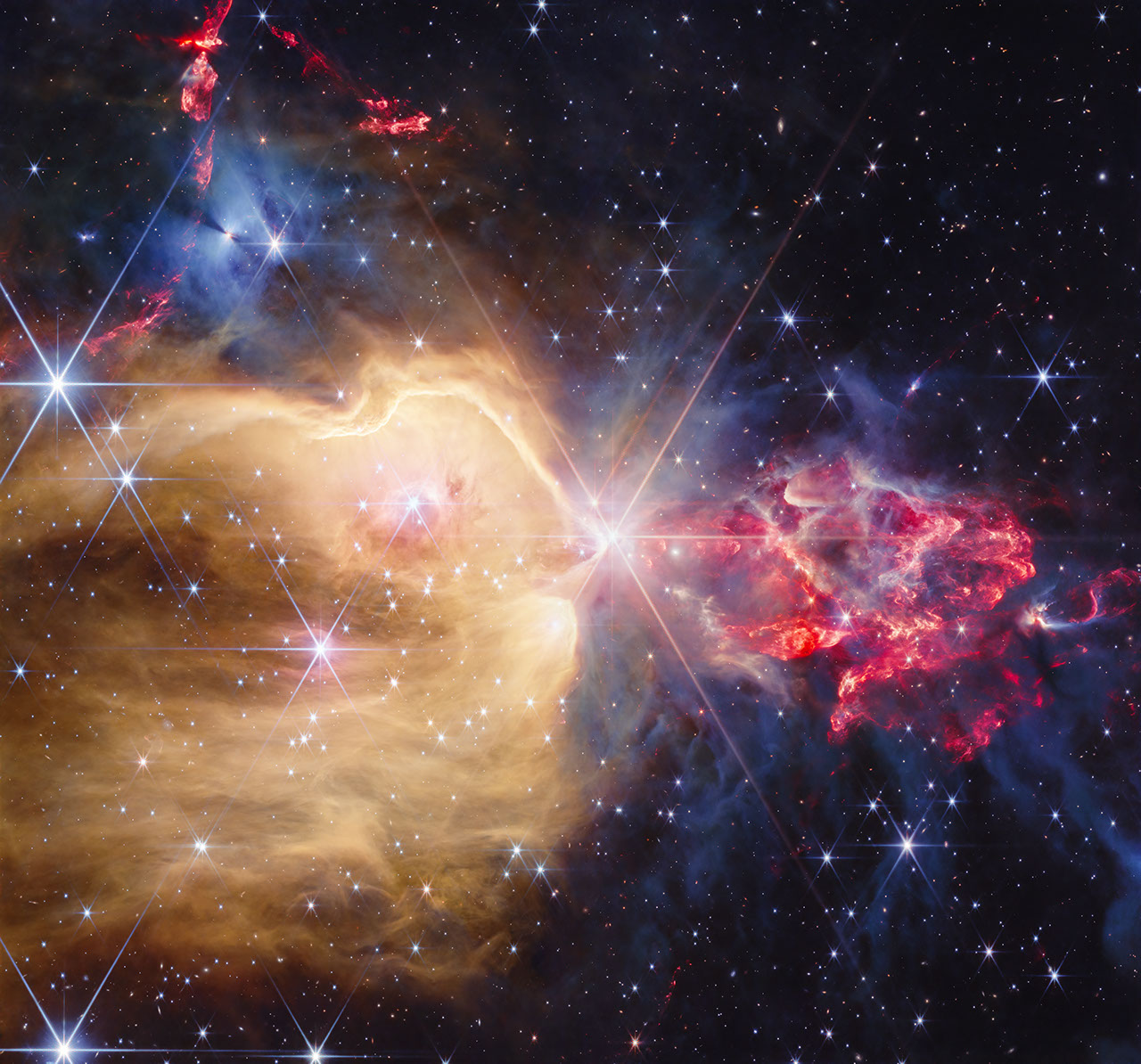
Quick Summary: NASA’s James Webb Space Telescope has imaged numerous young stars and their jets hidden behind dust clouds in NGC 7129, a nebula located about 3,300 light-years from Earth. This discovery offers a unique glimpse into the early stages of star formation.
Why Did Webb Image This Nebula?
Most of the stars we see in the night sky are mature stars that were born millions or even billions of years ago. However, in every corner of the universe, there are still stars in the throes of birth—stars that have not yet fully formed. These young stars are hidden within thick clouds of dust and gas, known as molecular clouds.
These nebulae are known as colossal “stellar nurseries” where stars are born. NGC 7129 is one such nursery. It lies about 3,300 light-years away in the direction of the constellation Cepheus. NASA’s James Webb Space Telescope (JWST) has imaged this region with its near-infrared camera (NIRCam), revealing unprecedented detail.
Webb’s greatest advantage here is its extraordinary sensitivity to infrared light. While ordinary telescopes cannot see through these dust clouds, Webb acts like an X-ray machine, penetrating the dust. This allows astronomers to study the very beginning of the stellar life cycle—the infancy of stars.

The Birth Pangs of Stars: Jets and Outflows
One of the most striking features in the image is the chaotic structure within the nebula. This chaos is caused by high-speed gas jets ejected by young stars. These jets are a natural part of the star formation process.
As a newborn star accretes matter from its surrounding disk, it also ejects material from its poles. These ejections create ionized gas streams that can reach speeds of hundreds of thousands of kilometers per hour. These jets collide with the surrounding gas and dust, sweeping them up and creating bright shock waves. In Webb’s image, these jets appear as brilliant red and orange streams within the nebula.
These jets are incredibly valuable to astronomers because they help us understand the dynamics of star formation. Additionally, the direction and speed of these jets provide information about the structure of the star’s surrounding disk and the star itself. We previously discussed similar processes in our article Traces of the Universe’s First Stars Unraveled with MEGATRON Simulation.
What You Need to Know About NGC 7129
NGC 7129 is classified as a reflection nebula, meaning its dust particles become visible by reflecting the light of nearby bright stars. However, Webb’s infrared image reveals that this nebula is actually much more complex and dynamic.
Here are some key characteristics of NGC 7129:
| Parameter | Value |
|---|---|
| Constellation | Cepheus |
| Distance | ~3,300 Light-years |
| Imaging Instrument | NIRCam (Near-Infrared Camera) |
| Observed Wavelength | Infrared (2.4 – 4.6 µm) |
| Object Type | Reflection Nebula and Star-Forming Region |
| Number of Young Stars | Hundreds (estimated) |
This table summarizes the key data from the article. But what’s truly exciting is that star formation is still ongoing within this nebula. Thanks to Webb, we can now observe this process with unprecedented clarity.
Why Is This Discovery So Important?
This image is not just a beautiful space photograph; it is also a critical data source for testing theories of star formation. Using this Webb image, astronomers can better understand the masses, ages, and interactions of young stars with their environments.
In particular, the shock waves created by the jets influence the distribution of gas and dust in star-forming regions. This can either trigger or inhibit the formation of new stars. In other words, these jets are shaping the future evolution of the nebula.
This observation by Webb, like Hubble’s observations while completing its 200,000th orbit, once again demonstrates how powerful space telescopes are. Each new image adds layers to our understanding of the universe.

Stellar Nurseries Through Webb’s Eyes
Webb has previously imaged many stellar nurseries. Iconic regions such as the Trifid Nebula and the “Pillars of Creation” in the Eagle Nebula have been reinterpreted through Webb’s infrared eyes. However, NGC 7129 holds a special place among such nebulae.
The reason is that NGC 7129 is relatively close and has intense star-forming activity. This gives astronomers the opportunity to study the star formation process in detail. Moreover, such regions, like planets reborn from the ashes of dead stars, hold important clues for understanding the formation of planetary systems.
This observation by Webb also sheds light on the history of our own solar system. Our Sun was born in such a nebula about 4.6 billion years ago. These images are, in fact, living witnesses to a process we ourselves were once part of.
How Were These Images Captured?
Webb is positioned at the L2 Lagrange point, about 1.5 million kilometers from Earth. This location shields the telescope from the light of both Earth and the Sun, providing an ideal environment for infrared observations.
NIRCam serves as Webb’s primary camera. It can observe in the near-infrared range of 0.6 to 5 micrometers. The NGC 7129 image was created by combining data from different NIRCam filters. Each filter tracks a different chemical element or dust feature.
The resulting image is both a scientific dataset and a visual feast. By analyzing these data, astronomers gain insights into the temperature, density, and chemical composition of the nebula. This helps refine models of star formation.

What Lies Ahead?
This image is just the beginning of research on NGC 7129. Astronomers plan to use Webb’s data to create a comprehensive catalog of young stars in the region. This catalog will help determine fundamental parameters such as star formation rates and the stellar mass function.
Additionally, observations with Webb’s spectroscopic instruments (NIRSpec and MIRI) could reveal which molecules are present in the disks around these stars. This could provide important clues about how the building blocks of life form in space.
In the coming years, we can expect Webb’s observations of such stellar nurseries to increase. Each new observation will open a new chapter in our understanding of star formation, one of the universe’s most fundamental processes.
Frequently Asked Questions
Where is NGC 7129 located?
NGC 7129 is a reflection nebula and star-forming region located in the direction of the constellation Cepheus, approximately 3,300 light-years from Earth.
What did the James Webb Space Telescope reveal in this image?
Webb imaged numerous young stars hidden behind dust clouds and the high-speed gas jets (stellar jets) they eject. These jets reveal the dynamics of the star formation process.
Why is Webb’s infrared vision so important?
Young stars are hidden in visible light due to the thick dust and gas in the molecular clouds where they are born. Webb’s infrared cameras can penetrate this dust, allowing us to see the stars and their surrounding structures clearly.
Editor’s Note: Webb’s image has once again left me in awe. Watching the birth pangs of stars in a cosmic nursery 3,300 light-years away is a testament to the impressive technological heights humanity has reached. Each of these jets is laying the foundation for future solar systems. Perhaps our own Sun was born from such chaos billions of years ago. It’s a thought that inspires both humility and excitement.
Bir Yorum Yazın