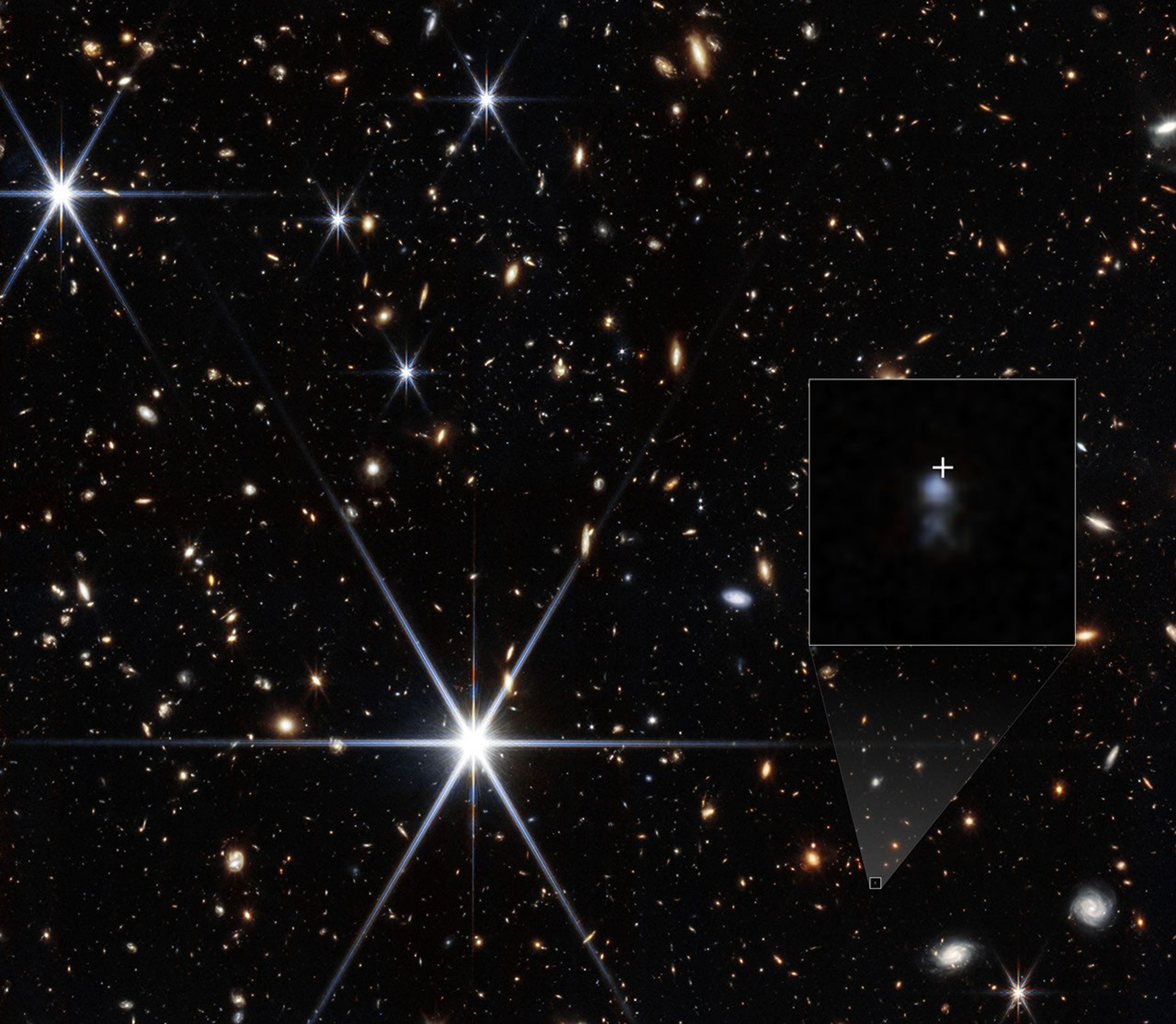
Quick Summary: The James Webb Space Telescope has found the source of the most distant fast radio burst ever detected (FRB 20240304B). The burst comes from a low-mass, actively star-forming dwarf galaxy that existed when the universe was only 3 billion years old. This discovery could change what we know about the origins of FRBs.
Where Is This Space Signal Coming From?
Astronomers have been studying fast radio bursts (FRBs), mysterious radio signals from space, for years. These signals can emit more energy in milliseconds than the Sun produces in a day. Yet their origins remain a major mystery.
Now, the James Webb Space Telescope (JWST) has shed light on this enigma by pinpointing the source of the most distant FRB ever discovered. Scientists have determined that this burst occurred when the universe was just 3 billion years old—an era known as “cosmic noon,” when star formation was at its peak.
FRB 20240304B: An Unexpected Host
This burst, named FRB 20240304B, was first detected by the MeerKAT telescope in South Africa. Later, the Webb telescope conducted a detailed study of the region from which the signal originated.
Webb’s NIRCam (Near-Infrared Camera) instrument identified a galaxy at the precise location. The NIRSpec (Near-Infrared Spectrograph) instrument then measured the galaxy’s redshift: 2.148. This value indicates that the burst occurred just 3 billion years after the Big Bang, when the universe was about a quarter of its current age.
But the real surprise was the nature of the burst’s source. The team, led by astronomer Daniele Michilli from Cardiff University, found that this galaxy was unlike any other FRB host.
Why Is This Discovery So Surprising?
Most previously detected FRBs originated from large, massive, star-forming galaxies. However, the host galaxy of FRB 20240304B is a dwarf galaxy with a mass about 1,000 times less than expected.
Lead author Michilli said, “We thought it would be a large, massive galaxy, but instead it was a small dwarf galaxy actively forming stars.” This finding calls for a reevaluation of our theories about the origins of FRBs.
“The host galaxy stands out from all the galaxy samples we have. It definitely wasn’t what we expected.” — Ben Stappers, University of Manchester
This dwarf galaxy existed during “cosmic noon,” an epoch when star formation across the universe was at its peak. The galaxy’s star formation rate suggests that most of its stars could have formed within just 30 million years, indicating a very young and dynamic structure.
Is Our Understanding of Fast Radio Bursts Changing?
This discovery challenges the previous notion that FRBs can only originate in massive galaxies. Such powerful bursts can also occur in dwarf galaxies.
So what causes these bursts? Scientists believe FRBs are produced by magnetars—neutron stars with extremely strong magnetic fields. However, this new discovery suggests the theory may be more complex.
The team estimates that in the future, the MeerKAT telescope could detect more than one distant FRB per year. As new radio telescopes come online, the number of such discoveries may increase. The Webb telescope will also play a critical role in characterizing these distant host galaxies.

How Does This Discovery Help Us Understand the Universe?
Because FRBs are signals from distant regions of the universe, they allow us to study the matter between them. These bursts can be used to map the distribution of ionized gas in the universe.
This new discovery reveals the diversity of FRB sources, providing insights into galaxy formation in the early universe. It also demonstrates once again Webb’s ability to trace such distant signals.
Previous discoveries, such as Webb’s imaging of stellar storms in the NGC 7129 Nebula, have showcased the telescope’s capability to study star-forming regions. Now, Webb can even resolve bursts from the farthest corners of the universe.
| Parameter | Value |
|---|---|
| FRB Name | FRB 20240304B |
| Redshift | 2.148 |
| Age of Universe (at Burst) | 3 Billion Years |
| Host Galaxy Mass | 1,000 Times Less Than Expected |
| Star Formation Period | 30 Million Years |
What Does the Future Hold?
This discovery could mark the beginning of a new era in FRB research. Telescopes like MeerKAT can detect more distant FRBs, and Webb can study their sources.
Scientists hope that such discoveries will help us understand galaxy formation in the early universe. We may also learn more about how magnetars, the sources of FRBs, form and evolve.
This discovery also contributes to our understanding of the universe’s most extreme conditions, much like the study of extraordinary stellar systems such as the Phoenix Planet. Perhaps one day we will fully unravel the mechanism behind these bursts.
From the Editor: This discovery shows that FRBs can originate not only in massive galaxies but also in small dwarf galaxies. It reminds us once again how diverse and unpredictable the universe is. Webb’s ability to resolve such a distant signal highlights how far technology has come. I eagerly await what else lies hidden in the depths of space.
Frequently Asked Questions
What is an FRB? Fast radio bursts (FRBs) are radio signals from distant corners of the universe that emit enormous energy in milliseconds.
Why is FRB 20240304B important? It is the most distant FRB ever detected, and its source is a dwarf galaxy much smaller than expected.
How did the Webb telescope make this discovery? Webb used its NIRCam and NIRSpec instruments to pinpoint the burst’s source and measure the galaxy’s redshift.
Bir Yorum Yazın