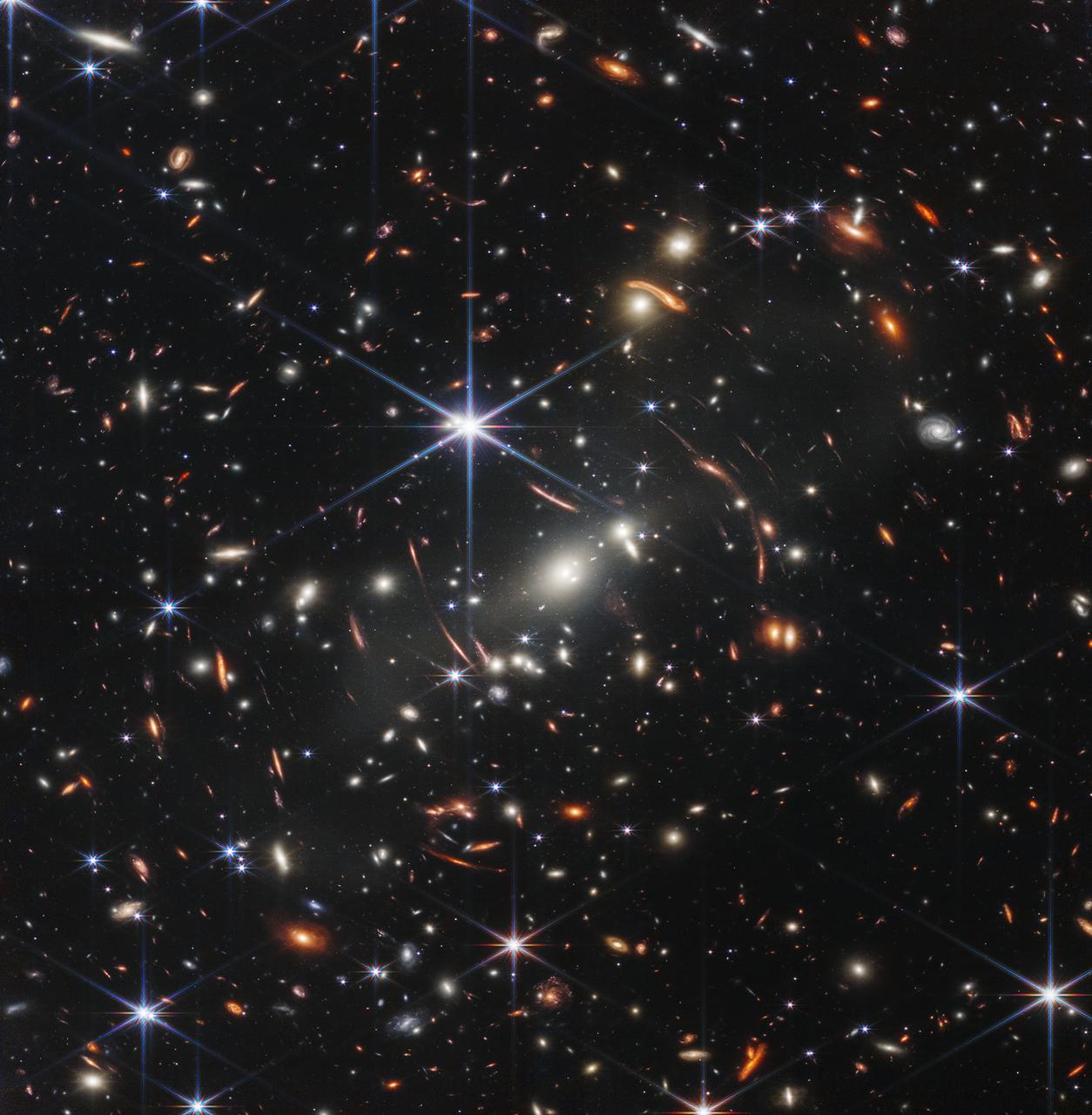
Quick Summary: Astronomers analyzing data from the James Webb Space Telescope (JWST) have identified a new gravitational lensing candidate behind the galaxy cluster MACS J0308.9+2645, dating back to when the universe was only 1 billion years old. This discovery helps us understand the mysterious galaxies of the early universe.
Webb’s Deep Gaze: Unlocking the Doors to the Early Universe
Since it began its observations, the James Webb Space Telescope has been showing us the farthest corners of the universe. Most recently, astronomers used Webb’s data to discover a new object from the early universe. This object is actually a galaxy candidate hidden behind a galaxy cluster and revealed through gravitational lensing. So why is this discovery so important?
The discovery focuses on a “gravitational arc” revealed by the lensing effect of the massive galaxy cluster MACS J0308.9+2645. This arc is actually a distorted and magnified image of a galaxy from when the universe was just 1 billion years old—about 13 billion years ago. Webb’s infrared observations offer a unique opportunity to study such distant and faint objects.

What Is Gravitational Lensing and Why Is It So Important?
Gravitational lensing is one of the most striking consequences of Einstein’s general theory of relativity. The gravity of a massive object, such as a galaxy cluster, bends the light behind it, acting as a giant natural telescope. This allows galaxies that are normally too faint and distant to be magnified and observed. Clusters like MACS J0308.9+2645 serve as our windows into the farthest reaches of the universe.
In this new study, astrophysicist Homer Dávila Gutierrez analyzed Webb’s data to identify a previously unnoticed gravitational arc candidate in this cluster. Gutierrez, founder and director of SKYCR.ORG, the first Costa Rican elected as a Fellow of the Royal Astronomical Society (FRAS), and a member of the European Astronomical Society (EAS), has once again highlighted the richness of data in Webb’s deep-space observations.
“Discoveries like this show just how revolutionary a tool Webb is. Each new dataset reveals details about the early universe that we’ve never seen before.”
What Do We Know About This New Galaxy Candidate?
According to preliminary analyses, this new candidate, designated A1, corresponds to about 9 billion years ago, with a redshift of z ≈ 1.4. This means the galaxy’s light has taken nearly half the age of the universe to reach us. However, what’s truly intriguing is that this galaxy lies behind the MACS J0308.9+2645 cluster, and its light has been bent and magnified by the cluster’s gravity.
According to Gutierrez’s study, galaxy A1 appears as a single lensed image—meaning it hasn’t been duplicated into multiple copies, but rather slightly stretched and magnified. This is consistent with the galaxy being located about 51 arcseconds from the cluster’s center, with tangential elongation. However, for definitive results, an updated lens model of the cluster is needed.
| Parameter | Value |
|---|---|
| Galaxy Candidate | A1 |
| Redshift (z) | ≈ 1.4 (approximately 9 billion years ago) |
| Galaxy Cluster | MACS J0308.9+2645 (z = 0.356) |
| Distance from Cluster Center | ≈ 51 arcseconds |
| Lensing Type | Single image, slightly magnified |
New Questions Raised by Webb’s Data
What does this discovery tell us about the early universe? First, it suggests that there may be many undiscovered galaxies behind clusters like MACS J0308.9+2645. Webb’s deep observations are peeling back the regions behind such clusters layer by layer, much like an archaeological dig. Each new layer refreshes our understanding of the universe’s earliest epochs.
As you may recall, we previously discussed in our article [Rogue Supermassive Black Hole Revealed by a Star’s Death](https://galaktikuzay.com/basibos-super-kutleli-kara-delik-bir-yildizin-olumuyle-ortaya-cikti) just how full of surprises Webb can be. Discoveries like this once again prove how dynamic and unexplored the depths of space are. Additionally, technological advances such as [Starship Flight 13: Unique Images from Starlink V3 Cameras](https://galaktikuzay.com/starship-13-ucusu-starlink-v3-kameralarindan-essiz-goruntuler) are paving the way for such scientific breakthroughs.
Is a New Era Beginning in Early Universe Studies?
Discoveries like these from JWST are shedding light on some of the biggest questions in cosmology: When did the first galaxies form? How did they evolve? And how did they give rise to the massive structures we see today? Each new discovery forms a piece of the puzzle in answering these questions.
Gutierrez’s work shows that Webb’s data has not yet been fully processed and still holds many surprises. In particular, new observations in the field of gravitational lensing could fundamentally change our understanding of the universe’s earliest epochs. Discoveries like this are even poised to overshadow the excitement of events like the [Total Solar Eclipse on August 12, 2026: The Mysterious Corona Seen for the First Time](https://galaktikuzay.com/12-agustos-2026-tam-gunes-tutulmasi-ilk-kez-gorulecek-gizemli-korona).

Next Steps: To Be Confirmed with an Updated Lens Model
For now, it’s too early to say exactly what galaxy A1 is. However, researchers plan to construct an updated lens model of the cluster based on Webb’s new data. This model will allow us to more accurately determine the galaxy’s true properties, such as its mass, size, and star formation rate.
Studies like this once again prove what a powerful observatory Webb is. Every journey into the depths of space is also a journey into our own history. Because when we look at these galaxies, we are looking back at the past of the universe—and therefore, of ourselves. Combined with technological advances like [Starship Flight 13 in Space: A New Threshold for SpaceX](https://galaktikuzay.com/starship-ucus-13-uzayda-spacex-icin-yeni-esik), this discovery is a testament to how exciting the coming years of space exploration will be.

Editor’s Note: Every new piece of data from Webb reminds us just how small we are and what a vast mystery the universe remains. Discoveries like this should excite not only scientists but all of us. Because each new galaxy prompts us to question what we know about how the universe formed. As humanity continues to seek answers to these questions, we’ll all see together what else awaits us in the depths of space.
Curious Minds: Frequently Asked Questions
How does the Webb telescope detect objects from the early universe?
Webb observes in infrared wavelengths, allowing it to detect the most distant and faintest objects in the universe. Natural phenomena like gravitational lensing also magnify these distant objects, enabling more detailed study.
Why is the MACS J0308.9+2645 galaxy cluster so special?
This cluster is one of the largest known galaxy clusters, and it lenses distant galaxies behind it, making them observable. This allows us to gain insights into the early universe.
Does this discovery change our knowledge about the age of the universe?
No, the discovery does not change the age of the universe. However, it helps refine our models of how galaxies formed and evolved in the early universe.
Bir Yorum Yazın