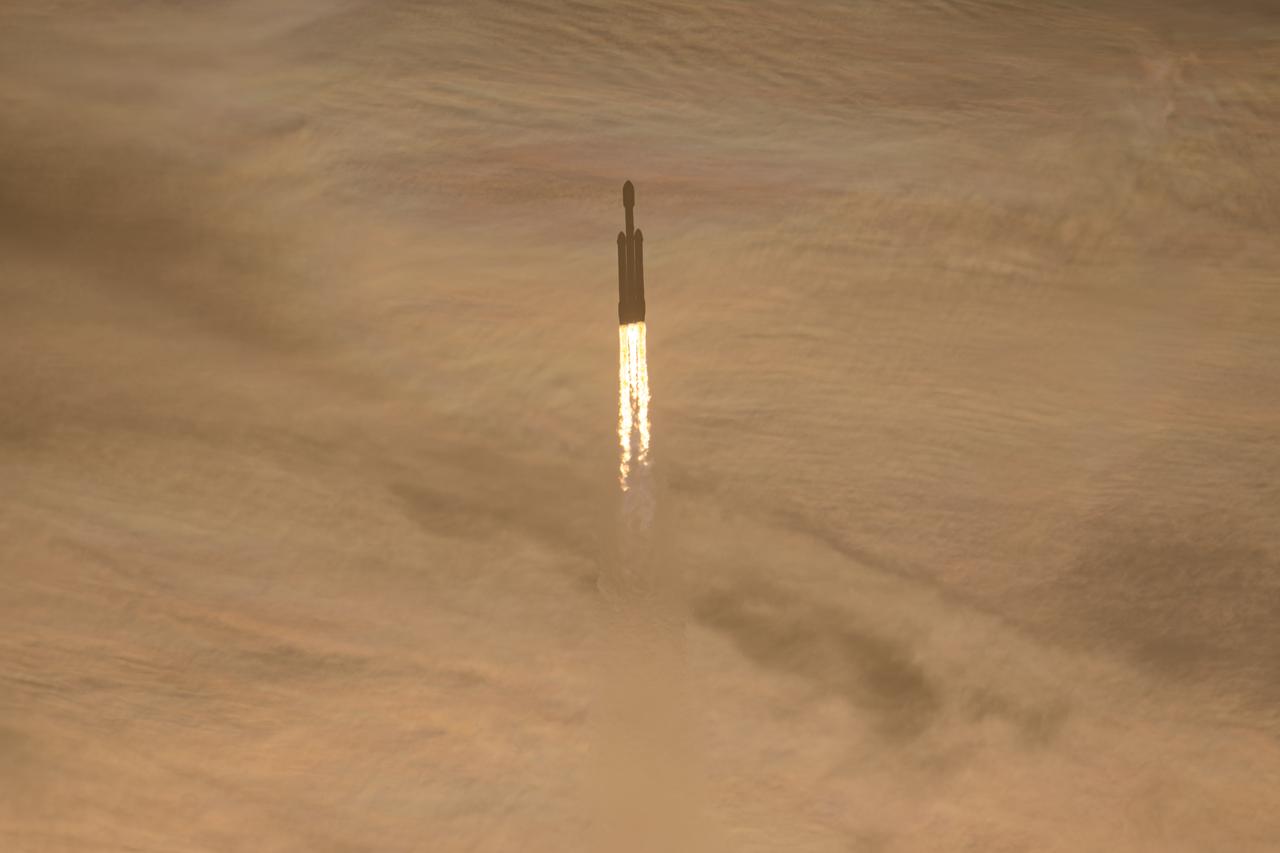
Snelle samenvatting: NASA’s Nancy Grace Roman Space Telescope successfully launched on August 30, 2026, aboard a SpaceX Falcon Heavy rocket. After a three-month journey, the telescope will settle into its orbit a million miles away, aiming to unravel the universe’s greatest mysteries by studying dark matter, dark energy, and exoplanets.
Why is the Roman Telescope So Important?
A new era in space exploration is beginning. One of NASA’s flagship missions, the Nancy Grace Roman Space Telescope, lifted off from Kennedy Space Center in Florida at 07:26 local time on the morning of August 30, 2026. SpaceX’s powerful Falcon Heavy rocket was the vehicle that carried this giant observatory into space.
Roman is named after Nancy Grace Roman, NASA’s first chief astronomer, who played a key role in building the Hubble Space Telescope. Thanks to her vision, we can look into the depths of space today, and now the telescope bearing her name will look even further.
This telescope is no ordinary observatory. With its wide field of view and sharp infrared vision, it will scan vast regions of the sky and delve deep into cosmic history. So, how do these features set it apart from other telescopes?

What Are the Secrets of the Dark Universe?
About 95% of our universe is made up of dark matter and dark energy. However, we still know very little about these two mysterious components. Dark matter acts like an invisible scaffolding that holds galaxies together; dark energy is the mysterious force accelerating the universe’s expansion.
The Roman Telescope was specifically designed to investigate these two dark concepts. With its wide field of view, it will scan never-before-seen regions of the sky and observe billions of galaxies. These observations will help us understand how dark matter influences galaxies and how dark energy accelerates the universe’s expansion.
Nicky Fox, Director of NASA’s Science Mission Directorate, said in a statement after the launch:
Roman will be a discovery machine that will bring us closer than ever to humanity’s deepest questions about our cosmic history. With its wide field of view and rapid scanning speed, it will usher us into a new era of discovery and make the invisible visible. This will lay the foundation for the search for life beyond our solar system.
When Will the Roman Telescope Begin Doing Science?
Although the launch was successful, the real excitement is just beginning. Roman is now on a three-month journey, heading toward its destination a million miles (about 1.5 million kilometers) away. This point is a special location known as the Lagrange 2 point, between Earth and the Sun.
This orbit allows the telescope to remain in Earth’s shadow and use its cooling systems more efficiently. It also enables uninterrupted views deep into the universe, away from Earth’s heat and light pollution.
After reaching its destination, Roman will spend several months testing and calibrating its instruments. The first scientific images are expected to arrive in the early months of 2027. Like the first images from the James Webb Space Telescope, these images will excite both the scientific community and space enthusiasts.
How Will Roman’s Exoplanet Hunt Work?
Another key mission for Roman is to investigate planets outside our solar system, known as exoplanets. Using the microlensing technique, the telescope will be able to detect planets even millions of light-years away from Earth.
This technique is based on the principle that the light of a distant star is bent by the gravity of another star passing in front of it. If the foreground star has a planet, this bending causes a brief brightening. By detecting these brightenings, Roman could discover thousands of new exoplanets.
These discoveries will help us understand the number of rocky planets in habitable zones. They will also provide important clues about how planetary systems form and evolve.

What Are Roman’s Other Missions?
Although Roman’s primary goals are the dark universe and exoplanets, this telescope will serve a much broader range of science. Because it will scan large areas of the sky, it will also gather data on galaxy evolution, star-forming regions, supernova explosions, and even objects in our own solar system.
NASA will make Roman’s data openly available to scientists worldwide. This means that, just like with Hubble and Webb, anyone can use this data to make new discoveries. Roman’s wide-area surveys will also create target lists for future observatories.
In particular, joint observations with the James Webb Space Telescope could shed light on the universe’s deepest secrets. While Roman scans wide areas and identifies interesting targets, Webb can study these targets in more detail. This collaboration could open a new chapter in the history of astronomy.
| Parameter | Value |
|---|---|
| Launch Date | August 30, 2026 |
| Launch Vehicle | SpaceX Falcon Heavy |
| Target Orbit | Lagrange Point 2 (L2) |
| Orbital Distance | 1.5 Million Kilometers |
| Travel Duration | 3 Months |
| Field of View | 100 Times Larger than Hubble |
| Primary Mirror Diameter | 2.4 Meters |
| Wavelength Range | Infrared |
| Science Start | First Quarter of 2027 |
What Does the Roman Telescope Mean for Humanity?
The launch of Roman marks a significant milestone in humanity’s journey to understand its place in the universe. Understanding the dark universe is not just a scientific curiosity; it means grasping the forces that determine the fate of the universe.
Learning what dark energy is could help us understand whether the universe will continue to expand or will one day collapse. Unraveling the nature of dark matter could explain how galaxies form and evolve.
Furthermore, Roman’s exoplanet discoveries will open new horizons in our quest to answer the question of whether we are alone. Perhaps, thanks to this telescope, we will discover the first truly Earth-like planet that could harbor life.

This mission, as we noted in our [report on the launch of the dark universe hunter Roman Telescope](https://galaktikuzay.com/nasanin-karanlik-evren-avcisi-roman-teleskobu-firlatildi), opens the door to a new era in space exploration. As we emphasized in our [analysis ahead of the Roman Telescope’s launch](https://galaktikuzay.com/nasanin-roman-teleskobu-firlatiliyor-karanlik-evrenin-sirlari-pesinde), this telescope will lead to the [discovery of thousands of alien worlds](https://galaktikuzay.com/nasanin-roman-teleskobu-firlatiliyor-binlerce-uzayli-dunyanin-pesinde-2).
What Will Roman’s Legacy Be?
Nancy Grace Roman was known for her vision in building Hubble and was nicknamed the “Mother of Hubble.” Now, the telescope bearing her name will carry her legacy even further. The data Roman collects will be used by scientists for decades and may inspire future explorers.
The telescope’s wide-area surveys will produce the most comprehensive maps of the universe ever made. These maps will fundamentally change how astronomers understand the sky. Additionally, the targets Roman discovers will become focal points for future space missions and ground-based telescopes.
In conclusion, the launch of the Roman Telescope opens a new chapter in humanity’s cosmic journey. As we await the telescope’s first images in the coming months, we will witness the dark secrets of the universe coming to light. In this exciting era, being part of this journey into the depths of space is truly fascinating.
Frequently Asked Questions about the Roman Telescope
When was the Roman Telescope launched?
The Roman Telescope was successfully launched on August 30, 2026, at 07:26 EDT aboard a SpaceX Falcon Heavy rocket from Kennedy Space Center in Florida.
Where is the Roman Telescope going?
Roman is heading to the Lagrange 2 (L2) point, approximately 1.5 million kilometers from Earth. This journey will take about three months.
What scientific questions will the Roman Telescope seek to answer?
Roman will investigate the nature of dark matter and dark energy, discover exoplanets, and study the evolution of galaxies. It will also provide important data on the expansion rate and structure of the universe.
From the Editor’s Perspective: Watching Roman’s launch, I felt an indescribable excitement. This telescope is a continuation of the story Hubble began, and perhaps it will solve the universe’s greatest mysteries. Although concepts like dark matter and dark energy sound like science fiction, thanks to Roman, we will truly begin to understand these mysterious forces. Thinking about the role this telescope will play in humanity’s journey to question its place in the universe fills me with hope for the future.
Bir Yorum Yazın